· physics · 6 min read
The Cosmological Constant Problem: The 120-Order-of-Magnitude Catastrophe in Theoretical Physics
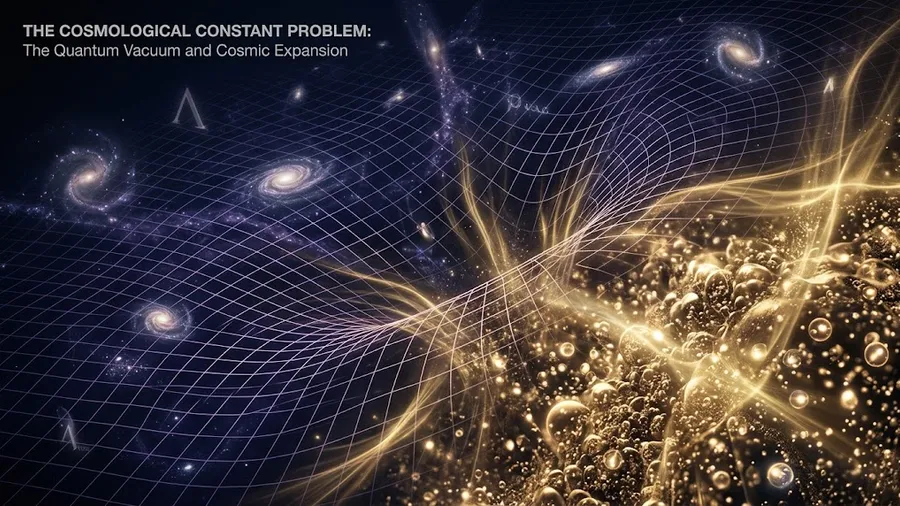
When quantum field theory calculates the energy density of empty space, its prediction exceeds astronomical observations by a factor of 10¹²⁰—the most disastrous theoretical discrepancy in the history of science.
In theoretical physics, discrepancies between calculation and experimental observation are the primary engine of progress. When Newtonian gravity failed to predict the perihelion precession of Mercury by just 43 arcseconds per century, it paved the way for Albert Einstein’s General Relativity. When classical thermodynamics predicted that an ideal black body would radiate infinite energy at ultraviolet wavelengths, Max Planck was forced to invent quantum hypothesis.
Usually, these discrepancies are subtle—fractions of a percent that hint at deeper, hidden mechanics.
Except in one terrifying case.
When theoretical physicists use the formidable mathematical framework of Quantum Field Theory (QFT) to compute the baseline energy density contained within empty space, and compare it to the cosmological expansion rate governed by General Relativity, the two theories do not diverge by a few percent. They diverge by 120 orders of magnitude ($10^{120}$).
Physicist Frank Wilczek described it as “the ultimate embarrassment of theoretical physics.” It is known formally as the Vacuum Catastrophe or the Cosmological Constant Problem.
What Weighs the Void?
To understand where physics broke down, one must look at how modern science defines empty space. In classical physics, a vacuum is simply nothingness: take away all matter, atoms, and radiation, and the energy remaining in that region is precisely zero.
Quantum mechanics fundamentally abolished this idea through the Heisenberg Uncertainty Principle:
$$\Delta E \cdot \Delta t \ge \frac{\hbar}{2}$$
At subatomic scales, the energy of a physical system cannot remain fixed at absolute zero for any measurable duration. In Quantum Field Theory, every fundamental particle—whether an electron, quark, or photon—is an excitation of a pervasive underlying quantum field.
Even in a perfect vacuum stripped of all physical particles, these fields cannot sit completely motionless. They continually fluctuate around a ground state known as the zero-point energy.
Every quantum oscillator retains an inescapable ground-state energy equal to:
$$E_0 = \frac{1}{2}\hbar\omega$$
Because a field can theoretically oscillate at an infinite spectrum of frequencies, summing the zero-point energies of every permissible quantum field mode across three-dimensional space yields an energetic baseline. If the vacuum contains energy, that energy must have physical consequences.
Under Einstein’s famous equivalence ($E = mc^2$), all energy exerts a gravitational pull.
Einstein’s Cosmological Constant ($\Lambda$)
Meanwhile, across the intellectual divide, Einstein’s field equations describe how energy and mass dictate the curvature of spacetime:
$$G_{\mu\nu} + \Lambda g_{\mu\nu} = \frac{8\pi G}{c^4} T_{\mu\nu}$$
Here, $\Lambda$ represents the Cosmological Constant—an intrinsic property of space itself that acts as an energetic pressure pushing outward uniformly across cosmic geometry.
In 1998, two independent teams of astronomers measuring distant Type Ia supernovae discovered that the cosmic expansion of our universe is not decelerating under gravitational attraction; it is accelerating. Empty space contains a persistent, repulsive dark energy density that drives galaxies apart.
When cosmologists converted this observed cosmic acceleration into the observed vacuum energy density ($\rho_{\text{obs}}$), the result was extraordinarily minuscule yet positive:
$$\rho_{\text{obs}} \approx 10^{-29}\text{ g/cm}^3 \quad (\approx 10^{-47}\text{ GeV}^4)$$
It is a whisper of energy—just enough to push galaxies apart over billions of light-years without disrupting the delicate gravitational cohesion of solar systems or atomic nuclei.
The Calculation of Catastrophe
The crisis emerges when particle physicists attempt to calculate what that vacuum energy density should be from first principles.
To calculate the vacuum energy density ($\rho_{\text{vac}}$) in Quantum Field Theory, theorists integrate the zero-point energies of all known particle fields up to a natural physical cutoff scale where smooth spacetime is expected to break down—the Planck energy scale ($M_{\text{Planck}} \approx 10^{19}\text{ GeV}$):
$$\rho_{\text{vac}} \approx \int_{0}^{M_{\text{Planck}}} \frac{k^2 dk}{2\pi^2} \left(\frac{1}{2}\sqrt{k^2 + m^2}\right) \propto M_{\text{Planck}}^4$$
When you insert the Planck scale into this integral, the theoretical expectation value for the energy density of empty space yields:
$$\rho_{\text{theoretical}} \approx 10^{74}\text{ GeV}^4$$
Comparing the theoretical expectation to what astronomers actually measure in the night sky reveals the staggering ratio:
$$\frac{\rho_{\text{theoretical}}}{\rho_{\text{obs}}} \approx 10^{120}$$
To write this discrepancy out in standard decimal notation, you would write a 1 followed by one hundred and twenty zeroes. If the quantum vacuum truly weighed what standard quantum field theory predicts, the outward repulsive pressure would have blown every atom, star, and galaxy apart within $10^{-43}$ seconds following the Big Bang. Spacetime would be curved so violently into an unrecognizable microscopic knot that no macroscopic universe could ever form.
The Fine-Tuning Nightmare
Faced with this gargantuan number, physicists proposed that Einstein’s bare geometrical cosmological constant ($\Lambda_{\text{bare}}$) might act as a natural counterweight to the quantum vacuum energy ($\rho_{\text{quantum}}$):
$$\rho_{\text{observed}} = \Lambda_{\text{bare}} + \rho_{\text{quantum}}$$
For this equation to hold true and match astronomical observations, the bare cosmological constant must cancel out the quantum vacuum fluctuations to 120 decimal places of precision:
$$\rho_{\text{observed}} = 1.00000000000000000000… (120 \text{ digits}) … - 0.99999999999999999999…$$
There is no known symmetry, mathematical conservation law, or physical mechanism in the Standard Model of particle physics that explains why two entirely unrelated constants—one from cosmic geometry, the other from subatomic quantum fluctuations—would conspire to cancel each other out to 120 decimal places, leaving behind a tiny, non-zero positive residue.
In theoretical physics, requiring this level of unnatural coincidence is considered an insurmountable conceptual defect.
The Competing Hypotheses
How do modern physicists attempt to resolve the vacuum catastrophe? Several leading avenues are currently debated:
- Supersymmetry (SUSY): In supersymmetric models, every standard particle (boson) has a partner particle (fermion). Because bosons and fermions contribute to vacuum zero-point energy with opposite mathematical signs, they theoretically cancel each other out to zero. However, because experiments at the Large Hadron Collider have found no supersymmetric particles at low energy scales, supersymmetry must be broken, leaving the discrepancy still dangerously wide (around 60 orders of magnitude).
- The Multiverse and Anthropic Selection: Proposed by Steven Weinberg in 1987, this framework posits that our universe is one pocket among an immense cosmic multiverse where the cosmological constant varies randomly across regions. If $\Lambda$ were even slightly larger than observed, galaxies could never condense, stars could never ignite, and no biological observers could evolve to measure it. We measure an absurdly fine-tuned value simply because it is the only value compatible with the existence of matter and life.
- Unimodular Gravity and Emergence: Other theorists argue that General Relativity must be reformed into frameworks like unimodular gravity, where the cosmological constant is not a dynamical energy source that couples to gravity, but an arbitrary integration constant decoupled from vacuum zero-point energy.
The Ultimate Crossroads of Physics
The Cosmological Constant Problem is not merely an isolated accounting error in astrophysical tables. It is the clearest signal we possess that our two crowning intellectual achievements—General Relativity and Quantum Field Theory—are fundamentally incomplete.
General Relativity insists that all energy has gravitational consequences and curves spacetime. Quantum Field Theory insists that empty space is fundamentally packed with zero-point energy. Both theories have passed every experimental test devised by human ingenuity with breathtaking accuracy, yet when forced to speak to each other about the weight of nothingness, their dialogue collapses into mathematical nonsense.
Resolving the 120-order-of-magnitude catastrophe will likely require more than tweaking a parameter. It demands a complete theory of Quantum Gravity—a paradigm shift where space, time, and the quantum vacuum are rewritten from the ground up.