· physics · 5 min read
The Holographic Principle: Why Our 3D Universe May Be Stored on a 2D Boundary
If entropy scales with surface area rather than volume, the three-dimensional fabric of space and time could be nothing more than an optical projection encoded on a distant two-dimensional cosmic boundary.
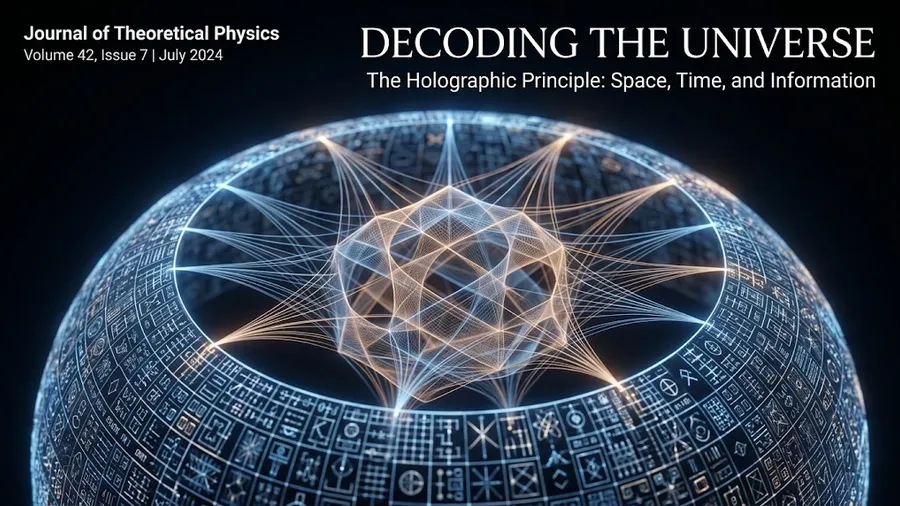
In everyday human intuition, information behaves according to three-dimensional volume. If you double the dimensions of a room, you gain eight times the space to store books, hard drives, or atomic particles. For centuries, classical physics operated under the universal assumption that the maximum data a region of space can hold is fundamentally bounded by its volume.
Yet, when theoretical physicists pushed quantum mechanics and Einsteinian general relativity to their extreme intersections, that foundational assumption collapsed entirely. The maximum amount of information that can ever fit inside a physical region does not scale with its volume at all. Instead, it is strictly governed by the surface area of its two-dimensional boundary.
This counterintuitive realization—formalized as the Holographic Principle—suggests one of the most radical hypotheses in modern science: the three-dimensional reality we observe, touch, and measure may be an emergent physical projection generated from quantum bits encoded on a distant two-dimensional horizon.
The Black Hole Horizon: Area Over Volume
The origin of this concept stems from a thermodynamic crisis in the early 1970s. When matter falls past the event horizon of a black hole, does its physical information and thermodynamic entropy disappear from the universe forever? If so, the sacred Second Law of Thermodynamics would be fatally broken.
Physicist Jacob Bekenstein proposed a bold counter-argument: a black hole does not erase entropy; it possesses entropy proportional to the surface area of its event horizon. Stephen Hawking subsequently verified this mathematically through quantum field theory in curved spacetime, establishing the Bekenstein-Hawking formula:
The maximum entropy of a black hole is equal to one-quarter of the area of its event horizon divided by the fundamental Planck area ($l_{\text{P}}^2 \approx 10^{-70}\text{ m}^2$).
This mathematical result carries an extraordinary implication. A black hole represents the absolute maximum packing density of information physically possible in any given volume. If you attempt to squeeze more information into that same space, the boundary simply grows outward. Because entropy scales with area rather than volume, every fundamental bit of information requires exactly four Planck areas on the boundary surface—no more, no less.
Dimensional Reduction: From Bulk to Horizon
In 1993, Nobel laureate Gerard ‘t Hooft analyzed the universality of Bekenstein’s bound and identified an unavoidable conclusion: if all the physical processes occurring inside a three-dimensional sphere can be fully mapped onto its two-dimensional boundary without losing a single bit of information, then the interior three dimensions cannot be truly fundamental.
Leonard Susskind quickly championed and refined this idea within string theory, naming it the Holographic Principle.
The principle functions like an optical hologram: a flat, two-dimensional sheet of photographic film captures microscopic interference patterns of light. When illuminated from the correct angle, those two-dimensional patterns produce an image with depth, perspective, and genuine three-dimensional parallax.
In identical fashion, the “bulk” of our universe—the three spatial dimensions where planets orbit, light travels, and humans exist—could be a macroscopic holographic projection generated from quantum field dynamics residing exclusively on the cosmic perimeter.
Maldacena’s Proof: The AdS/CFT Duality
For several years, holography was viewed by many physicists as an intriguing philosophical metaphor rather than a rigorous physical theory. That perception shifted dramatically in 1997 when physicist Juan Maldacena published what would become the most cited paper in the history of high-energy theoretical physics: the AdS/CFT correspondence.
Maldacena proved an exact mathematical equivalence between two seemingly completely incompatible physical realities:
- The 5-Dimensional Bulk: An Anti-de Sitter (AdS) spacetime governed by Einstein’s general relativity, gravitational curvature, and quantum strings.
- The 4-Dimensional Boundary: A Conformal Field Theory (CFT) living on the flat boundary of that spacetime, governed solely by quantum particle interactions with zero gravity.
Every complex gravitational interaction in the interior spacetime corresponds exactly to an ordinary non-gravitational particle interaction on the boundary. Calculations involving chaotic black hole singularities that are mathematically impossible to solve in the gravitational bulk transform into solvable algebraic problems when translated into the language of the flat boundary.
The two descriptions are mathematically identical—two distinct languages translating the exact same physical reality.
Spacetime Emergence from Quantum Entanglement
Recent advances in theoretical physics have taken the holographic principle one step further. Spacetime itself may not be a primordial continuous fabric, but an emergent property born out of quantum entanglement.
Through the “ER = EPR” conjecture formulated by Juan Maldacena and Leonard Susskind, geometric wormholes linking points in spacetime (Einstein-Rosen bridges) are physically equivalent to quantum entanglement links (Einstein-Podolsky-Rosen pairs) on the boundary.
- When quantum states on the boundary are strongly entangled, smooth spacetime and gravitational attraction emerge between them in the bulk.
- If you mathematically dissolve the entanglement between boundary particles, the continuous spatial geometry separating them tears apart and ceases to exist.
Space, distance, and gravity are not fundamental building blocks. They are the macroscopic, visual manifestation of microscopic quantum correlation networks.
The Frontier: The Shape of Our Reality
While the AdS/CFT correspondence operates in spacetimes with negative cosmological curvature (Anti-de Sitter space), our actual observable universe possesses a tiny positive cosmological constant (De Sitter space). Translating the holographic proof into our expanding cosmic horizon remains one of the most active frontiers of modern string theory and loop quantum gravity.
Regardless of which quantum gravity framework ultimately triumphs, the core lesson of the Holographic Principle remains unchallenged: reality is not built like a box packed with three-dimensional items. Instead, the universe appears to be an intricate projection—a cosmic display where every celestial movement and quantum leap is written in microscopic code along the distant horizons of spacetime.