· physics · 6 min read
The Poincaré Recurrence and Boltzmann Brains: Why an Eternal Universe Threatens Reality
If the cosmos endures forever and obeys statistical mechanics, every physical configuration must repeat infinitely—giving rise to the disturbing paradox of conscious minds fluctuating spontaneously out of thermal chaos.
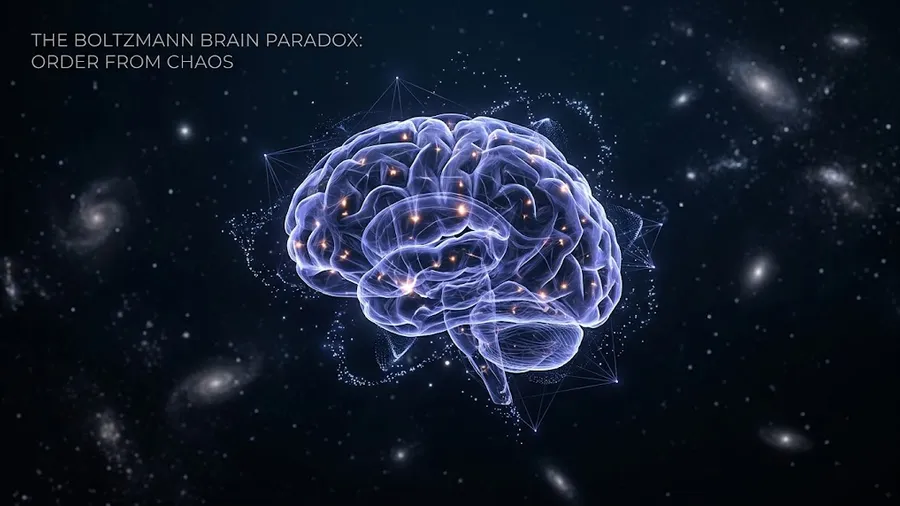
The Second Law of Thermodynamics is regarded as one of the most inviolable principles in the physical sciences. Heat flows spontaneously from hot to cold, gas disperses to fill an open room, and isolated systems evolve inexorably from order to disorder. Across cosmic scales, this universal tendency toward disorder—measured as entropy—points toward a grim ultimate destination: the “Heat Death” of the universe, where all stars have burned out, all black holes have evaporated, and the cosmos cools into an inert, uniform thermal bath.
Yet, when theoretical physicists apply the rigorous mathematics of statistical mechanics to an eternal universe, a profound conceptual crisis emerges.
Under the laws of classical and quantum statistical mechanics, maximum entropy is not a permanent, unyielding freeze. Given infinite time, even the most improbable arrangements of matter and energy must eventually reconstitute themselves through sheer random thermal fluctuations.
This mathematical certainty, first derived by mathematician Henri Poincaré, leads directly to one of the most troubling thought experiments in modern cosmology: the Boltzmann Brain Paradox.
Boltzmann and the Statistical Nature of Entropy
In the late 19th century, Austrian physicist Ludwig Boltzmann revolutionized thermodynamics by redefining entropy. Rather than treating entropy as an abstract fluid, Boltzmann proved that entropy is a direct measure of microscopic probability:
$$S = k_{\text{B}} \ln W$$
Here, $W$ represents the number of microscopic arrangements (microstates) that correspond to the same macroscopic appearance (macrostate).
A shattered teacup has high entropy because there are quadrillions of ways for the ceramic shards to lie scattered on the floor. An intact teacup has low entropy because only an extraordinarily specific configuration of atoms forms the functional cup.
Crucially, Boltzmann showed that the Second Law of Thermodynamics is not an absolute dynamical law, but a statistical probability. It is not physically impossible for the thermal vibrations of the floorboards to spontaneously align and reassemble the broken teacup; it is merely so astronomically unlikely that you would never witness it across the current age of the universe.
However, “astronomically unlikely” is not zero. If you wait long enough, unlikely events become inevitable.
The Poincaré Recurrence Theorem
In 1890, French polymath Henri Poincaré formalized this insight mathematically. The Poincaré Recurrence Theorem proves that any isolated, deterministic physical system possessing finite volume and conserving energy will, after a sufficiently long but finite time, return to a state arbitrarily close to its initial configuration.
Consider a sealed box containing a cloud of gas molecules gathered in the left corner. If you remove the partition:
- The gas rapidly expands to fill the entire volume (entropy increases).
- The molecules collide continuously in chaotic, pseudorandom trajectories.
- Because the total energy and volume are bounded, the system traces a trajectory through an abstract mathematical space of all possible configurations, known as phase space.
Eventually, the trajectory in phase space must pass back near where it started. Given enough time—often exceeding $10^{10^{26}}$ years—all the gas molecules will, purely by accident, find themselves huddled back together in the left corner of the box.
When cosmologists apply this principle to a closed universe or an accelerating cosmic horizon governed by a cosmological constant, the entire cosmos becomes a grand Poincaré system. Every past event, every solar system, and every historical moment must recur over infinite time.
The Genesis of the Boltzmann Brain
To explain why our current universe exhibits such remarkably low entropy—allowing stars, planets, and human life to exist—Boltzmann proposed a radical hypothesis: perhaps the universe is already in an eternal, high-entropy thermal equilibrium.
What we call the “Big Bang” might simply be an ultra-rare, colossal statistical fluctuation—a cosmic-scale accident where entropy dropped dramatically in our local sector of space, giving rise to our observable universe.
While this idea temporarily saved thermodynamics, British astrophysicist Sir Arthur Eddington and modern cosmologists quickly identified a fatal flaw.
In statistical mechanics, smaller fluctuations are exponentially more probable than larger fluctuations:
- The probability of gas molecules accidentally forming an entire galaxy is unimaginably small.
- The probability of gas molecules accidentally forming a single solar system is vastly higher.
- The probability of a minimal fluctuation producing just a single, isolated conscious observer—a functioning brain floating in the void, complete with simulated memories of having lived an entire life—is exponentially higher than fluctuating an entire universe of 100 billion galaxies.
This hypothetical entity is known as a Boltzmann Brain.
The Cosmological Reductio Ad Absurdum
The paradox becomes acute when you compare ordinary biological observers to spontaneous Boltzmann fluctuations:
- Ordinary Observers: Humans evolved on Earth as the result of a low-entropy Big Bang that produced trillions of cubic light-years of real matter, stars, and biological evolution spanning billions of years. This requires an immense, highly improbable initial low-entropy state across the entire observable cosmos.
- Boltzmann Observers: A Boltzmann Brain requires only a localized, microscopic thermal fluctuation sufficient to assemble a cognitive structure for a fraction of a second before suffocating in the void.
If our universe lasts forever in an eternal de Sitter vacuum, the number of spontaneous fluctuations over infinite time will outnumber biological observers by an infinite margin.
Statistically, in such a model, virtually all conscious observers in the cosmos are isolated Boltzmann Brains floating in empty space, whose memories, sensory inputs, and perceptions of an external reality are completely illusory.
Why the Paradox Must Be Solved: Cognitive Instability
Theoretical physicists do not believe that we are actually Boltzmann Brains. Instead, the concept serves as a reductio ad absurdum—a diagnostic test to determine whether a cosmological model is fundamentally flawed.
If a proposed cosmological theory predicts that Boltzmann Brains vastly outnumber normal observers, that theory suffers from cognitive instability:
- Science relies on empirical observations and memories of past experiments to validate theories.
- If you are overwhelmingly likely to be a Boltzmann Brain, your memories of laboratory measurements, telescopes, and physical laws are merely random neurological misfires.
- Therefore, the theory undermines the very empirical foundation used to formulate it in the first place.
Any cosmological model that produces a Boltzmann Brain problem must be rejected as physically unviable.
How Modern Cosmology Evades the Nightmare
How do contemporary theoretical physicists prevent the universe from drowning in spontaneous minds?
- Cosmic Vacuum Decay: As explored in false vacuum physics, our universe’s vacuum state may not be eternal. If the Higgs field or dark energy undergoes vacuum decay within $10^{100}$ years, the universe will terminate long before the first Poincaré recurrence timescales are reached.
- Eternal Cosmic Inflation: In multiverse models based on chaotic inflation, new “pocket universes” expand exponentially faster than old, dying vacua can generate Boltzmann Brains. If the production of new low-entropy, star-forming regions outpaces thermal fluctuations, ordinary biological observers will always remain the dominant majority.
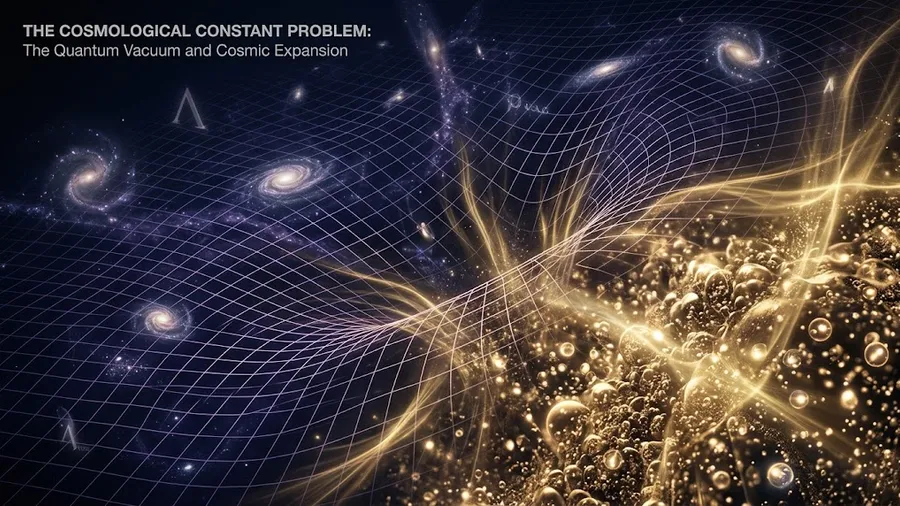
- The Decay of Dark Energy: If dark energy is not an immutable cosmological constant ($\Lambda$), but a dynamical field (quintessence) that decays to zero over deep time, cosmic space will expand indefinitely without trapping heat inside a closed horizon, effectively preventing recurring thermal fluctuations.
The Frontier of Cosmic Meaning
The Boltzmann Brain paradox demonstrates the delicate balance between infinity, time, and physical law. It reminds us that our ability to trust our own thoughts, memories, and sensory experiences depends directly on the global architecture of cosmic history.
We can only make sense of our existence because our cosmos began in an extraordinarily pristine, low-entropy state—and because the universe may carry the mercy of a finite lifespan, ensuring that conscious thought remains an earned product of stellar evolution rather than a transient hallucination drifting across an eternal void.