· physics · 6 min read
The AMPS Firewall Paradox: Why Quantum Mechanics and General Relativity Collide at the Event Horizon
According to Einstein, falling past a black hole's horizon should feel completely uneventful. But quantum information theory reveals an impossible contradiction: an incandescent wall of high-energy particles waiting to incinerate anything that enters.
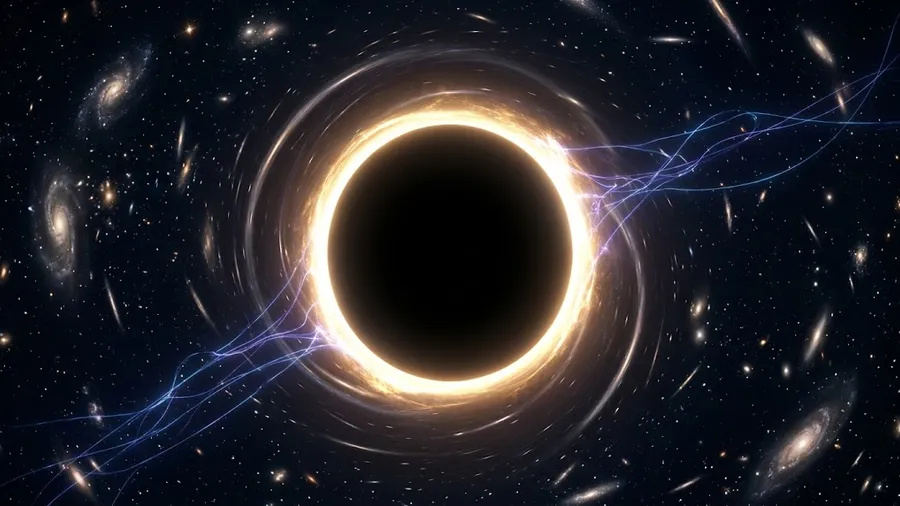
In 1907, Albert Einstein experienced what he later called the happiest thought of his life: if a person falls freely in a gravitational field, they will not feel their own weight. This simple realization grew into the Equivalence Principle, the foundational bedrock of General Relativity.
Applied to black holes, the Equivalence Principle makes a definitive, non-negotiable prediction. If you drift across the event horizon of a supermassive black hole, you will feel no sudden jolt or dramatic barrier. Because the tidal forces of a massive black hole are minuscule across human scales, the boundary between the external universe and the interior is locally indistinguishable from empty space. Physicists refer to this classical guarantee as the “No Drama” hypothesis.
However, in 2012, four theoretical physicists at the Kavli Institute for Theoretical Physics—Ahmed Almheiri, Donald Marolf, Joseph Polchinski, and James Sully (collectively known as AMPS)—uncovered a devastating mathematical contradiction.
By analyzing how quantum information behaves as a black hole evaporates, they discovered that if modern quantum mechanics is correct, the event horizon cannot be empty space. Instead, it must be an impenetrable, blazing sheet of high-energy particles possessing infinite energy density: a cosmic Firewall that would instantly incinerate any infalling observer.
The Root of the Crisis: Hawking’s Unitarity Problem
To understand the emergence of the firewall, one must look back to Stephen Hawking’s 1974 discovery that black holes are not completely black. Quantum fluctuations near the horizon constantly generate entangled pairs of virtual particles:
- One partner falls past the horizon into the singularity.
- The other partner escapes into open space as Hawking radiation.
Over astronomical spans of time, the black hole steadily loses mass and radiates away into thermal photons. This created the infamous Black Hole Information Paradox: if an encyclopedic book or a dying star collapses into a black hole, and the black hole subsequently evaporates into completely random, featureless thermal radiation, what happens to the original information that created it?
In quantum mechanics, the law of Unitarity mandates that quantum information can never be destroyed. The sum of all probabilities must always equal exactly one. If quantum information were permanently erased by a black hole, the mathematical foundation of quantum theory would disintegrate.
To preserve unitarity, physicists like Don Page demonstrated that by the time the black hole evaporates past halfway through its lifespan (a milestone known as the Page Time), the newly emitted Hawking radiation must begin carrying the trapped information back out into the universe.
The Rule of Monogamy in Quantum Entanglement
The vehicle that transfers information out of an evaporating black hole is quantum entanglement. However, quantum mechanics imposes an absolute constraint on how entanglement works, known mathematically as the Monogamy of Entanglement.
Under standard quantum information theory:
- A quantum particle can be maximally entangled with exactly one other quantum system at a time.
- If Particle B is maximally entangled with Particle A, it is mathematically forbidden from sharing that maximal entanglement with Particle C.
This is where the AMPS calculation uncovers an impossible quantum triangle:
- Entanglement with the Past: To preserve quantum unitarity and allow information to escape, each newly emitted Hawking particle outside the horizon must be maximally entangled with all the Hawking radiation emitted long ago.
- Entanglement with the Inside: To satisfy the Equivalence Principle and keep spacetime smooth and continuous at the horizon, that same newly emitted particle must be maximally entangled with its infalling twin particle inside the black hole.
A single quantum particle at the horizon is required by the fundamental laws of physics to be maximally entangled with two entirely different systems simultaneously. In quantum field theory, this is an absolute impossibility.
The AMPS Dilemma: Three Incompatible Pillars
In their landmark 2012 paper, the AMPS team proved that theoretical physics had reached an unavoidable breaking point. They showed that three core principles of modern science cannot simultaneously be true:
- Pillar 1 (Quantum Unitarity): Quantum mechanics holds true, information is preserved, and Hawking radiation is not purely random.
- Pillar 2 (Local Quantum Field Theory): The laws of physics apply locally outside the black hole without faster-than-light signals or non-local interactions.
- Pillar 3 (The Equivalence Principle): Spacetime is smooth and an observer in free-fall experiences “no drama” when crossing the horizon.
If you preserve quantum mechanics (Pillar 1) and preserve local field theory (Pillar 2), you are forced to violently break the entanglement between the newly created particles and their infalling partners at the horizon.
In quantum mechanics, breaking entanglement between adjacent points in space is not a benign process. Severing those quantum correlations releases immense amounts of energy. Summing this broken entanglement across the entire horizon produces an infinite energetic barrier: the AMPS Firewall.
The Firewall Reality: The Death of Smooth Spacetime
If the AMPS hypothesis is correct, Einstein’s geometric vision of spacetime fails at the event horizon:
- The interior of a black hole does not exist; spacetime literally ends at the event horizon.
- Any object attempting to cross the horizon does not glide smoothly toward a central singularity. Instead, it strikes an ultra-hot, high-density quantum curtain that destroys its atomic structure at the Planck scale.
- The Equivalence Principle—the foundation of Einstein’s general theory of relativity—is violated at macroscopic horizons.
Because theoretical physicists find the idea of an actual physical firewall conceptually unpalatable, the AMPS paradox ignited one of the most intense debates in modern theoretical physics.
Competing Solutions: ER = EPR
How are physicists attempting to resolve the firewall crisis without discarding General Relativity or Quantum Mechanics?
The most influential proposal came in 2013 from Juan Maldacena and Leonard Susskind, summarized as “ER = EPR”:
- EPR represents quantum entanglement (named after the Einstein-Podolsky-Rosen paradox).
- ER represents non-traversable wormholes in spacetime (Einstein-Rosen bridges).
Maldacena and Susskind conjectured that whenever two particles are quantum mechanically entangled, they are physically connected through a microscopic, Planck-scale wormhole.
Applying this to an evaporating black hole past its Page Time: the early Hawking radiation scattered across the cosmos is not a detached, external system. It is connected through a vast geometric network of quantum wormholes directly into the black hole interior.
Because the interior and the early radiation are connected geometrically, the infalling partner and the external radiation are, in a deeper sense, manifestations of the same system. The particle at the horizon is not violating the monogamy of entanglement because it is only entangled with one unified physical reality. The firewall vanishes, and the Equivalence Principle is saved.
The Crossroads of Quantum Gravity
The AMPS firewall paradox proved that black holes are the ultimate theoretical laboratories. You cannot resolve the paradox by making minor adjustments to mathematical approximations; it forces physicists to choose which sacred principle of 20th-century physics must give way.
Whether the resolution lies in ER = EPR wormholes, non-local quantum corrections, or the literal existence of a quantum barrier, the firewall debate has brought theoretical physics to a unanimous conclusion: continuous space, time, and gravitational fields are not fundamental. They are macroscopic approximations woven from quantum entanglement—and where that entanglement breaks down, the very fabric of reality ceases to exist.