· physics · 6 min read
Conformal Cyclic Cosmology: Why the End of the Universe Becomes the Next Big Bang
Nobel laureate Roger Penrose proposed that when all matter decays into massless photons in the unimaginably distant future, the loss of physical clocks and scale transforms the cold death of one cosmos into the hot Big Bang of another.
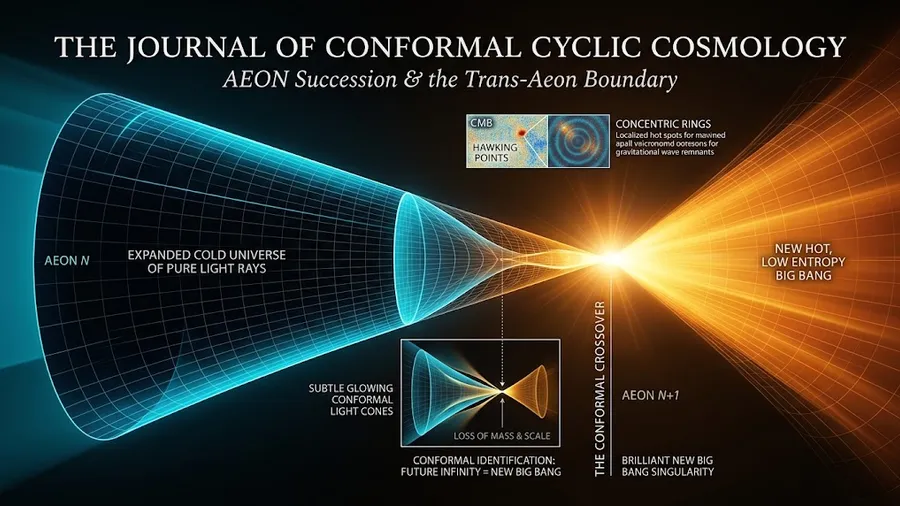
In mainstream cosmology, the story of the universe is an open-ended tragedy. It begins with a blazing Big Bang roughly 13.8 billion years ago, expands under the repulsive influence of dark energy, and drifts inexorably toward the Heat Death—a desolate, frozen expanse where all stars have burned out, all black holes have evaporated via Hawking radiation, and entropy has reached its absolute maximum.
In this standard picture, the story ends forever. Nothing more ever happens.
However, Nobel laureate Sir Roger Penrose identified a deep thermodynamic paradox hiding at the origin of this narrative: if entropy always increases in accordance with the Second Law of Thermodynamics, why did our universe begin in a state of extraordinarily low gravitational entropy?
Penrose’s radical resolution to this question reshapes our understanding of cosmic history. Known as Conformal Cyclic Cosmology, it proposes that the universe does not end in eternal silence. Instead, the ultimate, cold, diluted graveyard of our cosmos smoothly transforms into the energetic, ultra-dense Big Bang of the next cosmic era—an unending chain of cosmic epochs called aeons.
The Riddle of Gravitational Entropy
To understand Penrose’s framework, one must contrast thermal entropy with gravitational entropy.
When gas is distributed uniformly across a room, its thermal entropy is maximized; it is completely disordered. But when gravity enters the picture, the rules invert:
- Under gravity, a uniform distribution of gas is extraordinarily unstable and represents low gravitational entropy.
- Over time, gravitational attraction clumps gas into stars, stars collapse into stellar clusters, and clusters eventually collapse into supermassive black holes.
- A black hole represents the absolute maximum entropy state that a given region of spacetime can achieve.
When cosmologists observe the Cosmic Microwave Background—the thermal remnant of the early universe—they observe gas that is smooth and uniform to one part in 100,000. Thermally, the early universe appeared to be near maximum entropy, but gravitationally, it was extraordinarily pristine and organized. The curvature of spacetime was virtually flat, with black holes entirely absent.
Penrose formalized this through his Weyl Curvature Hypothesis: the curvature governed by matter density was immense at the Big Bang, but the Weyl curvature—which measures tidal forces, gravitational clumping, and black holes—was precisely zero.
Why would the universe start with such an unnaturally precise zero-entropy boundary condition? Penrose argued that it was not an accidental coincidence, but a geometric consequence of the death of a previous cosmic era.
The Remote Future: The Erasure of Clocks and Rulers
Fast-forward into our own cosmos trillions of years into the future:
- All stars have long since exhausted their nuclear fuel.
- Supermassive black holes have completely evaporated away into diffuse baths of low-energy photons.
- Virtually all massive particles have either annihilated or decayed into pure radiation.
In this unimaginably distant era, the cosmos is populated exclusively by massless particles, primarily photons and gravitons.
Here, Penrose applies a fundamental principle of Special Relativity: massless particles do not experience time.
A photon travels at the speed of light. Along its trajectory, the elapsed proper time is identically zero. Furthermore, without particles possessing rest mass, physical clocks cannot exist. Clocks require periodic oscillations of massive systems, such as atoms or mechanical pendulums.
Without mass and clocks, the universe loses all physical markers of distance and duration. The concepts of one millimeter and a trillion light-years become physically indistinguishable. Space loses its metric scale, retaining only its conformal geometry—the shape of light cones and causal relationships.
The Conformal Bridge: When Infinity Equals Zero
In differential geometry, a conformal transformation is a mathematical operation that stretches or shrinks distances while preserving angles and causal light cones.
Penrose demonstrated an astonishing mathematical equivalence between two extreme states of spacetime:
- The Remote Future: Infinitely cold, infinitely expanded, empty of mass, and possessing zero scale.
- The Big Bang: Infinitely hot, infinitely compressed, with particles moving so violently that their rest masses are negligible compared to their kinetic energies—also possessing zero scale.
Because both the infinite future of one universe and the initial singularity of a new universe are conformally invariant, they are mathematically identical.
By applying a conformal mathematical rescaling factor, the infinite, stretched boundary of our dying universe maps smoothly onto the compact, initial Big Bang boundary of the next universe.
What an observer in our universe would view as an infinite expanse of empty space becomes the infinitesimal, hyper-dense origin of the next aeon.
The Succession of Aeons
In Conformal Cyclic Cosmology, our Big Bang was not the beginning of space and time. It was simply the transition point from an antecedent cosmic epoch.
Each aeon follows an identical macro-cycle:
- It begins with a conformally flat Big Bang where gravitational Weyl curvature is zero.
- Matter condenses, gravitational clumping produces galaxies, stars, and supermassive black holes, driving gravitational entropy to immense heights.
- Over astronomical spans of time, black holes radiate away, matter decays, and the universe dilutes into pure radiation.
- Scale vanishes as space becomes conformal, automatically resetting the conditions required to ignite the Big Bang of the subsequent aeon.
The Observational Signature: Hawking Points in the CMB
Unlike many speculative cosmological hypotheses that cannot be tested empirically, Conformal Cyclic Cosmology makes a specific, falsifiable observational prediction.
When supermassive black holes in the previous aeon collided and merged, they emitted immense bursts of gravitational waves. Toward the end of that aeon, when those supermassive black holes finally evaporated, their stored Hawking entropy was released across the conformal boundary.
Because the transition between aeons preserves conformal light paths, the energy released by evaporating supermassive black holes should leave faint, circular temperature anomalies in the Cosmic Microwave Background of our current universe.
Penrose and his collaborators identified these predicted circular rings—which they named Hawking Points—in data collected by the Planck satellite mission. While their statistical significance remains an active debate within the astrophysical community, the presence of anomalous concentric circles of uniform temperature in the cosmic background provides a real observational test.
The Deepest Implication of Cyclic Time
Conformal Cyclic Cosmology overturns the bleakest conclusion of classical thermodynamics. The Second Law is not broken, nor is entropy artificially reversed by an impossible cosmic crunch.
Instead, entropy continues to climb indefinitely. But when the universe exhausts every scrap of matter and forgets the meaning of size and time, the maximum entropy of a dead universe becomes the starting low-entropy baseline of a newborn cosmos.
The universe does not die in a frozen void. It simply finishes a chapter—passing the baton of pure light across the boundary to begin the dance of stars all over again.