· physics · 8 min read
Maxwell's Demon: How Erasing Information Generates Physical Heat
In 1867, James Clerk Maxwell imagined a microscopic entity capable of violating the Second Law of Thermodynamics. Resolving the paradox took more than a century, culminating in Landauer's Principle and the revelation that information is fundamentally physical.
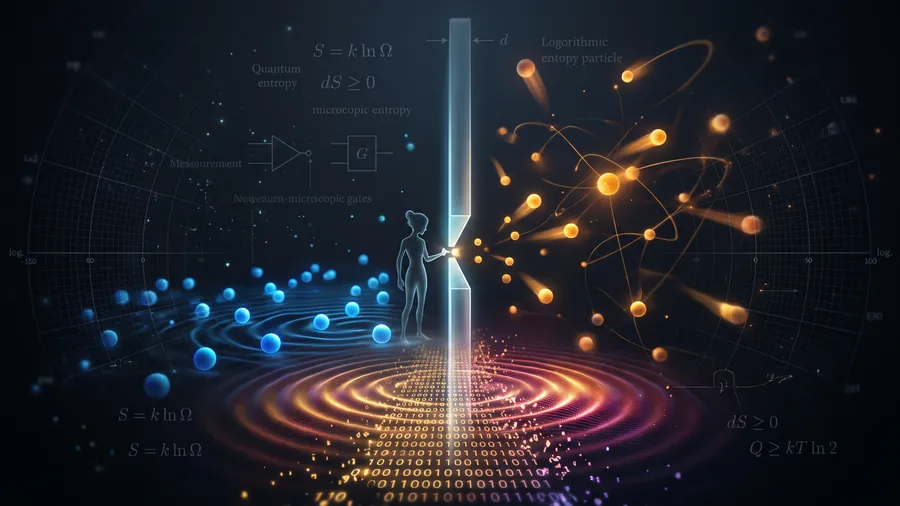
In the pantheon of physical laws, none commands greater authority than the Second Law of Thermodynamics. Formulated in the 19th century to understand the limits of steam engines, it dictates that in any isolated system, the total entropy—a measure of microscopic disorder and unusable energy—must always increase or remain constant over time.
Heat naturally flows from hot objects to cold objects, never the reverse. A cup of hot coffee inevitably cools to room temperature; it never spontaneously draws warmth from the air to bring itself back to a boil.
Yet, in 1867, Scottish physicist James Clerk Maxwell proposed a thought experiment that threatened to dismantle this cornerstone of physics.
Maxwell wondered whether the Second Law was truly an absolute, immutable law of nature, or merely a statistical limitation stemming from human clumsiness—our inability to track and control individual atoms.
To test this boundary, Maxwell imagined a microscopic, hyper-intelligent entity operating at the atomic scale: Maxwell’s Demon.
The Creature at the Trapdoor
Maxwell envisioned an isolated container filled with a gas at uniform temperature, divided into two chambers (Chamber A and Chamber B) by an insulating wall. In the middle of the wall sat a frictionless, weightless trapdoor operated by the microscopic demon.
Although the gas is at a uniform overall temperature, the individual gas molecules do not all move at the same speed:
- Some molecules are energetic and fast (hot).
- Other molecules are sluggish and slow (cold).
- Under ordinary thermodynamics, fast and slow particles collide randomly, maintaining a well-mixed, average temperature across both chambers.
The demon, however, monitors every incoming molecule:
- When a fast-moving particle approaches the door from Chamber A, the demon quickly opens the trapdoor and allows it to pass into Chamber B.
- When a slow-moving particle approaches from Chamber B, the demon lets it slip into Chamber A.
- In all other cases, the demon keeps the door firmly shut.
Because the door is frictionless and requires zero mechanical work to open, the demon expends no energy.
Yet, after hours of selective sorting, Chamber B becomes densely populated with fast, energetic molecules, while Chamber A is left with only sluggish ones. Chamber B grows hot, Chamber A grows cold, and a temperature gradient emerges out of uniform thermal noise.
By exploiting this temperature difference, an engineer could run a heat engine, generating useful mechanical work indefinitely out of thin air. The demon had apparently reduced the total entropy of an isolated system, resurrecting the forbidden dream of a perpetual motion machine.
Leó Szilárd and the Single-Particle Engine
For more than half a century, physicists struggled to pinpoint where Maxwell’s logic failed.
The first major breakthrough came in 1929, when Hungarian-American physicist Leó Szilárd simplified the paradox into its barest conceptual essence: the Szilárd Engine.
Szilárd replaced the countless gas molecules with a container holding just one single gas particle:
- A partition is inserted into the middle of the box, trapping the particle on either the left or the right side.
- The demon measures the box to determine which side holds the particle.
- If the particle is on the left, the demon attaches a piston to the partition from the right. As the particle bounces against the partition, its thermal collisions push the partition, extracting mechanical work from the surrounding heat bath.
Szilárd proved mathematically that in order to extract work, the demon must acquire one bit of binary information: the answer to the question “Is the particle on the left or on the right?”
Szilárd concluded that information and thermodynamics are intimately linked. To rescue the Second Law, the act of acquiring information had to carry a physical cost.
The Measurement Fallacy
For several decades following Szilárd’s work, the physics community believed the solution was solved by Léon Brillouin and Dennis Gabor.
Brillouin argued that to know whether the particle was on the left or right, the demon had to illuminate it with at least one photon of light.
Generating that photon, reflecting it off the particle, and registering it on a detector would inevitably dissipate energy as heat into the environment. Brillouin calculated that the thermodynamic entropy generated by the measurement light beam was always slightly larger than the entropy reduction achieved by sorting the particle.
Case closed? Not quite.
In the 1970s and 1980s, computer scientists and physicists specializing in quantum computation realized that Brillouin’s explanation was deeply flawed.
Using techniques of reversible measurement, researchers showed that it is theoretically possible to measure the state of a physical system without dissipating any minimum amount of energy. A measurement can be performed adiabatically and reversibly, producing zero thermodynamic entropy.
The demon could indeed observe the particle for free. The paradox was wide open once again.
Rolf Landauer and the Cost of Forgetting
The definitive resolution to Maxwell’s Demon arrived not from measuring, but from erasing.
In 1961, IBM physicist Rolf Landauer published a foundational paper titled Irreversibility and Heat Generation in the Computing Process. Landauer recognized a fundamental asymmetry in the physics of computation:
- Logical operations that preserve information (such as copying a bit or swapping two states) can theoretically be performed with zero energy dissipation.
- However, any logical operation that is informationally irreversible—where multiple input states are compressed into a single output state, destroying historical data—must dissipate a strictly non-zero amount of heat into the environment.
The most universal example is the Reset to Zero operation: forcing a computer bit from an unknown state (either 0 or 1) back to 0.
Because two distinct physical possibilities are compressed into one, the phase space of the computer’s internal state shrinks. To prevent the universe’s total entropy from decreasing, that compressed entropy must be dumped into the surroundings as thermal heat.
This universal limit is known as Landauer’s Principle:
Erasing a single bit of information at absolute temperature $T$ must dissipate a minimum energy of:
$$E \ge k_B T \ln 2$$
(where $k_B$ is the Boltzmann constant).
Bennett’s Exorcism of the Demon
In 1982, IBM Fellow Charles Bennett applied Landauer’s Principle directly to Maxwell’s thought experiment, completing the exorcism of the demon once and for all.
Bennett asked a simple question that previous physicists had overlooked: Where does the demon store its measurements?
A physical demon cannot possess an infinite, disembodied memory. Whether the demon is a conscious biological observer, a microchip, or a single mechanical lever, it must store its observation in a physical memory register:
- The demon starts with its memory cleared (holding a 0).
- It measures the particle and records its position (storing a 1).
- It uses that information to open the trapdoor and extract work.
- The Trap: To repeat the cycle and run continuously as a perpetual engine, the demon must clear its memory register back to 0, ready for the next particle.
At the exact moment the demon erases that single bit of data from its memory bank to reset itself, Landauer’s Principle strikes with relentless mathematical force.
The physical erasure of the bit forces the demon to dissipate heat into the surroundings, generating an amount of entropy that exactly matches or exceeds the entropy reduced by sorting the particle.
The demon does not violate the Second Law. It merely acts as a temporary information battery—converting environmental heat into stored memory bits, which must inevitably be repaid with interest the moment those memory bits are erased.
Experimental Confirmation: Information Turned into Work
For decades, Landauer’s limit was viewed as a profound theoretical boundary. However, in 2012, an experimental physics team at the École Normale Supérieure de Lyon in France brought the principle into physical reality.
Using a microscopic silica bead suspended in water and manipulated by ultra-sensitive laser optical tweezers:
- Researchers trapped the bead in a double-well potential, representing a physical bit (left well = 0, right well = 1).
- By tilting and lowering the laser barrier, they forced the bead into a predetermined state, effectively executing an erasure cycle.
- By measuring the heat dissipated into the surrounding water molecules, the physicists confirmed that the energy released asymptotically approached the exact Landauer bound ($k_B T \ln 2$).
Subsequent experiments in Tokyo and Cambridge demonstrated the inverse: converting pure information directly into mechanical energy, building functioning microscopic “information engines” that run on data.
“Information Is Physical”
Rolf Landauer famously summarized the philosophical impact of his discovery with a three-word motto: “Information is physical.”
Before Landauer and Bennett, information was viewed as a ghost—an abstract mathematical concept residing exclusively in the human mind, detached from the heavy, mechanical laws of matter and energy.
Maxwell’s Demon taught modern science that information cannot be separated from the universe that holds it.
Every thought registered by human neurons, every byte processed by a supercomputer, and every data point encoded in the double helix of DNA is tethered to the physical laws of thermodynamics. You cannot create, manipulate, or destroy an idea without rippling the entropy of the cosmos.