· physics · 7 min read
The Unruh Effect: Why Pure Acceleration Makes the Vacuum Burn with Thermal Radiation
In classical intuition, empty space is cold, dark, and absolute. But quantum field theory reveals a staggering truth: whether a vacuum is empty or blazing with thermal particles depends entirely on how fast you accelerate.
If you take a sealed container, evacuate every atom of gas, shield it from stray radiation, and cool it to absolute zero, you obtain what classical physics considers a perfect vacuum. To an observer floating motionless inside this chamber, the space is undeniably empty: no particles hit the walls, no light travels across the void, and the temperature is zero.
For centuries, physics treated this emptiness as an objective, universal property. If a room contains zero particles, anyone looking into that room must also agree that it is empty.
However, in the mid-1970s, theoretical physicists Stephen Fulling, Paul Davies, and William Unruh uncovered an astonishing prediction bridging special relativity and quantum field theory.
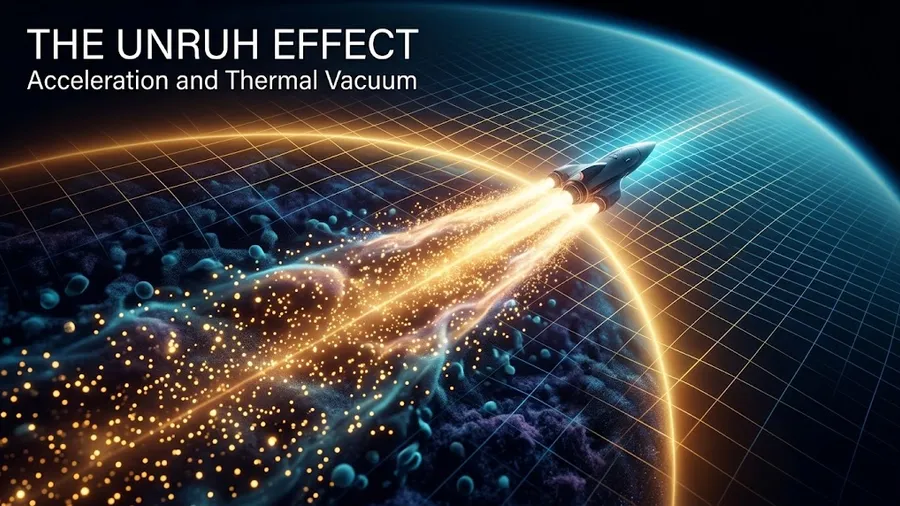
If an observer accelerates through that very same “empty” vacuum, they will not measure zero particles. Instead, their particle detectors will click relentlessly, and their thermometers will register a warm, glowing bath of thermal radiation.
To an accelerating observer, empty space is literally on fire. This phenomenon is known as the Unruh Effect.
The Death of the Universal Particle
To understand how acceleration can conjure heat out of nothingness, one must abandon the 19th-century mental picture of elementary particles as tiny, permanent billiard balls flying through space.
In Quantum Field Theory (QFT), fundamental particles do not exist as independent objects. What truly exists are pervasive, universe-spanning quantum fields—such as the electromagnetic field or the electron field. What we call a “particle” is merely a localized, quantized vibrational ripple in one of these fields.
In standard textbooks, physicists calculate whether a field ripple exists by dividing the wave modes into positive frequencies (representing particles) and negative frequencies (representing antiparticles).
Crucially, defining what constitutes a “positive frequency” requires a specific time coordinate—it requires an agreed-upon definition of ticking clocks.
An observer at rest or moving at a constant velocity (an inertial observer) uses standard Minkowski spacetime coordinates. To this inertial observer, the quantum field rests in its lowest possible ground state: the zero-particle vacuum state.
An accelerating observer, however, is constantly speeding up. Their onboard clocks tick at continuously changing rates relative to the background space. When they translate the quantum field into their own coordinates (known mathematically as Rindler coordinates), the pristine separation between positive and negative frequencies scrambles completely.
What the stationary observer measures as pure, motionless vacuum fluctuations, the accelerating observer experiences as actual, physical particles carrying heat and momentum.
The Rindler Horizon: The Causal Wall
Why does acceleration scramble the quantum vacuum? The answer lies in the relativistic structure of spacetime.
When an observer accelerates indefinitely at a constant rate, their velocity approaches the speed of light. Because no physical signal can travel faster than light, a vast region of spacetime behind the accelerating observer becomes permanently inaccessible to them. Light signals emitted from that region can never catch up to the accelerating ship.
This boundary is called the Rindler Horizon. It is mathematically identical to the event horizon of a black hole:
- An accelerating observer is shielded from a portion of the universe behind an inescapable causal wall.
- Because quantum vacuum fluctuations are inherently entangled across all space, the Rindler horizon abruptly cuts the observer off from the quantum partners of field fluctuations lying behind the boundary.
- When you trace over or ignore half of an entangled quantum system, what was once a pure, zero-entropy quantum ground state mathematically transforms into a mixed, thermal state.
Just as Stephen Hawking proved that the event horizon of a black hole emits thermal radiation, William Unruh demonstrated that the artificial horizon created by pure acceleration produces an identical thermal glow.
The Unruh Temperature
The temperature measured by an accelerating observer depends directly on how hard they are accelerating.
The relationship is governed by the Davies-Unruh formula: the observed temperature is directly proportional to the acceleration ($a$) multiplied by the reduced Planck constant ($\hbar$), and inversely proportional to the speed of light ($c$) and the Boltzmann constant.
This formula contains the fundamental constants of quantum mechanics, relativity, and thermodynamics in a single expression:
- If acceleration is zero, the temperature is absolute zero.
- The harder you accelerate, the hotter the surrounding vacuum becomes.
However, the reason the Unruh effect is not part of everyday human experience is the extreme weakness of the coupling. Because the Planck constant is exceedingly tiny and the speed of light in the denominator is enormous, producing even a modest temperature requires monumental acceleration.
To heat the vacuum by just 1 Kelvin, an observer or particle detector must accelerate at approximately $2.5 \times 10^{20}$ meters per second squared—billions of times stronger than the gravity on the surface of the Sun.
What Does the Stationary Observer See?
The Unruh effect creates a profound conceptual puzzle. Imagine an accelerating rocket equipped with a physical thermometer. The thermometer absorbs Unruh particles from the vacuum and heats up, reading 100 degrees Celsius.
Now, consider a stationary astronaut floating nearby watching the rocket zoom past. The stationary astronaut sees a vacuum with zero particles. How can the stationary observer explain why the rocket’s thermometer gets hot without seeing any particles hitting it?
The resolution is breathtakingly elegant:
- From the Rocket’s Perspective: The accelerating thermometer absorbs real, thermal Unruh photons existing in its accelerating frame, heating up in the process.
- From the Stationary Perspective: The thermometer does not absorb a pre-existing particle. Instead, the thermometer’s accelerated motion pumps energy into the quantum field, causing the thermometer to emit a particle into the vacuum while undergoing an internal excitation.
Both observers agree completely on the objective physical outcome: the thermometer registers 100 degrees, and its internal energy state has changed. But they describe the underlying causal mechanism in fundamentally different languages.
Whether a particle was absorbed or emitted—and whether particles even existed in that patch of space—depends entirely on the observer’s state of motion.
The Equivalence Principle and Hawking Radiation
The Unruh effect is not an isolated curiosity; it is the theoretical backbone of modern gravitational physics.
Through Einstein’s Equivalence Principle, the physical effects of standing motionless in a gravitational field are indistinguishable from accelerating through flat spacetime. A person standing on the surface of the Earth is continuously accelerating upward at 9.8 meters per second squared relative to a local freely falling frame.
When applied to strong gravity, the Unruh effect and Hawking radiation become two sides of the same mathematical coin:
- A static observer hovering just outside the event horizon of a black hole must fire powerful rockets to keep from falling in.
- That hover requires tremendous acceleration.
- Therefore, the hovering observer experiences an intense Unruh thermal bath.
- The radiation that manages to escape from that near-horizon acceleration bath into distant space is precisely what Stephen Hawking calculated as black hole radiation.
Hawking radiation is simply the Unruh effect viewed through the lens of curved spacetime geometry.
Experimental Quests: Detecting the Unruh Glow
Because detecting the thermal glow at standard laboratory accelerations requires impossible g-forces, physicists have turned to extreme high-energy physics and analog systems to test the theory:
- Petawatt Laser Pulses: Ultra-intense lasers can accelerate electrons to nearly the speed of light over subatomic distances, subjecting them to accelerations exceeding $10^{21}$ meters per second squared. Theorists look for subtle radiative signatures indicating the electron is interacting with an Unruh thermal bath.
- Bose-Einstein Condensates and Superconducting Circuits: By creating sonic event horizons in ultra-cold quantum fluids or simulating accelerating mirrors in quantum circuits, experimentalists have confirmed the underlying mathematical equations of Davies and Unruh with high precision.
The Subjective Fabric of Reality
The ultimate philosophical lesson of the Unruh effect strikes at the heart of reductionism. We instinctively want the universe to be composed of definite, objective ingredients: a container of space filled with a countable list of particles.
The Unruh effect proves that this intuition is fundamentally incorrect. There is no universal answer to the question: “How many particles are in this room?”
The count of particles, the temperature of space, and the very concept of emptiness are not intrinsic properties of the cosmos. They are relational properties established between quantum fields and the observer moving through them. Reality does not just exist in the vacuum; it emerges from how you travel across it.