· cosmos · 4 min read
The Dying Singularity: Why Black Holes Are Thermodynamically Destined to Evaporate
General Relativity painted black holes as eternal cosmic prisons from which nothing escapes. In 1974, Stephen Hawking united quantum field theory with thermodynamics to prove they are slowly boiling away.
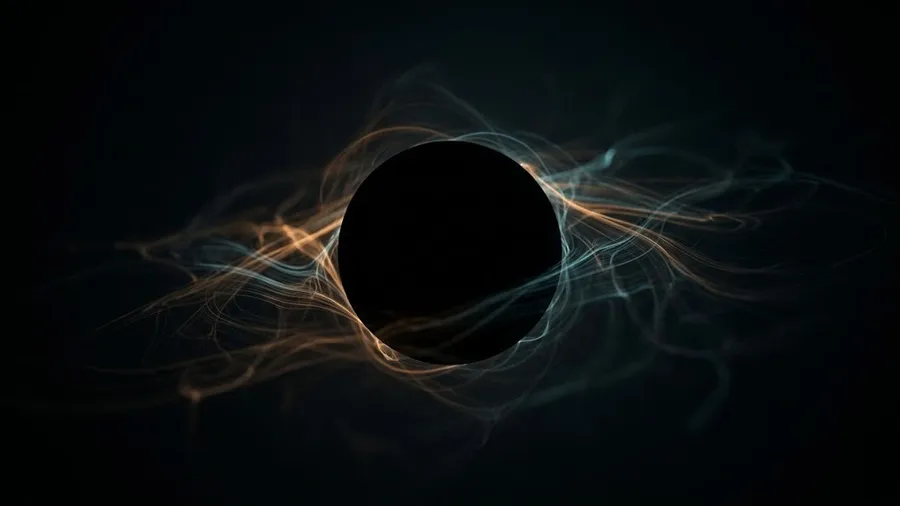
The Eternal Cosmic Prison
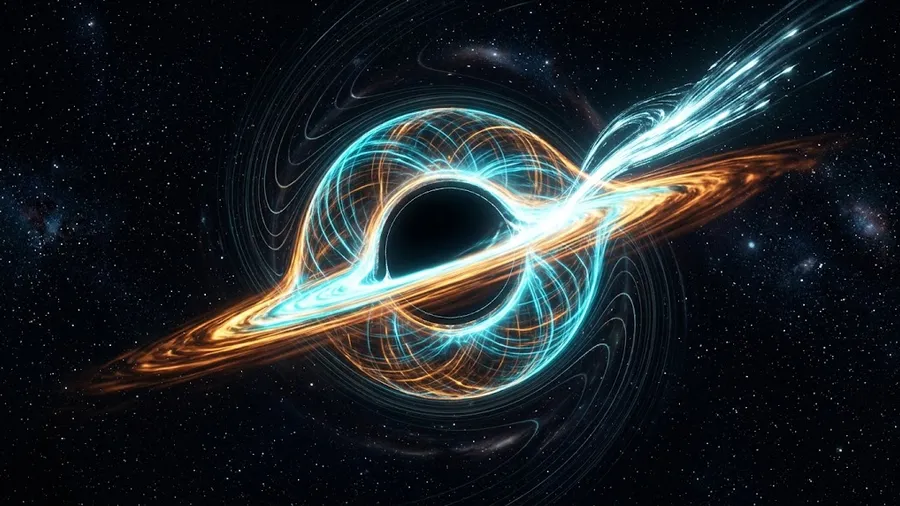
Under Albert Einstein’s General Relativity, a black hole is an absolute mathematical boundary:
- At its outer boundary sits the Event Horizon—a geometric threshold where the escape velocity of space itself matches the cosmic speed of light (c).
- Because nothing can travel faster than c, whatever crosses this membrane is severed permanently from the causal structure of the universe.
In classical astrophysics, a black hole could only grow. It could devour stars, sweep up cosmic dust, merge with other singularities, and expand its gravitational footprint forever. It was considered an eternal, silent one-way drain in spacetime.
This classical picture harbored a catastrophic contradiction with thermodynamics: The Information Paradox.
If you throw an object with high thermodynamic entropy (like an encyclopedic library or a tank of chaotic heated gas) past the event horizon, that entropy seemingly disappears from the cosmos. The total entropy of the universe would decrease, directly violating the inviolable Second Law of Thermodynamics.
Bekenstein’s Geometry of Entropy
In 1972, a doctoral student named Jacob Bekenstein proposed a radical solution: a black hole does not erase entropy; its event horizon embodies it.
Bekenstein argued that when mass plunges into a black hole, the surface area of the horizon expands. Therefore, the horizon’s two-dimensional surface area (A) must serve as a direct measure of its internal entropy.
Initially, Stephen Hawking set out to prove Bekenstein wrong. Hawking considered the idea physically absurd: if a black hole possesses thermodynamic entropy, classical physics dictates that it must also possess a temperature. And if an object has a non-zero temperature, it must emit thermal radiation. But by definition, nothing could radiate outward past an event horizon.
Hawking applied quantum field theory to curved spacetime around the horizon to demolish the claim. Instead, his calculations confirmed it down to the decimal point.
The Quantum Boiling of the Void
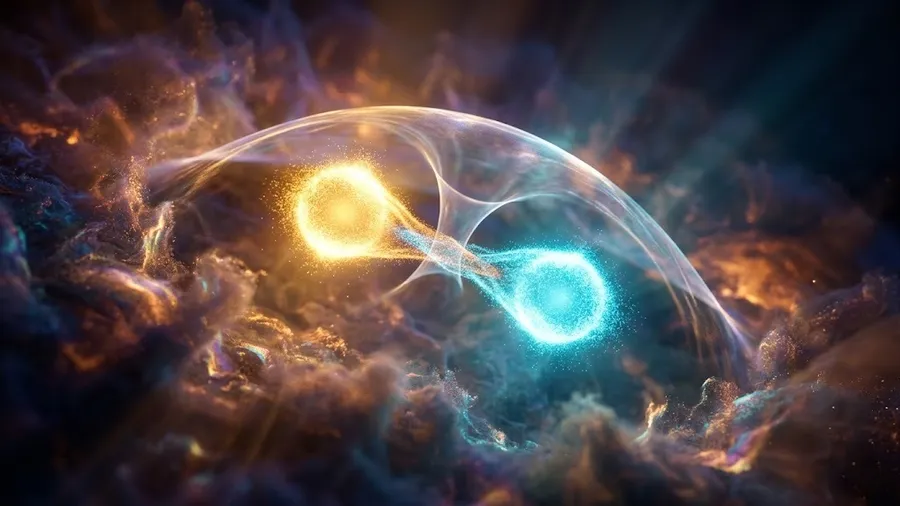
The vacuum surrounding an event horizon is not inert emptiness. As governed by the Heisenberg Uncertainty Principle, pairs of virtual particles and antiparticles constantly materialize, exchange momentum, and annihilate each other back into nothingness.
Near the razor-thin boundary of a black hole, extreme gravitational tidal forces interfere with this quantum ballet:
- Before a virtual pair can recombine, one particle slips backward across the event horizon.
- The partner particle remains outside in normal space, unable to annihilate.
- From the perspective of an external observer at infinity, the trapped particle possesses negative energy relative to the surrounding universe, reducing the overall mass of the black hole.
- The surviving particle is flung into deep space as real, measurable thermal glow: Hawking Radiation.
Hawking derived the exact temperature (T_H) of this emission:
T_(H) = (ħ · c³) / (8π · G · M · k)
Where:
- ħ is the reduced Planck constant (quantum action).
- c is the cosmic speed of light (relativistic barrier).
- G is Newton’s gravitational constant (curvature of spacetime).
- M is the mass of the black hole.
- k is Boltzmann’s constant (thermodynamic link).
Notice the terrifying consequence of the denominator: temperature is inversely proportional to mass (M).
Ordinary physical objects cool down as they radiate heat. A black hole does the exact opposite: the more mass it loses through radiation, the hotter and more luminous it becomes.
The Horizon Area Formula
By synthesizing quantum mechanics, gravity, and thermodynamics, Hawking formulated the absolute entropy of a black hole:
S_(BH) = (k · c³ · A) / (4 · G · ħ)
This equation revealed that a black hole is the most efficient storage medium for entropy in the universe: all information is inscribed not across its three-dimensional interior volume, but directly onto the two-dimensional surface area (A) of its boundary, sliced into microscopic Planck-length tiles.
The Final Detonation
For stellar-mass black holes today, Hawking radiation is agonizingly weak:
- A black hole with the mass of our Sun radiates at a frigid temperature of roughly 60 nanokelvin (−273.14999994°C).
- Because this is vastly colder than the Cosmic Microwave Background (2.7 Kelvin), stellar black holes currently absorb far more microwave background energy than they emit. They are net gainers.
However, in the far cosmic future, as the universe continues its accelerating expansion and the background cools toward absolute zero, every black hole in existence will begin its terminal countdown.
Over unfathomable timescales—roughly 10⁶⁷ years for a solar-mass remnant and 10¹⁰⁰ years for supermassive behemoths—their mass will evaporate atom by atom.
In its final fractional second, when its mass drops to a few hundred tons, the temperature skyrockets to trillions of degrees. The dying black hole releases its remaining mass in a cataclysmic burst of gamma radiation—a subatomic flash packing the energy of millions of hydrogen bombs detonated simultaneously.
Nothing in this cosmos is permanent. Even the dark gravitational titans that devour stars must eventually pay their debt to quantum thermodynamics.