· cosmos · 5 min read
Mining the Void: How Spacetime Dragging Lets You Steal Energy from Black Holes
In 1969, Roger Penrose proved that a rotating black hole is not an inescapable thermodynamic drain. It is the most monstrous mechanical engine in existence, storing 29% of its total mass as harvestable spin.
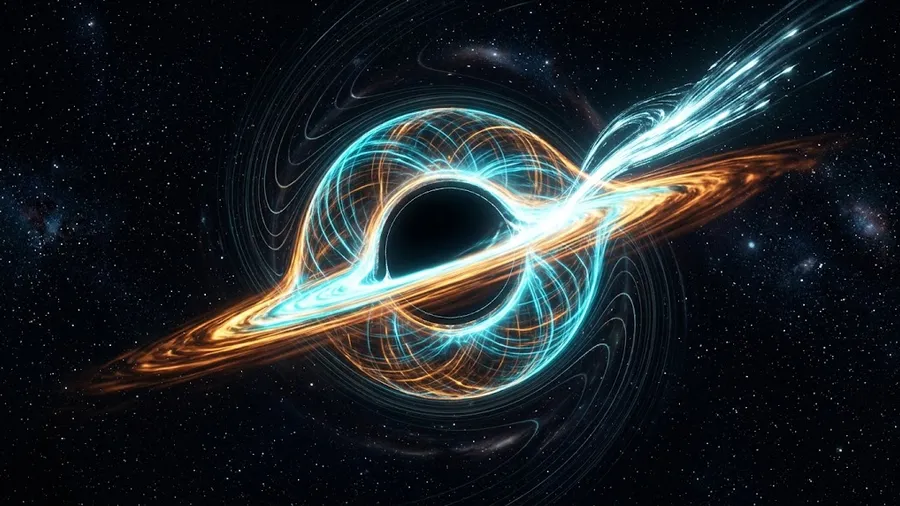
The Machine That Twists Spacetime
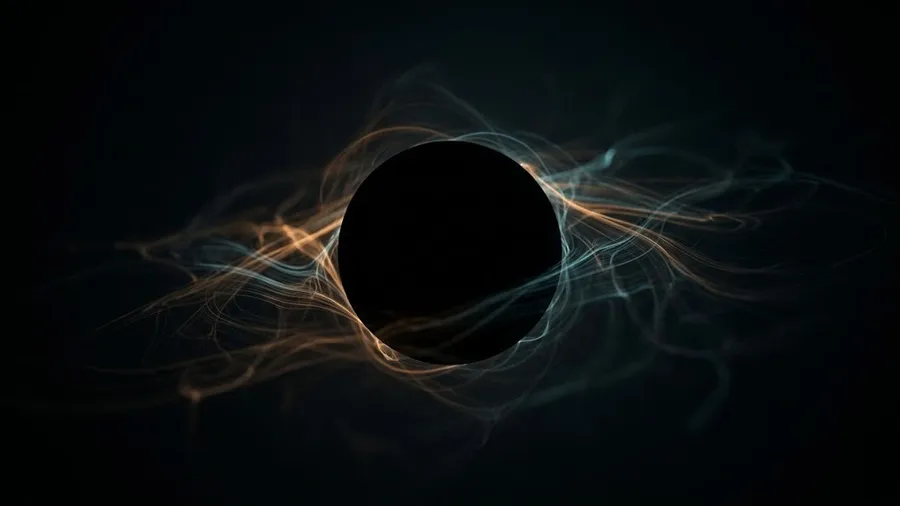
In popular culture, a black hole is pictured as an omnivorous cosmic vacuum: a static, symmetrical sinkhole from which nothing can ever be reclaimed.
That simple picture holds true only for a dead, non-rotating gravitational corpse—a Schwarzschild black hole.
In the real universe, virtually every star spins. When massive spinning stars exhaust their nuclear fuel and implode, conservation of angular momentum forces their rotation to accelerate violently. What emerges is an axisymmetric gravitational whirlpool described by New Zealand mathematician Roy Kerr in 1963: The Kerr Black Hole.
A rotating black hole does not just sit in space. Through an extreme consequence of Albert Einstein’s General Relativity known as Lense-Thirring Frame-Dragging, the spinning singularity drags the physical geometry of space and time along with it like molasses churned by a high-speed blender.
Surrounding the event horizon sits an oblately flattened cosmic region where the fabric of space itself is whipped around faster than the speed of light: The Ergosphere.
Inside the Ergosphere: Where Standing Still Is Forbidden
The outer boundary of the ergosphere is known as the Static Limit. The coordinate radius (r_E) of this boundary depends on the latitude (θ) and the angular momentum (a) of the black hole:
r_E(θ) = M + √(M² − a² · cos²θ)
At the poles (θ = 0° or 180°), the static limit touches the outer event horizon. But at the equator (θ = 90°), it balloons outward into an immense spatial pocket.
The moment any object crosses the static limit into the ergosphere, an inescapable physical threshold is crossed:
- To remain stationary relative to a distant observer at infinity, you would have to travel backward against the spin of spacetime at a speed greater than light (c).
- Because Special Relativity forbids traversing space faster than c, it is geometrically impossible to stand still inside the ergosphere.
- Spacetime seizes everything—atoms, photons, spacecraft—and forcibly sweeps them in the direction of the singularity’s spin.
Yet, because the ergosphere sits entirely outside the event horizon, an object inside can still escape back into the broader universe if fired along the correct trajectory.
The Penrose Mechanism: Splitting the Bill
In 1969, British mathematical physicist Roger Penrose asked an audacious question: Can an astronaut or an advanced civilization use this vortex to extract mechanical work?
Penrose designed a rigorous orbital thought experiment:
- A spacecraft fires a payload projectile of total energy E₀ into the ergosphere from deep space.
- While hurtling through the frame-dragged vortex, the projectile splits into two pieces (m₁ and m₂) via an internal explosion or spring release.
- Piece m₁ is intentionally kicked backward, opposing the direction of the swirling spacetime current.
- Because it moves counter to the dragging of space, piece m₁ acquires a paradoxical property: a negative total energy state (E₁ < 0) relative to an observer at infinity.
Piece m₁ falls inward across the event horizon, swallowed forever by the black hole.
Meanwhile, piece m₂ accelerates violently along an outward trajectory, escaping the ergosphere and returning to deep space with energy E₂.
Conserving total orbital energy yields a startling mathematical equation:
E₂ = E₀ − E₁
Because the swallowed fragment possessed negative energy (E₁ < 0), subtracting a negative number yields a positive increase:
E₂ > E₀
The escaping fragment rockets back into the galaxy with more energy than the original parent payload brought into the system.
Siphoning the Rotational Bank
Where did this excess kinetic energy come from? It was not conjured from nothingness.
By devouring the negative-energy fragment moving counter to its rotation, the black hole absorbed negative angular momentum. In doing so, the black hole was forced to slow down.
The Penrose Process literally leaches the rotational kinetic energy of the singularity and transfers it into the velocity of escaping matter.
Demetrios Christodoulou calculated the fundamental Irreducible Mass (M_irr) of a Kerr black hole:
M² = M(irr)² + (J · c / 2G · M(irr))²
Where:
- M is the total mass-energy of the black hole.
- J is its angular momentum.
- M_(irr) is the permanent core mass that can never be destroyed or harvested.
For a maximally spinning black hole (a = M), Christodoulou proved that up to 29.3% of the entire mass-energy of the black hole resides in its harvestable rotational reservoir.
To appreciate the scale:
- Converting hydrogen to helium via thermonuclear fusion inside stellar cores yields an efficiency of roughly 0.7%.
- Complete matter-antimatter annihilation converts 100% of the fuel, but requires equal parts manufactured antimatter.
- The Penrose Process allows a civilization to throw ordinary planetary garbage or asteroid slag into an ergosphere and recover up to 20.7% to 29% of its rest-mass equivalence as pure kinetic energy.
Nature’s Relativistic Particle Accelerators
Decades after Penrose published his blackboard thought experiment, radio telescopes and the Event Horizon Telescope observed the real-world manifestation of this physics in deep space.
Supermassive black holes, such as the 6.5-billion-solar-mass monster at the heart of galaxy Messier 87 (M87*), are encircled by magnetic plasma fields anchored into their spinning ergospheres.
Via the related Blandford-Znajek process—an electromagnetic extension of the Penrose mechanism—magnetic field lines threaded through the ergosphere act as cosmic dynamos, draining the black hole’s spin to blast relativistic plasma jets thousands of light-years across intergalactic space.
A spinning black hole is not an empty cosmic pit. It is the ultimate flywheel of the cosmos: a colossal thermodynamic powerhouse carving its mechanical signature across the architecture of the universe.