· computer-science · 6 min read
The P versus NP Problem: The Universal Mystery of Computational Limits
Is finding a brilliant solution inherently harder than verifying one? The P versus NP problem represents the deepest unsolved mystery in computer science, holding the keys to the future of cryptography, medicine, and human creativity.
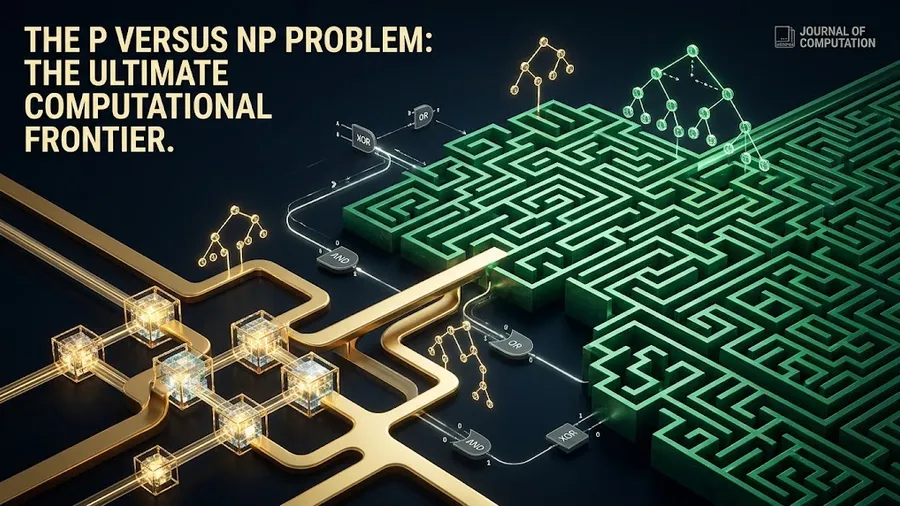
Imagine being handed a completed 9x9 Sudoku puzzle. In a matter of seconds, you can scan each row, column, and 3x3 grid with a pencil to confirm that every number from 1 to 9 appears exactly once without repetition. The verification process is straightforward, mechanical, and fast.
Now, imagine being handed an empty grid containing only a handful of starting digits, tasked with finding the correct configuration from scratch. Finding the solution may take minutes, hours, or require systematic trial-and-error that branches into hundreds of dead ends.
This intuitive contrast—between the ease of checking an answer and the difficulty of discovering it—sits at the heart of the most celebrated unsolved question in computer science: The P versus NP Problem.
Formulated independently by Stephen Cook and Leonid Levin in 1971, and designated as one of the seven Millennium Prize Problems by the Clay Mathematics Institute in 2000, the question asks whether every problem whose solution can be quickly verified by a computer can also be quickly solved by one.
Defining the Arena: Class P and Class NP
To understand the problem rigorously, computer scientists measure the efficiency of algorithms not in seconds or minutes, but in how their running time scales as the size of the input data ($N$) grows.
- Class P (Polynomial Time): These are problems considered computationally tractable. An algorithm belongs to class P if the time required to solve it scales as a polynomial function of the input size, such as $N^2$ or $N^3$. Everyday digital tasks—alphabetizing a contact list of a million names, finding the shortest driving route between two cities via GPS, or multiplying massive integers—belong to class P. Even if the input grows tenfold, modern processors can compute the answer rapidly.
- Class NP (Nondeterministic Polynomial Time): These are problems where finding the answer may be extraordinarily hard, but verifying a proposed solution can be accomplished in polynomial time. If someone hands you a potential answer, a computer can confirm whether it is correct almost instantly.
Every problem in class P is automatically in class NP, because if you can solve a problem quickly, you can verify it quickly by simply running the solution.
The profound, billion-dollar question is whether the reverse is true: Does P equal NP?
Does the universe contain problems that are intrinsically, mathematically hard to solve, or are we simply using clumsy algorithms for challenges that secretly possess lightning-fast shortcuts?
The Master Key: Cook-Levin and NP-Completeness
In 1971, Stephen Cook proved an astonishing mathematical breakthrough: within the vast ocean of NP problems, there exists a elite subset called NP-Complete problems.
NP-complete problems represent the hardest challenges in class NP. Cook demonstrated that these problems are mathematically entangled through polynomial-time reductions.
If an engineer discovers an efficient polynomial-time algorithm to solve just one single NP-complete problem, that exact algorithm can be converted to solve every single problem in class NP with equal speed.
Shortly after Cook’s work, computer scientist Richard Karp proved that dozens of notoriously difficult real-world puzzles are NP-complete:
- The Traveling Salesperson Problem: Given a list of cities and distances between them, finding the absolute shortest route that visits every city once and returns home.
- The Subset Sum Problem: Determining whether any combination of numbers in a large set sums up exactly to zero.
- The Boolean Satisfiability Problem (SAT): Finding an assignment of true/false values that satisfies a massive network of logical clauses.
- Protein Structure Prediction: Finding the lowest-energy three-dimensional folding state of a biological polypeptide chain.
Today, thousands of fundamental challenges across logistics, genetics, economics, and quantum chemistry are known to be NP-complete. They all share the exact same underlying computational spine.
What Happens if P Equals NP?
If a mathematician proves tomorrow that P equals NP, the consequences would reshape human civilization overnight. The barrier between “verifying greatness” and “producing greatness” would evaporate.
- The Annihilation of Modern Cryptography: Every secure transaction on Earth—online banking, encrypted messaging, blockchain ledgers, and national security firewalls—relies on asymmetric encryption schemes like RSA and Elliptic Curve Cryptography. These systems are secure solely because factoring massive prime products is computationally intractable. If P equals NP, those digital locks could be broken in seconds.
- The Automation of Scientific Discovery: Verifying whether a proposed molecular compound binds to a cancer cell receptor takes moments; finding the right molecule among billions of candidates takes decades of laboratory trial. If P equals NP, computational drug design becomes near-instantaneous.
- The End of Mathematical Struggle: As mathematician Donald Knuth noted, verifying a formal mathematical proof is an NP problem. If P equals NP, a computer program could be written to systematically find formal proofs for any valid theorem in minutes—automating the work of generations of mathematicians.
If P equals NP, recognizing a masterpiece of music would mathematically imply the ability to compose one with equal ease.
Why Most Theorists Believe P Does Not Equal NP
Despite the tantalizing possibilities of equality, the overwhelming consensus among theoretical computer scientists is that P does not equal NP.
The strongest argument is empirical: across more than half a century, thousands of the most brilliant minds in mathematics, engineering, and computer science have attempted to find efficient algorithms for NP-complete problems. Every attempt has failed. The algorithms inevitably hit an exponential wall, where adding a few extra variables multiplies the required computation by billions of years.
Furthermore, computational complexity theorists have encountered deep structural barriers when attempting to prove inequality:
- The Relativization Barrier (1975): Baker, Gill, and Solovay proved that standard proof techniques based on simulation and diagonalization cannot resolve the question, as they hold true in systems where P equals NP and systems where P does not equal NP.
- The Natural Proofs Barrier (1993): Alexander Razborov and Steven Rudich demonstrated that broad classes of combinatorial proofs that distinguish between hard and easy circuits are inherently doomed to fail, because if such proofs worked, they would accidentally destroy standard pseudorandom number generators.
- The Algebrization Barrier (2008): Aaronson and Wigderson showed that even modern algebraic techniques that bypass relativization cannot untangle the P versus NP knot.
These “barrier theorems” prove that resolving P versus NP will require an entirely new branch of mathematics—one capable of understanding computational structures globally rather than locally.
The Value of the Boundary
The P versus NP problem is far more than an abstract puzzle for software engineers. It is an exploration of the fundamental laws of information and physical reality.
Just as the laws of thermodynamics establish that you cannot build a perpetual motion machine that creates energy from nothing, the separation of P and NP suggests that the universe has an intrinsic speed limit on the creation of insight.
It suggests that discovery is fundamentally more difficult than recognition, that truth cannot be extracted without genuine creative friction, and that some mysteries of nature are protected by the sheer computational geometry of space and time.