· physics · 6 min read
The Three-Body Problem: Why Adding Just One Planet Breaks Classical Physics
Isaac Newton solved the motion of two orbiting bodies with effortless precision. Yet adding a single third object creates a chaotic gravitational dance that has defied general analytical solutions for more than three centuries.
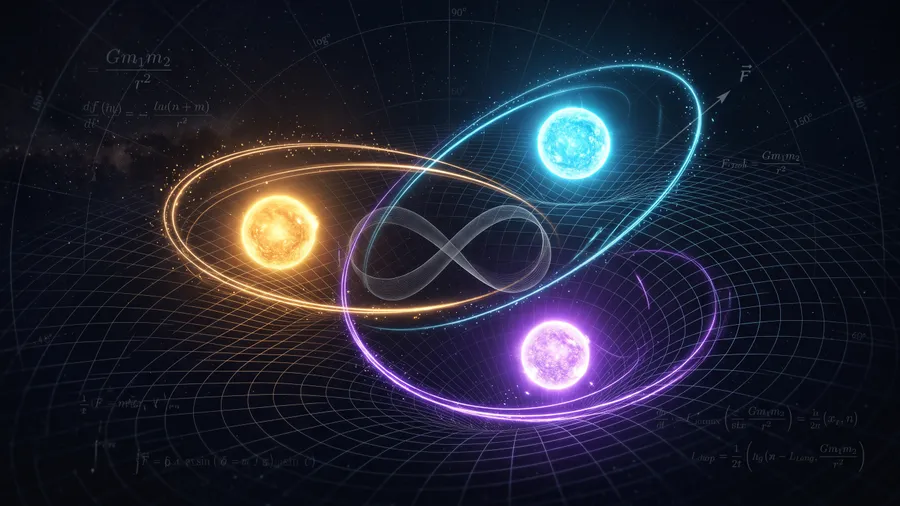
In 1687, Isaac Newton published his Principia Mathematica, unveiling the universal law of gravitation and transforming astronomy forever. Using his equations of motion, Newton effortlessly solved the two-body problem: given the masses, positions, and velocities of two celestial objects—such as the Sun and the Earth, or the Earth and the Moon—mathematics can predict their exact orbital paths infinitely far into the past and future.
In a two-body system, objects trace clean, predictable conic sections: ellipses, parabolas, or hyperbolas. Once you know the initial conditions, the clockwork universe runs on rails.
Naturally, Newton turned his attention to a slightly more realistic question: what happens when you add a third gravitational body, such as the Sun, the Earth, and the Moon interacting simultaneously?
Newton confessed that the problem gave him severe headaches—famously remarking that his head never ached except when he studied the motion of the Moon.
Over the next three hundred years, the greatest mathematicians in history—including Leonhard Euler, Joseph-Louis Lagrange, Pierre-Simon Laplace, and Henri Poincaré—attacked the three-body problem. They discovered something astonishing: adding just one extra object shatters the clockwork predictability of the cosmos, giving birth to chaos theory.
Why Two Bodies Are Simple and Three Are Chaotic
Why does adding a single mass turn a solvable equation into a mathematical nightmare?
In physics, a system is solvable in “closed form” (meaning you can write down a neat formula that outputs the exact position at any time $t$) when it possesses enough conserved quantities—such as total energy, linear momentum, and angular momentum—to lock down every degree of freedom.
- The Two-Body System: Has 12 variables (three spatial coordinates and three velocity components for each object). Conservation laws eliminate enough variables to reduce the motion to a single, simple two-dimensional ellipse.
- The Three-Body System: Jumps to 18 variables (six coordinates and velocities per body). However, the universe still provides the exact same 10 conserved quantities (energy, linear momentum, angular momentum, and center of mass).
Those missing conserved quantities leave leftover degrees of freedom that can never be algebraically eliminated. Instead of following fixed tracks, each body continuously tugs on the other two, altering their trajectories in real time—which in turn alters the gravitational forces they exert on the very next instant.
Henri Poincaré and the Birth of Chaos
In 1887, King Oscar II of Sweden and Norway offered a prestigious prize to anyone who could find a general mathematical solution to the $n$-body problem and prove whether the Solar System is permanently stable.
French mathematician Henri Poincaré submitted a brilliant paper that won the prize. However, while preparing the manuscript for publication, Poincaré discovered a subtle flaw in his own proof—a discovery that overturned centuries of deterministic philosophy.
Poincaré realized that in a three-body system, trajectories exhibit extreme sensitivity to initial conditions:
- If you shift the starting position of one planet by a fraction of a millimeter—less than the width of a single atom—its future trajectory diverges exponentially.
- Within a relatively short astronomical timeframe, two nearly identical three-body systems evolve into completely unrecognizable configurations: in one, a planet settles into a tight binary orbit; in the other, that same planet is violently slingshotted out into interstellar space forever.
Although Newton’s laws of gravity are strictly deterministic, Poincaré proved that determinism does not equal predictability. Because no measurement in the physical universe can ever be infinitely precise, the long-term future of three gravitating bodies is fundamentally unknowable.
Rare Islands of Stability: Lagrange Points and Figure-Eights
While no general formula exists for all possible three-body arrangements, mathematicians have discovered extraordinary special cases where three bodies dance in repeating, periodic harmony:
- Euler’s Collinear Solutions (1767): Three bodies can orbit in a straight line if their distances maintain a precise mathematical ratio—though any tiny nudge causes the formation to collapse.
- Lagrange’s Equilateral Triangle (1772): Joseph-Louis Lagrange discovered that if three bodies sit at the vertices of an equilateral triangle, they can rotate stably together forever. Nature actually builds these configurations: thousands of Trojan asteroids orbit the Sun in locked equilateral triangles 60 degrees ahead of and behind Jupiter. These same gravitational sweet spots—known as Lagrange Points—are where humanity parks flagship space observatories like the James Webb Space Telescope.
- The Figure-Eight Orbit (1993): Using modern computers, physicist Cristopher Moore discovered a mesmerizing solution in which three equal-mass bodies chase one another endlessly along a single, closed figure-eight loop—a choreography later proven mathematically by Alain Chenciner and Richard Montgomery.
Since the advent of high-speed supercomputing, researchers have uncovered thousands of exotic periodic choreographies resembling braided knots and kaleidoscopes, though almost all require razor-thin initial perfection to survive.
Cosmic Pinball: Slingshots and Ejections
Out in the real universe, triple star systems and multi-planet architectures play out the chaotic three-body problem on a grand scale.
When three stars of comparable mass interact closely, they rarely remain together for long. Instead, they engage in a violent gravitational pinball match:
- Two of the stars frequently pair up into a tight, fast-orbiting binary system, transferring their excess orbital energy to the third star.
- Like a whip cracking, the binary pair flings the third star outward at tremendous velocity, creating hypervelocity runaway stars that tear through the galaxy fast enough to escape the Milky Way’s gravity altogether.
- This exact same mechanism governs the early history of planetary systems, where giant planets like Jupiter and Saturn gravitationally scattered smaller rocky worlds—flinging rogue planets into the dark void between stars while herding surviving worlds into stable, widely spaced orbits.
The Limits of Cosmic Prediction
Even our own Solar System—comprising the Sun, eight planets, and countless moons and asteroids—is technically an $n$-body system governed by chaotic dynamics.
Long-term numerical simulations conducted by astronomers show that while Earth’s orbit is remarkably steady over millions of years, subtle gravitational resonances between Jupiter and Mercury introduce enough chaos that over a span of several billion years, there is a small statistical chance Mercury’s orbit could become wildly eccentric—potentially colliding with Venus or being hurled into the Sun.
The three-body problem stands as one of science’s most profound lessons in humility. Even when we know the exact physical laws governing every particle in a system, nature retains the capacity to weave infinite, unpredictable complexity out of three simple points of mass moving through empty space.