· physics · 6 min read
The Wigner's Friend Paradox: Can Two Observers Experience Contradictory Realities?
If quantum mechanics applies universally to conscious observers, an event can be simultaneously an established historical fact for one person and an uncollapsed superposition for another, challenging the existence of observer-independent facts.
In classical physics, an objective reality exists independently of who happens to be looking. If a light turns green at an intersection, it is green for the driver in the car, green for the pedestrian on the sidewalk, and green for a surveillance camera overhead. Observers may perceive events from different angles or velocities, but they will never disagree on whether an event actually occurred.
In quantum mechanics, this common-sense foundation unravels.
In 1961, Nobel laureate Eugene Wigner introduced a thought experiment designed to push the standard Copenhagen interpretation to its absolute logical extreme. Known as the Wigner’s Friend Paradox, it reveals an unsettling implication of quantum theory: two observers, both following the exact same laws of physics, can disagree on whether an event has taken place at all.
The Laboratory in Superposition
Wigner’s thought experiment expands upon Erwin Schrödinger’s famous cat scenario, replacing the cat with a human colleague:
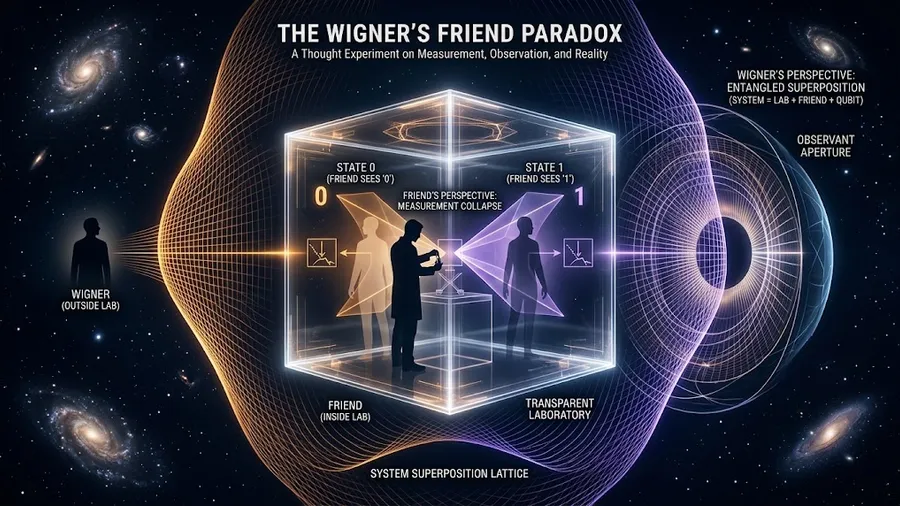
- Inside the Lab: A physicist (the “Friend”) is sealed inside a perfectly isolated laboratory equipped with a quantum particle whose spin is in an equal superposition of two states: spin-up and spin-down.
- The Measurement: The Friend measures the particle’s spin. According to standard quantum theory, the wave function collapses: the detector clicks, and the Friend records a definite result—for example, spin-up. From the Friend’s perspective, the measurement is complete, and the outcome is an established historical fact.
- Outside the Lab: Eugene Wigner stands outside the sealed room. Because the laboratory is isolated from all environmental interactions, Wigner does not see the result.
From Wigner’s perspective, the laws of linear quantum mechanics apply to the entire laboratory. Because no measurement has broken the room’s isolation, the laboratory, the detector, and the Friend have not collapsed.
Instead, they have entered an entangled quantum superposition:
- A state where the Friend saw spin-up and noted it in their journal.
- A simultaneous state where the Friend saw spin-down and noted it in their journal.
To the Friend inside, an objective reality crystallized the instant they made the measurement. To Wigner outside, that same measurement has not occurred—the Friend remains trapped in a macroscopic quantum blur.
The Interference Test
A skeptic might argue that Wigner simply lacks information: the measurement occurred inside, and Wigner is merely ignorant of the outcome.
Wigner anticipated this objection. In quantum mechanics, a true superposition is physically distinct from simple ignorance.
If Wigner is purely ignorant of the outcome (a classical mixture of probabilities), he can never reconstruct quantum interference. But because the laboratory is theoretically isolated, Wigner can perform a quantum interference measurement on the entire room.
If Wigner measures the interference pattern of the entire room, the mathematical outcome will confirm that the laboratory was in a coherent quantum superposition up until the exact moment Wigner intervened.
This creates an irreconcilable contradiction:
- If the Friend collapsed the wave function, quantum interference on the room should be impossible.
- If Wigner detects quantum interference, the Friend could not have collapsed the wave function into a single definite fact.
Did the measurement happen when the Friend looked, or when Wigner opened the door?
The Modern Escalation: The Frauchiger-Renner Theorem
For half a century, the Wigner’s Friend paradox was treated as a philosophical puzzle about the nature of consciousness in physics. That changed in 2018 when theoretical physicists Daniela Frauchiger and Renato Renner published a rigorous no-go theorem in Nature Communications.
Frauchiger and Renner expanded Wigner’s thought experiment by designing a multi-agent scenario involving two friends in separate isolated labs and two external observers. Using standard quantum information theory, they proved mathematically that three foundational assumptions of modern physics cannot simultaneously be true:
- Assumption Q (Universal Quantum Mechanics): Quantum theory applies universally to systems of any size, including measuring devices and human observers.
- Assumption C (Consistency): Different observers using the same theory must arrive at mutually compatible conclusions. If Observer A deduces that an outcome is definitely true, Observer B cannot deduce that it is impossible.
- Assumption S (Single Outcomes): Any individual measurement yields exactly one objective physical outcome.
The theorem proves that no interpretation of physics can preserve all three principles. If quantum mechanics is universal, then either physical reality is fundamentally inconsistent between observers, or single, objective outcomes do not exist.
What Does This Mean for Reality?
Physicists interpret the resolution of the paradox through different lenses, each demanding a radical departure from classical intuition:
- Relational Quantum Mechanics (RQM): Championed by Carlo Rovelli, this view argues that physical variables have no absolute values. An outcome is only real relative to a specific physical system. The particle is definitely spin-up relative to the Friend, but in superposition relative to Wigner. Facts are relational, not universal.
- Quantum Bayesianism (QBism): In QBism, a quantum wave function does not represent an external physical object, but an observer’s personal degree of belief. The Friend and Wigner use different wave functions because they possess different subjective experiences, resolving the contradiction by abandoning mind-independent quantum states.
- The Many-Worlds Interpretation: Hugh Everett’s framework preserves universal quantum mechanics by abandoning Assumption S. When the Friend makes the measurement, the universe branches. In one branch, the Friend observes spin-up; in the other branch, the Friend observes spin-down. Wigner simply describes the global wave function containing both branches.
- Objective Collapse Theories: Models such as Ghirardi-Rimini-Weber (GRW) postulate that wave functions collapse spontaneously when a system reaches a certain mass threshold, preventing macroscopic humans and laboratories from ever entering superpositions regardless of isolation.
Experimental Confirmation of “Observer Facts”
In 2019 and 2020, research teams at Heriot-Watt University and Griffith University built experimental realizations of the extended Wigner’s Friend paradox using entangled photons and optical circuits.
By treating individual photons as microscopic “observers” that record information into polarization states, the experiments verified that the correlations violated Bell-type inequalities constructed for observer-independent facts.
Within the experimental constraints, the data showed that nature cannot be described by a framework where all observers share a single, unified record of historical events.
The Death of the God’s-Eye View
The Wigner’s Friend paradox dismantles the classical dream of a “God’s-eye view” of the cosmos. For centuries, science operated under the premise that reality is an objective stage where every event is permanently recorded in a universal ledger.
Quantum mechanics reveals that nature may not possess a universal ledger. What has occurred in the history of the universe may depend fundamentally on who is asking the question, reminding us that an observer can never be completely separated from the reality they measure.