· physics · 5 min read
Quantum Darwinism: How the Classical World Emerges from Quantum Decoherence
The quantum realm permits particles to exist in multiple places simultaneously, yet our macroscopic world appears solid, definite, and objective. Quantum Darwinism explains how the environment selects which quantum states survive for observers to see.
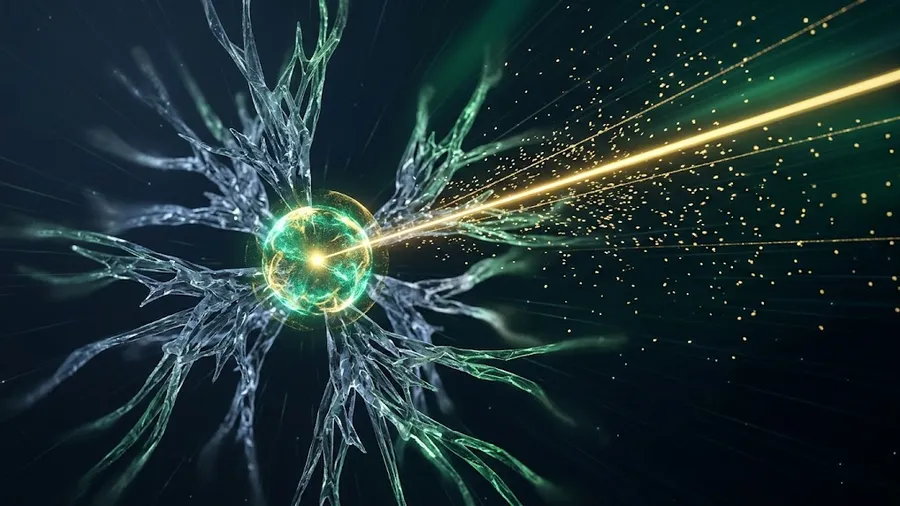
At the microscopic scale, nature obeys the strange laws of quantum mechanics. A single electron does not possess a definite position until it is measured; instead, it travels as a wave of probability amplitudes, existing in a simultaneous superposition of multiple spatial locations.
Yet, when we look at the macroscopic world around us, this ghostly indeterminacy vanishes entirely. Chairs, planets, and laboratory instruments never appear in two places at once. We do not experience Schrödinger’s cat trapped in a purgatory of being simultaneously alive and dead.
For nearly a century, this sharp contradiction was known as the Measurement Problem. The traditional Copenhagen interpretation simply declared that when an observer makes a measurement, the quantum wave function collapses instantly and mysteriously into a single classical outcome. But it never explained the physical mechanism behind this collapse.
In recent decades, theoretical physicist Wojciech Zurek at Los Alamos National Laboratory developed a revolutionary resolution: Quantum Darwinism.
The theory demonstrates that the classical world does not require a conscious observer or an ad-hoc wave function collapse. Instead, our objective everyday reality is naturally selected by the surrounding environment through a process analogous to biological evolution.
The Open System: Quantum Decoherence
In early formulations of quantum mechanics, physicists treated quantum experiments as closed, isolated systems. In reality, no macroscopic object is truly isolated.
Every physical object is permanently immersed in a relentless bath of environmental particles—such as cosmic microwave background photons, air molecules, and thermal vibrations.
In the late 20th century, physicists discovered the mechanism of quantum decoherence:
- When a quantum particle enters a superposition, it immediately collides with surrounding environmental particles.
- With every collision, the quantum phase information of the particle leaks into the wider environment.
- The superposition becomes quantum mechanically entangled with the immense number of degrees of freedom in the surroundings.
Decoherence explains why quantum superpositions vanish almost instantaneously in macroscopic objects: the environmental collisions occur on timescales faster than fractions of a femtosecond.
However, decoherence alone left a crucial question unanswered: why do we specifically observe definite positions and trajectories, rather than superpositions of different energy states or other quantum observables?
Natural Selection in the Quantum Arena
This is where Zurek introduced the evolutionary paradigm of Quantum Darwinism.
In standard quantum mechanics, an arbitrary quantum state can be constructed from an infinite variety of mathematical superpositions. But when an open quantum system interacts with its environment, not all states are treated equally:
- Fragile Superpositions: Delicate quantum overlaps are rapidly destroyed by environmental disruption within attoseconds. Zero copies survive.
- Pointer States: Certain privileged states possess an intrinsic resilience against environmental noise. They interact with passing photons or air molecules without having their own core properties scrambled.
Just as natural selection in biological evolution favors organisms that can withstand and reproduce in their environment, quantum environmental interactions naturally filter out fragile states and preserve only the fittest pointer states.
The environment does not merely scramble quantum information; it acts as a relentless communication channel and selective filter.
The Redundant Archive: Why Observers Agree
The most profound breakthrough of Quantum Darwinism lies in how observers access information about reality.
When you look at an object—such as a book resting on a table—your eyes do not interact directly with the book’s atoms. Instead, you intercept photons that bounced off the book.
- The passing photon bath acts as an environmental witness.
- Every time a photon scatters off the book, it records an imprint of the book’s pointer state, specifically its exact spatial position and shape.
- Trillions of photons scatter every microsecond, creating an astronomically large, redundant archive of copies of that single pointer state throughout the surrounding electromagnetic field.
Because millions of independent observers can intercept distinct fractions of this scattered photon bath, they all read the exact same information. Observer A and Observer B agree on where the book is located not because of a mysterious mental collapse, but because the environment has broadcast millions of identical copies of that specific classical state into the room.
The definition of an objective classical fact is simply a quantum state that has been copied redundantly enough times into the environment that multiple independent agents can observe it without disturbing it.
Experimental Validation: Watching Darwinism in the Lab
For many years, Quantum Darwinism remained an elegant mathematical framework. However, between 2019 and 2021, three independent research groups in Italy, Germany, and the United Kingdom confirmed its core predictions in laboratory experiments.
Using synthetic quantum environments:
- Researchers at the Italian National Institute of Optics used single photons scattering through polarization channels to simulate an environment.
- Other teams used nitrogen-vacancy centers in diamonds and nuclear magnetic resonance systems to track information flow.
In each experiment, physicists observed the exact signature predicted by Zurek: as observers sampled increasing fractions of the artificial environment, the retrieved information rapidly saturated at a fixed, classical value. The environment proved to be carrying redundant, identical copies of the quantum pointer state, validating that classical objectivity emerges directly from environmental entanglement.
The Death of the Measurement Myth
Quantum Darwinism dismantles one of the most stubborn misconceptions in modern science: the notion that consciousness is required to collapse the quantum wave function.
The universe does not wait for a human mind to observe it before snapping into classical solidity. Long before biological life emerged on Earth, the surrounding sea of ancient photons, interstellar gas, and gravitational radiation was already recording and selecting pointer states.
The environment has been acting as a cosmic photocopier since the first fraction of a second after the Big Bang.
The Reality Beneath the Copier
The enduring philosophical beauty of Quantum Darwinism is that it does not replace quantum mechanics with classical physics. At its fundamental core, the entire universe remains purely quantum, governed by linear wave mechanics and universal entanglement.
What we call the classical world is not a separate physical layer of nature. It is an information-theoretic optical effect—the small, resilient tip of a vast quantum iceberg, filtered through the lens of an environment that continuously broadcasts the states most equipped to survive.