· physics · 6 min read
Superfluid Helium: The Bizarre Quantum Liquid That Climbs Walls and Defies Gravity
Cooled to just two degrees above absolute zero, liquid helium undergoes a quantum transformation—losing all viscosity, creeping effortlessly up glass walls, and flowing forever without friction.
Every familiar fluid in nature—from water and olive oil to honey and molten lava—possesses viscosity, a measure of internal friction that resists flow. If you stir a cup of coffee and remove the spoon, viscosity gradually slows the swirling liquid down until it comes to a complete rest.
Helium, the second lightest element in the universe, plays by entirely different rules.
Unlike every other substance on the periodic table, helium refuses to freeze into a solid at normal atmospheric pressure, even when cooled all the way down toward absolute zero ($-273.15^\circ\text{C}$). Its atoms are so light and interact so weakly that their residual quantum zero-point jiggling prevents them from locking into a rigid crystal lattice.
Instead, when liquid helium-4 is cooled below a critical threshold of 2.17 Kelvin (roughly $-271^\circ\text{C}$), it undergoes one of the most dramatic phase transitions in physics—transforming into Helium II, a frictionless quantum state of matter known as a superfluid.
The Lambda Point: Sudden Stillness in the Cold
In late 1937, Soviet physicist Pyotr Kapitsa in Moscow and researchers John Allen and Don Misener in Cambridge independently noticed something startling while chilling liquid helium inside glass cryogenic flasks.
Above 2.17 Kelvin (known as the Lambda point because the graph of its specific heat capacity spikes into the shape of the Greek letter $\lambda$), liquid helium boils violently like water on a stove, churning with rising bubbles of gas.
The instant the temperature crosses 2.17 Kelvin:
- All bubbling stops abruptly.
- The turbulent liquid turns completely still, crystal clear, and eerily tranquil.
- Rather than boiling inside the bulk liquid, evaporation occurs quietly and exclusively from the flat top surface.
This sudden stillness occurs because superfluid helium conducts heat roughly a thousand times more efficiently than copper—so rapidly that localized hot spots cannot form anywhere inside the fluid to create bubbles.
Zero Viscosity and the Wall-Climbing Rollin Film
Once helium crosses into its superfluid state, its internal friction drops to absolute zero. This complete absence of viscosity unlocks physical behaviors that appear to violate everyday gravity and fluid mechanics:
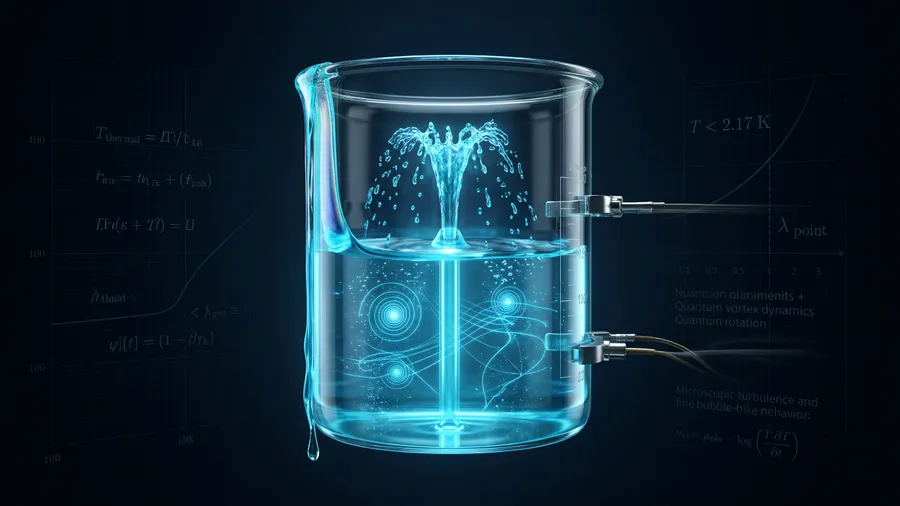
- Escaping Sealed Containers: If you pour superfluid helium into an open glass beaker suspended above a bath, a microscopic liquid layer just 30 nanometers thick—known as a Rollin film—crawls straight up the inner walls of the glass, over the top rim, and down the outside, dripping off the bottom until the beaker empties itself completely.
- Passing Through Atomic Cracks: A container capable of holding ordinary gas under high pressure will leak superfluid helium effortlessly. Because it has zero viscosity, the fluid slips through microscopic pores less than a billionth of a meter wide—a phenomenon known as a superleak.
- Perpetual Swirling: If you set a ring of superfluid helium spinning inside a closed loop, it will continue circulating indefinitely without ever slowing down, exhibiting frictionless perpetual motion on a macroscopic scale.
The Thermomechanical Fountain Effect
Superfluid helium also exhibits an extraordinary link between heat and mechanical motion known as the fountain effect.
Suppose you take a glass tube packed tightly at the bottom with fine emery powder—creating channels too narrow for ordinary viscous fluid to pass through, yet wide enough for frictionless superfluid atoms—and submerge the lower end in a bath of superfluid helium.
When you shine a beam of warm light onto the top of the powder inside the tube:
- The gentle warmth converts a fraction of the superfluid into normal fluid, lowering the local concentration of superfluid atoms inside the tube.
- To restore equilibrium, pure superfluid rushes upward through the microscopic powder pores from the surrounding bath.
- The surging liquid shoots out of the top nozzle of the tube in a continuous, shimmering cryogenic fountain rising tens of centimeters into the air—powered solely by a tiny pulse of heat.
In a superfluid, heat does not spread slowly through diffusion as it does in a metal rod; instead, temperature pulses propagate through the liquid as coherent waves—a phenomenon physicists call second sound.
Macroscopic Quantum Mechanics
How can a liquid visible to the naked eye behave without friction? The answer lies in quantum statistics.
Elementary particles and atoms fall into two fundamental quantum families: fermions (such as electrons, protons, and neutrons, which strictly refuse to occupy the exact same quantum state) and bosons (particles with integer spin that eagerly crowd together into identical quantum states).
Because a helium-4 atom contains two protons, two neutrons, and two electrons—an even number of fermions—its spins cancel out, making the entire atom behave as a composite boson.
When cooled below 2.17 Kelvin, billions upon billions of individual helium-4 atoms undergo a phenomenon closely related to Bose-Einstein condensation:
- The quantum de Broglie wavelengths of neighboring atoms expand until they overlap.
- Instead of acting like independent billiard balls colliding randomly, all the superfluid atoms lock together into a single, unified macroscopic quantum wave function.
- Because every atom moves in lockstep as one giant quantum entity, individual atoms cannot scatter off container walls or collide with one another to dissipate energy. To slow the fluid down, an obstacle would have to alter the quantum state of the entire liquid simultaneously—making ordinary friction impossible.
Even when rotated inside a bucket, a superfluid refuses to spin like an ordinary liquid; instead, it forms a geometric lattice of microscopic, quantized vortices—tiny whirlpools whose rotational speeds are restricted to exact integer multiples of Planck’s constant.
Superfluids Inside Dead Stars
While physicists must build elaborate cryogenic refrigerators to create superfluid helium on Earth, nature manufactures superfluids on an astronomical scale inside neutron stars.
Deep beneath the solid iron crust of a neutron star, neutrons are crushed together at densities exceeding an atomic nucleus. Despite temperatures reaching millions of degrees, the extreme density forces neutrons to pair up into bosons—turning the star’s interior into a colossal neutron superfluid.
As a spinning pulsar gradually loses rotational energy and slows down, its outer crust decelerates while its frictionless superfluid interior continues spinning at its old speed. Periodically, quantized vortices inside the superfluid unpin and transfer angular momentum violently outward to the crust—causing astronomers on Earth to observe sudden, mysterious spin-ups known as pulsar glitches.
From a glass beaker in a terrestrial laboratory to the heart of a collapsed star, superfluidity reveals what happens when the elusive rules of the quantum realm step out into the macroscopic world—turning fluid motion into a frictionless symphony governed by a single quantum wave.