· physics · 6 min read
Sonoluminescence: How Sound Waves Crush Tiny Bubbles Into Miniature Stars
Bombard a microscopic gas bubble in water with high-frequency sound waves, and it implodes so violently that its core reaches tens of thousands of degrees—emitting an eerie flash of light known as 'a star in a jar.'
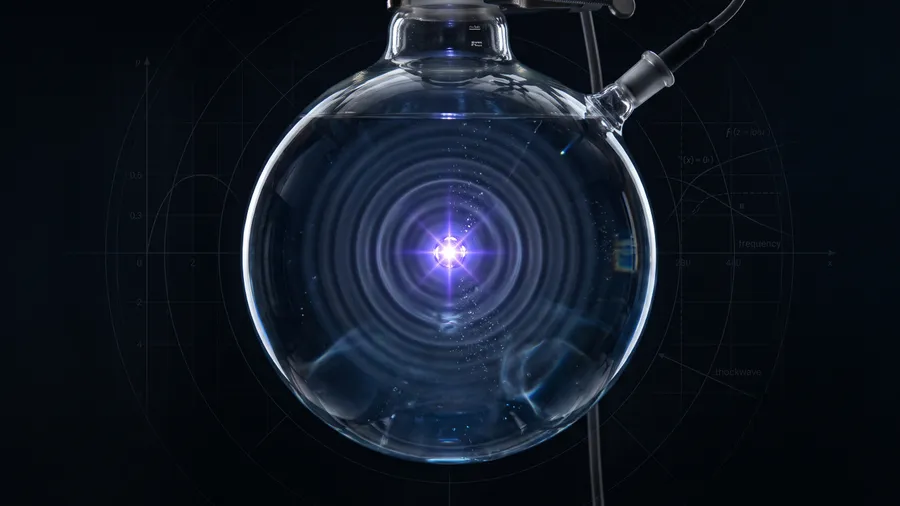
In 1934, two German physicists at the University of Cologne, Hermann Frenzel and H. Schultes, were testing high-powered ultrasonic transducers in a tank of photographic developer fluid as part of early marine sonar research. When they turned the sound waves up, they noticed something bizarre in the darkened laboratory: tiny, faint glimmers of bluish light were flickering inside the liquid.
They had stumbled upon sonoluminescence—the extraordinary physical phenomenon in which sound energy passing through a liquid is converted directly into flashes of visible light.
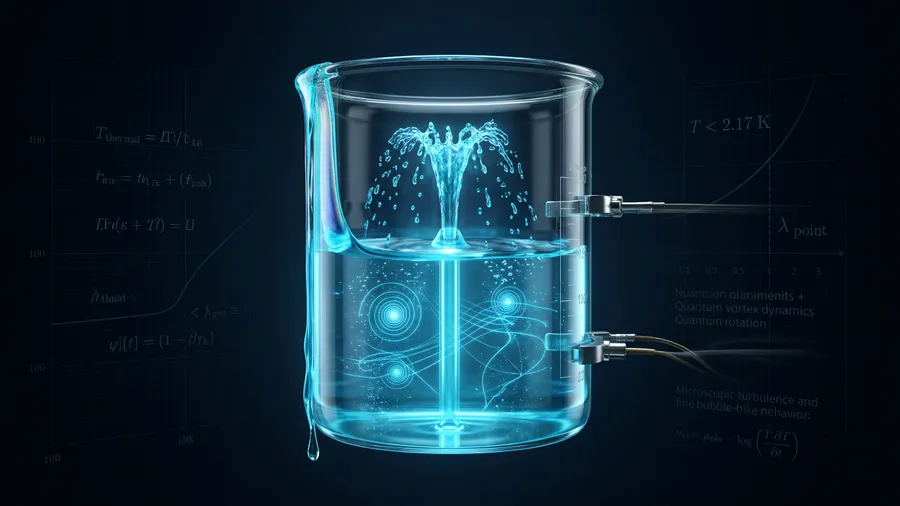
For more than fifty years, sonoluminescence remained an elusive curiosity, producing only chaotic, unpredictable clouds of short-lived sparks. Then, in 1989, physicists Felipe Gaitan and Lawrence Crum achieved a dramatic breakthrough: they tuned the acoustic standing waves inside a spherical glass flask so precisely that they trapped one single microscopic gas bubble suspended motionless in the center of the water.
When they dimmed the room lights, a steady, eerie blue pinprick of light hovered in the middle of the water—a phenomenon physicists immediately nicknamed “a star in a jar.”
The Mechanics of a Supersonic Implosion
To the naked eye, the glowing dot inside a sonoluminescence chamber looks like a continuous, tranquil star. In reality, it is a violent, rhythmic strobe flashing 20,000 to 40,000 times per second in lockstep with the frequency of the ultrasonic wave.
Every single acoustic cycle drives a microscopic bubble—initially just 5 micrometers across, smaller than a human red blood cell—through an extreme physical ordeal:
- Acoustic Expansion: As the low-pressure trough of the sound wave passes over the trapped bubble, the surrounding water pulls outward, causing the bubble to balloon rapidly to roughly ten times its original radius (around 50 micrometers).
- Catastrophic Collapse: Half a cycle later, the high-pressure crest of the sound wave slams into the expanded bubble. Because the gas inside is nearly a vacuum after expanding, the surrounding water rushes inward with crushing momentum—accelerating past the speed of sound inside the gas.
- Adiabatic Flash: Within less than a nanosecond, the bubble is compressed back down to a fraction of a micrometer. Because the implosion happens far too quickly for heat to escape into the surrounding water, the trapped gas undergoes extreme adiabatic heating.
- Rebound: Instantly after releasing a blinding, picosecond pulse of ultraviolet and blue light, the compressed gas rebounds outward, ringing like a microscopic bell before the next sound wave arrives to repeat the cycle.
Through this acoustic focusing, the energy density inside the collapsing bubble is amplified by more than twelve orders of magnitude—concentrating diffuse, gentle sound waves into a microscopic furnace hotter than the surface of the Sun.
Inside the Plasma Core
Measuring what happens inside a collapsing sphere smaller than a wavelength of light during a flash lasting less than 100 picoseconds pushed experimental physics to its absolute limits.
For years, researchers debated whether the light came from friction, quantum vacuum radiation, or simple blackbody heat. The definitive answer arrived in 2005, when chemists David Flannigan and Kenneth Suslick at the University of Illinois studied single-bubble sonoluminescence inside concentrated sulfuric acid, which allows bubbles to grow larger and shine brighter than in water.
By analyzing the light spectrum emitted by the collapsing bubble, they detected distinct spectral emission lines from highly ionized oxygen and argon atoms—states of matter that cannot form through ordinary chemical reactions.
The core of the bubble was not merely hot gas; the acoustic shockwave had stripped electrons free from their atomic nuclei, creating a dense, fleeting ball of ionized plasma reaching temperatures between 10,000 and 20,000 Kelvin—nearly three times hotter than the Sun’s 5,800-Kelvin photosphere.
The Argon Mystery: Why Air Glows
One of the most puzzling discoveries in early single-bubble experiments involved the chemistry of the gas inside the bubble.
When physicists injected bubbles of ordinary room air into degassed water, the trapped bubble glowed brightly. Naturally, they assumed the glow came from nitrogen or oxygen—the two gases that make up 99 percent of Earth’s atmosphere. Yet, when they tested bubbles made of pure nitrogen or pure oxygen, the light almost vanished.
The secret turned out to lie in the remaining one percent of air: argon.
- During the extreme 15,000-Kelvin implosion, reactive diatomic molecules like nitrogen ($N_2$) and oxygen ($O_2$) are ripped apart into individual atoms, which immediately react with water vapor to form nitric acid and nitrous oxide that dissolve out of the bubble into the surrounding liquid.
- After a few hundred acoustic cycles, the collapsing bubble acts like a microscopic chemical rectifier—purging all reactive gases and leaving behind a concentrated core of pure, chemically inert noble gas (such as argon, xenon, or helium).
- Because noble gas atoms cannot break apart or undergo chemical reactions to absorb the incoming shockwave, they have no choice but to channel 100 percent of the compressive thermal energy into kinetic heat, ionization, and photons of light.
Nature’s Acoustic Weapon: The Pistol Shrimp
Long before physicists built ultrasonic flasks in laboratories, marine evolution harnessed the exact same physics on the ocean floor.
The snapping shrimp (family Alpheidae) possesses one oversized claw that snaps shut with extraordinary speed—shooting a high-velocity water jet that drops local water pressure so drastically that a cavitation bubble forms and violently implodes.
In 2001, researchers using high-speed cameras and photomultiplier tubes confirmed that the collapsing cavitation bubble generated by a snapping shrimp emits a genuine flash of shrimpoluminescence, accompanied by a shockwave loud enough to stun nearby prey and temperatures momentarily rivaling the Sun.
The Frontier of Extreme Energy Density
In the early 2000s, sonoluminescence sparked fierce scientific controversy when researchers speculated that imploding bubbles in deuterated acetone might reach millions of degrees—hot enough to trigger tabletop nuclear fusion. While subsequent experiments ruled out nuclear fusion at standard acoustic pressures, the phenomenon remains one of the most accessible laboratories on Earth for studying extreme states of matter.
Today, physicists use acoustic cavitation to synthesize exotic nanomaterials, drive chemical reactions without toxic solvents (a field known as sonochemistry), and test equations of state for dense plasmas that otherwise exist only inside exploding stars or inertial confinement laser facilities.
A simple glass jar of water and an invisible wave of sound remain a powerful reminder of how deeply nonlinear physics can amplify energy—turning gentle acoustic vibrations into a fleeting, incandescent star suspended in water.