· physics · 4 min read
The Watched Atom Never Decays: How Observation Freezes Quantum Reality
Ancient Greek philosopher Zeno argued that motion was an illusion. In 1977, quantum physicists proved something even stranger: measuring an unstable subatomic particle continuously stops time itself.
The Arrow Frozen in Mid-Air
In the fifth century BCE, Greek philosopher Zeno of Elea proposed an infuriating logical riddle: The Arrow Paradox.
Zeno argued that for an arrow to fly through the air, it must occupy a single, definite position in space at every individual instant of time. But if it is stationary at every single freeze-frame, when does motion actually occur? To Zeno, physical change was an illusion.
Classical physics easily disassembled Zeno’s thought experiment using Newtonian calculus. But in the quantum realm, Zeno got the last laugh.
In 1954, British mathematician and computing pioneer Alan Turing noticed a disturbing quirk in the Schrödinger equation: if an unstable, decaying quantum particle is observed continuously, it will never decay.
Two decades later, in 1977, physicists Baidyanath Misra and George Sudarshan published the rigorous mathematical framework, christening it The Quantum Zeno Effect (or Turing’s Paradox).
In the subatomic world, the watched pot truly never boils.
The Mathematics of Quantum Stasis
Under standard quantum mechanics, an atom transitions from one energy state to another via the continuous evolution of its wave function (Ψ).
Common intuition suggests that radioactive decay proceeds linearly over tiny intervals. But quantum mechanics dictates that at vanishingly short timescales, the probability of transition (P) is quadratic, not linear:
P(t) ≈ (t / τ)²
Where:
- t is the duration of time elapsed.
- τ (tau) is the characteristic Zeno timescale of the quantum transition.
Notice the power of two: because t is squared, when the time interval t is extremely small (for instance, 0.001 seconds), the probability of decay collapses to a microscopic fraction of that time (0.000001).
Here is where the Measurement Problem enters the equation:
- Every time a measurement occurs, the continuous Schrödinger evolution is interrupted. The wave function collapses back into an eigenstate—resetting the decay clock to absolute zero (t = 0).
- If you divide an interval of time T into N rapid, consecutive measurements, the overall survival probability (P_survival) becomes:
P_(survival) = [ 1 − (T / N · τ)² ]ᴺ
As the frequency of observation approaches infinity (N → ∞), the probability of the atom decaying drops to zero:
P_(survival) → 1 as N → ∞
By interrogating the atom repeatedly, you trap it in its ground state. The physical transition is mechanically paralyzed.
The 1989 NIST Breakthrough
For years, many theorists dismissed the Zeno effect as an unphysical artifact of ideal mathematical operators. That changed in 1989 at the National Institute of Standards and Technology (NIST) in Colorado.
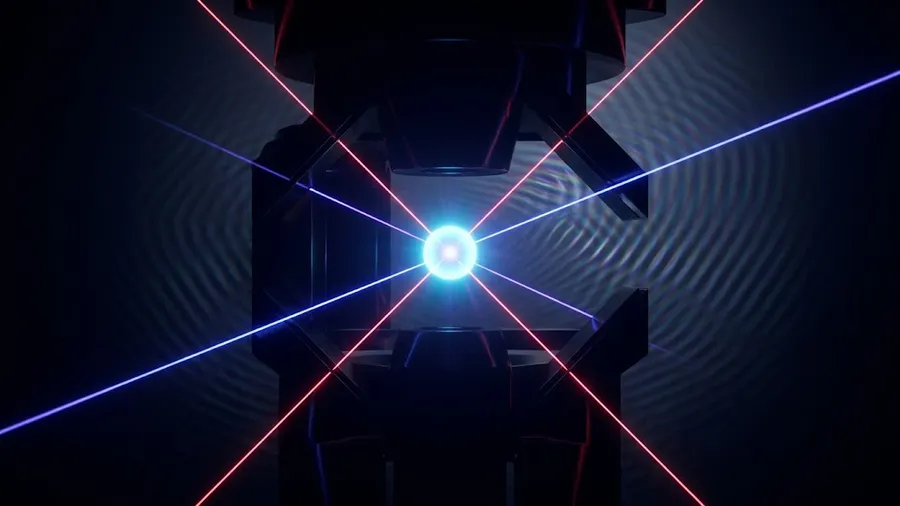
A team led by David Wineland and Wayne Itano trapped approximately 5,000 positively charged Beryllium-9 ions inside a cylindrical radio-frequency electromagnetic trap:
- The ions were stimulated by a radio-frequency field designed to smoothly drive them from ground state to an excited state over an interval of 256 milliseconds.
- Left unobserved, 100% of the ions transitioned to the higher state.
- The researchers then fired rapid, ultra-short optical laser pulses to “probe” the ions while they were trying to climb into the excited state.
When the team pulsed the ions with 64 measurements during that 256-millisecond window, the transition rate plummeted.
When they blasted the ions with 512 rapid laser pulses, almost none of the ions transitioned. The beryllium ions remained locked in their initial state. The act of measuring the ions had physically prevented nature from evolving.
The Anti-Zeno Reversal
The quantum knife cuts both ways. Subsequent investigations revealed that the Zeno effect has an equally bizarre sibling: The Anti-Zeno Effect.
If the energy levels of the environment are structured differently, or if measurements are spaced with specific delays, repeated observation can distort the wave function in the opposite direction.
Instead of freezing the system, frequent measurements can exponentially accelerate quantum transitions, forcing particles to decay thousands of times faster than their natural half-life.
Trapping Fragile Superpositions
Far from being an academic curiosity, the Quantum Zeno Effect has emerged as a cornerstone of next-generation quantum computing:
- Quantum bits (qubits) are notoriously fragile. Environmental thermal vibrations and stray magnetic fields cause decoherence—collapsing delicate superpositions before computations finish.
- Modern quantum error-correction algorithms exploit the Zeno effect by performing continuous, non-destructive parity checks on clusters of entangled qubits.
By measuring the error signatures without reading the underlying calculation data, engineers effectively freeze the quantum state in place, shielding the computational circuit from thermal decay.
Observation in quantum physics is not a passive spectator sport. To measure a system is to physically intervene in its reality—proving that the boundary between an observer and the physical universe is an illusion.