· physics · 3 min read
The Ghost Particles Defying Geometry: Why Cosmic Muons Hit Earth
A subatomic muon's lifespan is only 2.2 microseconds. Even moving at 99.8% the speed of light, it should decay high above the clouds. The reason it reaches sea level proves that space and time bend.
The Impossible Journey
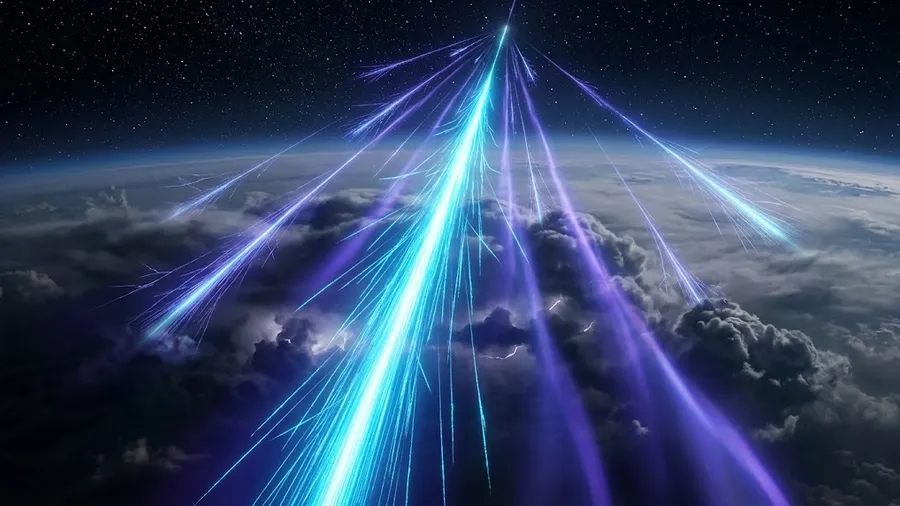
Roughly 15 kilometers above your head, high-energy cosmic protons from deep space collide violently with nitrogen and oxygen atoms in the upper stratosphere. These catastrophic subatomic impacts shatter atmospheric nuclei, spawning showers of unstable, heavy elementary particles known as muons.
A muon is essentially a heavy, unstable cousin of the electron. It is born with an inherent biological clock: an average resting lifespan of just 2.2 microseconds (2.2 × 10⁻⁶ seconds) before it decays into an electron and a pair of neutrinos.
Even if a muon descends toward the planet at blistering relativistic speeds—roughly 99.8% of the speed of light (0.998c)—simple classical distance arithmetic reveals an insurmountable problem:
d = v · t = (299,192 km/s) · (0.0000022 s) ≈ 660 meters
Before an average muon can travel even a single kilometer, its internal lifespan expires. It should vanish into background radiation while still miles above commercial airliner cruising altitudes. By all laws of classical Newtonian physics, zero muons should reach the surface of our planet.
Yet right now, as you read this sentence, roughly one cosmic muon is passing through your skull every second.
The Sea-Level Anomaly
In 1940, physicists Bruno Rossi and David Hall placed particle detectors at the top of Mount Washington in New Hampshire (1,900 meters elevation) and at sea level. If muons decayed strictly according to Newtonian mechanics, ground-level detectors should have registered virtually nothing.
Instead, they detected tens of thousands of them.
The universe was not breaking the speed of light to deliver these particles to Earth. It was bending the fabric of space and time.
Perspective 1: The Earth Observer (Time Dilation)
From our reference frame stationed on the surface of the planet, the muon is hurtling downward at 99.8% the speed of light. Because of this extreme velocity, Einstein’s Lorentz factor (γ) stretches the particle’s passage through time:
γ = 1 / √(1 − v² / c²)
At v = 0.998c, the Lorentz factor scales to roughly 15.8.
To an observer on the ground, the muon’s moving clock does not tick at ordinary speed. It slows down by a factor of 15.8. Its effective lifespan dilates:
t’ = γ · t₀ = 15.8 · 2.2 μs ≈ 34.8 microseconds
In 34.8 microseconds, a particle moving at near-light speed covers over 10.4 kilometers—more than enough distance for vast swaths of the muon population to survive atmospheric transit and slam into detectors at sea level.
Perspective 2: The Muon (Length Contraction)
Now invert the reference frame. How does the journey look from the perspective of the muon itself?
In its own rest frame, the muon’s internal clock does not dilate. Its lifespan remains strictly 2.2 microseconds.
However, from the muon’s vantage point, it is not moving downward; Earth’s surface and the entire 15-kilometer column of atmosphere are rushing upward toward it at 0.998c.
Special Relativity dictates that moving lengths contract along the line of motion:
L = L₀ / γ
To the muon, the entire 15,000-meter atmosphere is squashed flat by a factor of 15.8:
L = 15,000 m / 15.8 ≈ 949 meters
The distance between the upper stratosphere and Earth’s crust is no longer 15 kilometers; it has physically shrunk to under a single kilometer. The muon easily crosses this compressed space within its fleeting 2.2-microsecond existence.
Two Faces of the Same Metric
Whether you calculate the journey as time stretching out from the ground, or space physically shrinking from the particle’s point of view, both frames arrive at the exact same physical reality: the muon strikes the Earth.
Cosmic muons are not abstract theoretical constructs confined to chalkboard diagrams. They are tangible physical proof raining down around us every second—proving that time is not universal, distance is not absolute, and geometry bends to accommodate velocity.