· physics · 5 min read
Breaking the Speed of Light: The Geometry of Cherenkov Radiation
Einstein proved that nothing can exceed the speed of light in a vacuum. Yet inside nuclear reactor pools, subatomic particles routinely outrun photons, igniting an eerie sapphire shockwave of light.
The Speed Limit With an Asterisk
In 1905, Albert Einstein cemented the foundational speed limit of the universe in his theory of Special Relativity: no physical object possessing mass can accelerate to or exceed the cosmic speed of light, symbolized by c (299,792,458 meters per second).
There is, however, an essential physical caveat: c represents the speed of light strictly in a total vacuum.
When electromagnetic radiation enters a transparent dielectric medium—such as water, quartz, or heavy water—photons constantly interact with the electron clouds of surrounding atoms. This continuous absorption, phase delay, and re-emission slows the macroscopic propagation of the wave front down to a phase velocity (v_p):
v_p = c / n
Where:
- c is the cosmic speed of light in a vacuum.
- n is the refractive index of the medium.
In pure water, the refractive index is roughly 1.333. Divide c by 1.333, and the speed of light inside a swimming pool drops to approximately 224,900 kilometers per second—slashing its velocity by roughly 25%.
While photons are hobbled by the dense matrix of water molecules, high-energy beta particles (electrons) shot out by decaying nuclear fission products careen through the water at 99% of c (over 296,000 km/s).
Under these conditions, nature permits an astonishing reversal: the electron is physically traveling faster than light itself.
The Optical Sonic Boom
When a supersonic fighter jet slices through the atmosphere faster than the local speed of sound (Mach 1), acoustic pressure waves cannot propagate forward fast enough to get out of the aircraft’s path. The sound waves pile up, compress into a conical boundary, and detonate as an acoustic sonic boom.
Cherenkov radiation is the exact electrodynamic equivalent of a sonic boom, rendered in visible photons.
As an electrically charged particle hurtles through water at subluminal speeds, its negative charge polarizes the surrounding water molecules, briefly shifting their electron shells. As the particle passes, the molecules snap back into equilibrium, emitting faint electromagnetic ripples. At ordinary speeds, these ripples radiate outward symmetrically and destructively interfere, canceling each other out into invisibility.
When the electron tears through the liquid faster than the phase velocity of light, the electromagnetic wake is left trailing behind:
- The wavefronts emitted along the electron’s path cannot race ahead of the particle.
- Instead of destructive cancellation, the electromagnetic waves constructively pile up along a coherent wavefront.
- They form a razor-sharp shock cone of pure, concentrated light.
The Frank-Tamm Geometry
In 1934, Soviet physicist Pavel Cherenkov observed this faint glow in irradiated liquid solutions. Three years later, theorists Ilya Frank and Igor Tamm formulated the underlying classical electrodynamics, earning them the 1958 Nobel Prize in Physics.
Frank and Tamm derived the exact half-angle (θ) of the emitted Cherenkov light cone:
cos θ = 1 / (β · n) = c / (v · n)
Where:
- θ (theta) is the emission angle relative to the particle’s trajectory.
- β (beta) is the normalized velocity ratio of the particle (v / c).
- n is the refractive index of the medium.
Notice the mathematical constraint: because the cosine of an angle cannot exceed 1, emission can occur only when:
β · n ≥ 1 ⇒ v ≥ c / n
If the particle slows down below the local speed of light, β · n drops below unity, the cosine boundary shatters, and the radiation vanishes instantly.
Why the Deep Blue Glow?
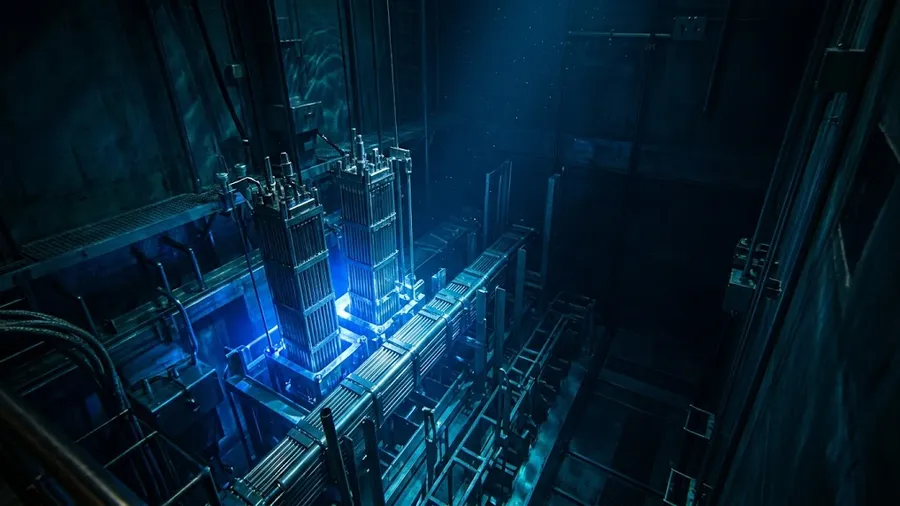
Anyone who has looked at archival photographs of a submerged TRIGA research reactor or spent fuel cooling pond will recognize the signature aesthetic of Cherenkov radiation: an ethereal, luminescent deep sapphire cyan.
The color is not an aesthetic accident; it is written directly into the Frank-Tamm Energy Distribution Formula.
The formula dictates that the energy radiated per unit path length (dW / dx) is directly proportional to the electromagnetic frequency (ω):
dW / dx ∝ ω
Higher frequencies radiate with drastically greater intensity than lower frequencies.
Cherenkov radiation does not peak in the red or green wavelengths. The vast majority of its photons are blasted out at extreme high frequencies—peaking deep within the invisible ultraviolet spectrum.
Because the human retina cannot register ultraviolet light, our photoreceptor cone cells register the highest visible tail of the spectrum: electric cobalt blue and violet.
Tracking the Ghosts of the Universe
Far from being merely an eerie glow at the bottom of nuclear cooling ponds, Cherenkov radiation is one of modern astrophysics’ most sensitive sensory organs:
- Neutrino Observatories: Deep beneath Mount Ikeno in Japan sits Super-Kamiokande, an immense subterranean tank filled with 50,000 metric tons of ultra-pure water lined with 11,000 photomultiplier sensors. When elusive cosmic neutrinos collide with water nuclei, they eject relativistic electrons or muons. The resulting cones of Cherenkov light reveal the neutrino’s arrival angle and energy with pinpoint precision.
- IceCube at the South Pole: A cubic kilometer of Antarctic glacial ice is weaponized into a Cherenkov detector, tracking subatomic tracks etched into the frozen continent by deep-space extragalactic events.
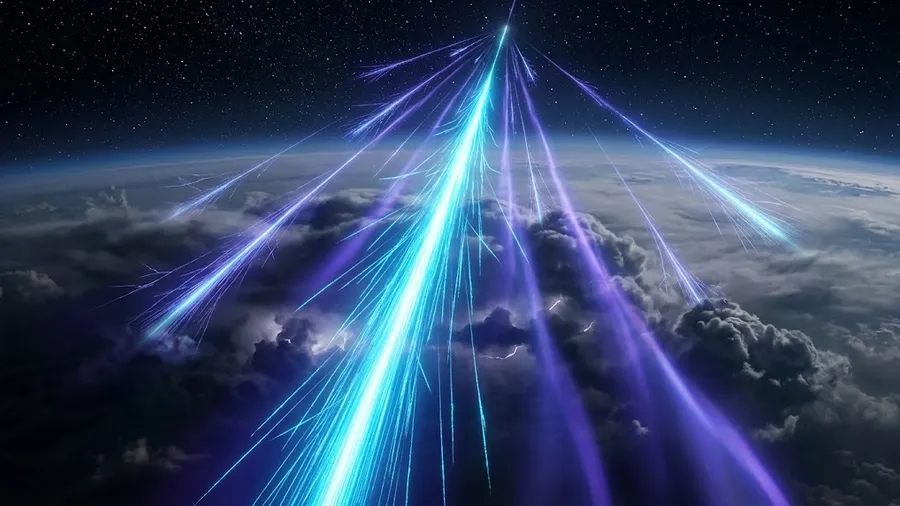
- Atmospheric Air Showers: When ultra-high-energy gamma rays from distant blazars hit Earth’s stratosphere, they create cascading showers of secondary particles that exceed the local speed of light in air (n ≈ 1.00029), casting brief, nanosecond-long flashes of blue Cherenkov glow across the night sky.
The cosmic speed limit of the universe remains undefeated in the vacuum of space. But in the crowded corridors of transparent matter, physics leaves a loop hole—transforming superluminal motion into an electric blue monument to wave mechanics.