· physics · 3 min read
The Universe Is Not Locally Real: How Quantum Mechanics Broke Classical Physics
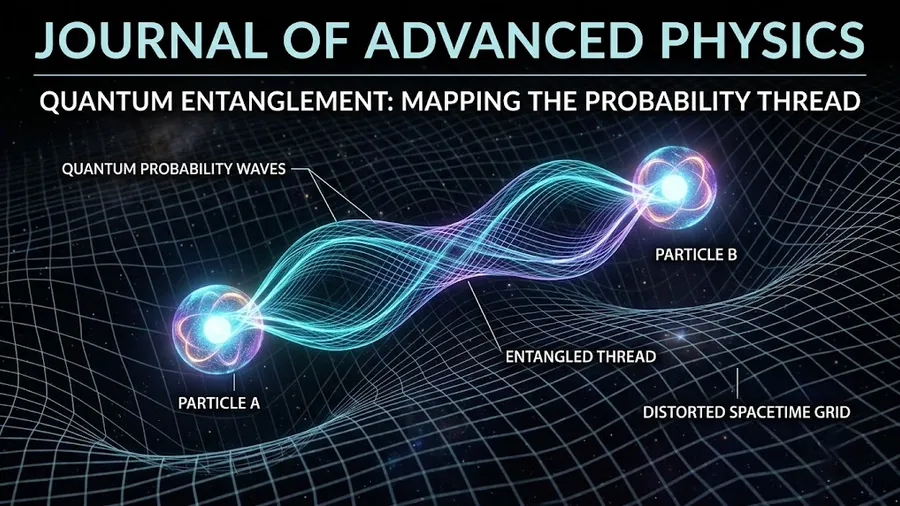
Einstein famously dismissed entanglement as 'spooky action at a distance.' Decades of Bell test experiments proved an even stranger reality: physical reality does not exist in definite states until observed.
Einstein’s Unease With Reality
In 1935, Albert Einstein, along with Boris Podolsky and Nathan Rosen, published what became known as the EPR Paradox. Einstein believed that standard quantum mechanics was incomplete.
His objection rested on two seemingly unshakable pillars of classical science:
- Realism: Objects possess definite properties (such as position, mass, and spin) independent of whether an observer measures them.
- Locality: An event occurring at point A cannot instantaneously influence an event at point B faster than the cosmic speed of light (c).
Quantum theory predicted that two entangled particles, once separated across light-years, would instantly coordinate their quantum states upon measurement. Einstein rejected this implication, dryly labeling it “spukhafte Fernwirkung” (spooky action at a distance). He insisted that particles must carry “hidden variables”—secret pre-programmed parameters established when the pair formed.
For three decades, this dispute remained an untestable philosophical deadlock.
John Bell’s Mathematical Knife
In 1964, Northern Irish theorist John Stewart Bell shattered the deadlock by translating the philosophical argument into an experimentally testable inequality.
Bell proved that if the universe operates under classical Local Realism (local hidden variables), the correlation between measurements of entangled pairs across different detector angles cannot exceed a strict mathematical ceiling:
|E(a, b) − E(a, b’) + E(a’, b) + E(a’, b’)| ≤ 2
This is the Clauser-Horne-Shimony-Holt (CHSH) formulation of Bell’s Inequality.
However, if standard quantum mechanics is true, entangled particles can violate this boundary, reaching a maximum theoretical correlation of:
2√2 ≈ 2.828
Known as Tsirelson’s Bound, this mathematical threshold meant physicists no longer had to debate metaphysics. They could build detectors, count photons, and let physical nature deliver the verdict.
Closing the Loopholes
Over the following half-century, teams led by John Clauser, Alain Aspect, and Anton Zeilinger designed increasingly rigorous optical experiments. They fired pairs of polarization-entangled photons in opposite directions across kilometers:
- Detectors switched their measurement orientations randomly while the photons were already in flight, eliminating any possibility of sub-light communication between devices.
- High-efficiency detectors closed the “detection loophole,” ensuring that unmeasured particles were not skewing the statistical outcome.
The experimental outcome was unequivocal: Bell’s inequality was violated by dozens of standard deviations. The experimental correlation matched 2√2 with breathtaking precision. The work was formally awarded the Nobel Prize in Physics in 2022.
The Death of Local Realism
The experimental proof against Bell’s inequality forces modern physics into an inescapable conclusion: The universe is not locally real.
To preserve modern physical models, you must sacrifice one of Einstein’s two foundational assumptions:
- Abandon Locality: Accept that measuring a particle in a lab on Earth instantly collapses the wave function of its entangled partner on the other side of the Andromeda galaxy, without any signal traversing the intervening space.
- Abandon Realism: Accept that physical properties do not exist prior to observation. A photon does not “have” a polarization until a detector forces nature to roll the cosmic dice.
The particles of the cosmos are not tiny, autonomous billiard balls bouncing through absolute space and time. They are manifestations of an interconnected quantum field where reality is negotiated only at the moment of measurement.