· physics · 2 min read
The Physics Lie in Every Textbook: How Airplanes Actually Fly
Most school science books explain flight using Bernoulli's principle and the 'equal transit time' theory. Aerodynamic engineers know that theory is dead wrong.
The Classroom Myth
Ask almost anyone how an airplane wing generates lift, and they will recite the standard classroom doctrine:
“The top of the wing is curved, while the bottom is flat. Air rushing over the curved top must travel farther than air underneath. To meet at the trailing edge at the exact same time, the top air travels faster, creating lower pressure above the wing, lifting the plane into the sky.”
This is commonly taught as Bernoulli’s Principle of Lift. It sounds elegant, logical, and intuitive.
There is only one issue: it is fundamentally false.
Why the Textbook Explanation Fails
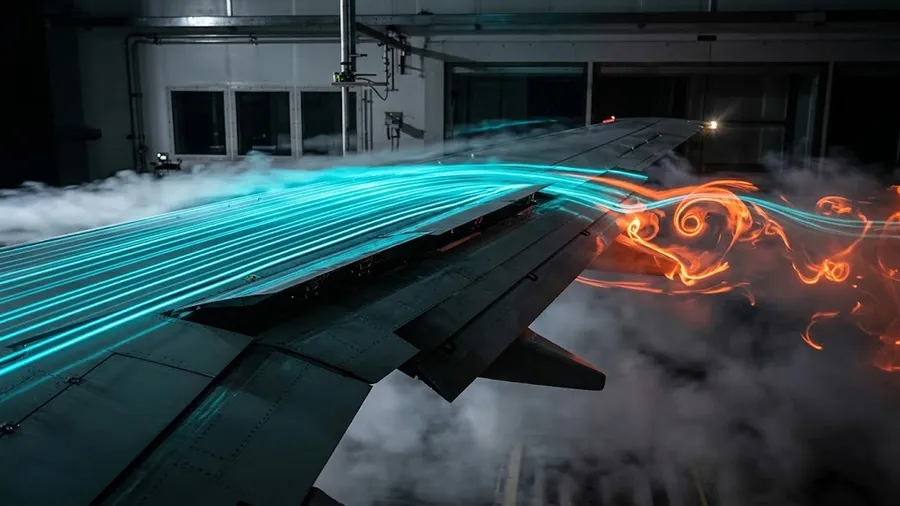
The “Equal Transit Time” assumption has no basis in physical law. In wind tunnel tests conducted with pulsed smoke lines, the parcel of air traveling over the top of a wing does not arrive at the back at the same time as the parcel underneath.
In fact, the air moving across the curved upper surface travels vastly faster than equal transit time predicts—it reaches the back edge long before the under-wing air gets halfway.
Furthermore, if the curved-top explanation were true:
- Airplanes could never fly upside down (yet aerobatic pilots do so routinely).
- Paper airplanes—which use completely flat, non-curved wings—would be physically incapable of flight.
The Real Physics: Newton Meets Coanda
Generating lift requires a brutal application of Newton’s Third Law of Motion: to push a 400-ton Boeing 777 into the sky, the wing must force a monumental mass of air downward every single second.
This downwash is achieved through a combination of the angle of attack and the Coandă Effect—the physical tendency of a fluid jet to stay attached to a convex surface.
As air flows over the curved camber of the wing, viscous forces pull the airflow down along the rear slope. Because hundreds of tons of air are deflected downward with immense velocity, the aircraft experiences an equal and opposite force upward: Lift.
Bernoulli’s pressure equation still holds true as a diagnostic tool for measuring local pressure changes, but it does not cause lift by itself. Air travel is fundamentally powered by redirecting atmospheric mass downward.
Every time you sit in a pressurized cabin at 35,000 feet, you are not floating on a gentle cushion of low pressure. You are suspended by thousands of tons of sky being slammed toward the Earth every second.