· physics · 6 min read
The Wheeler-DeWitt Equation: Why Time Disappears at the Quantum Foundation of the Universe
When physicists first attempted to merge Einstein's general relativity with quantum mechanics, the variable representing time completely vanished from their master equation—leaving behind the profound 'Problem of Time'.
In human conscious experience, nothing feels more self-evident than the flow of time. We remember the past, experience the present, and anticipate the future. Classical physics mirrored this intuition: Isaac Newton described time as an absolute, immutable river flowing uniformly throughout the cosmos, indifferent to anything happening within it.
Albert Einstein shattered Newton’s absolute clock by showing that time is malleable—stretching, slowing down, and intertwining with space into a dynamic four-dimensional fabric called spacetime. Yet, even in Einsteinian relativity, time remains a continuous coordinate along which physical trajectories evolve.
In quantum mechanics, time plays an equally central role. The fundamental equation of quantum theory—Erwin Schrödinger’s wave equation—tracks how a quantum system’s state transforms as time ticks forward. The time derivative sits prominently on the left side of the equation.
However, in the late 1960s, when theoretical physicists John Archibald Wheeler and Bryce DeWitt attempted to marry General Relativity with Quantum Mechanics to write down a quantum theory of the entire universe, something extraordinary occurred.
When the calculation was complete, the time derivative had vanished entirely. In its place stood an eerie mathematical statement: the total wave function of the universe multiplied by the Hamiltonian operator equals zero.
According to the master equation of quantum cosmology, the total wave function of the universe does not evolve with time. At the most fundamental level of reality, time does not exist.
The Birth of Canonical Quantum Gravity
To understand why time disappeared, one must examine how John Wheeler and Bryce DeWitt set out to quantize cosmic geometry.
In standard quantum mechanics, you quantize a physical system by turning classical variables (such as position and momentum) into mathematical operators that act on a wave function. Wheeler and DeWitt applied this same canonical quantization procedure to Einstein’s general relativity.
Instead of tracking a particle moving through pre-existing space, the dynamical variable in general relativity is the geometry of space itself—described mathematically by the three-dimensional spatial metric.
The wave function in this theory, often called the “Wave Function of the Universe”, does not describe where an object is located. It assigns a quantum probability amplitude to an entire three-dimensional spatial geometry existing at once. Wheeler coined the infinite-dimensional mathematical arena containing all possible shapes of space superspace.
The Vanishing Variable: Diffeomorphism Invariance
In general relativity, coordinates are merely arbitrary labels. Einstein’s principle of general covariance states that the laws of physics must remain completely identical regardless of how you bend, stretch, or relabel your spacetime coordinate grid (a mathematical property known as diffeomorphism invariance).
Because time in general relativity is not an external physical background, but an internal coordinate label, the total energy of a closed universe must vanish identically. When Wheeler and DeWitt applied the quantum Hamiltonian constraint to enforce this symmetry on the cosmic wave function, the familiar time-evolution term was mathematically annihilated.
This is the Wheeler-DeWitt equation.
It states that the quantum state of the entire cosmos is completely static. The universe as a whole does not get older. It does not evolve from a cosmic past to a cosmic future. It simply is.
This baffling paradox—where a dynamic cosmos full of ticking clocks and expanding galaxies arises from an equation that forbids time—is known in theoretical physics as the Problem of Time.
The Block Universe vs. Quantum Superposition
The Wheeler-DeWitt equation can be viewed as the ultimate quantum realization of the relativistic Block Universe.
In classical relativity, past, present, and future coexist simultaneously as a four-dimensional static geometric block. What we perceive as the passage of time is merely our consciousness moving along our particular worldline through that static geometry.
The Wheeler-DeWitt equation extends this concept into quantum superposition:
- The universe is not a movie playing sequentially frame-by-frame.
- The universe is the entire film strip, every film reel, and every possible alternative ending stored simultaneously in a timeless quantum archive.
- Each slice of three-dimensional geometry inside the wave function corresponds to what we would call a “moment” in history, but none of these slices has a privileged label called “Now.”
The Resolution: Relational Time
If the overarching universe is timeless, why do we observe coffee cooling down, stars burning hydrogen, and hair turning gray?
In 1983, physicists Don Page and William Wootters offered an elegant resolution known as the Page-Wootters Mechanism or Relational Quantum Mechanics. Their proposal hinges on a fundamental distinction regarding observer perspective:
- Global Perspective (Outside the Universe): If an impossible observer could step outside of the entire cosmos, the total quantum state has zero energy, no external clock, and zero temporal evolution. The cosmos is permanently static.
- Local Perspective (Inside the Universe): An observer locked inside the universe cannot see the total wave function. Instead, the universe is partitioned into two entangled subsystems: a small subsystem acting as a clock (such as an oscillating atom or planetary orbit) and the rest of the system (the observer and their environment).
When the internal observer measures the state of the clock, quantum entanglement forces the rest of the system to be in a correlated state. What we experience as time passing is not an intrinsic property of the cosmos; it is the mathematical correlation between internal quantum subsystems.
Time is an entanglement-induced illusion experienced exclusively by observers embedded within the system they are measuring.
Experimental Verification
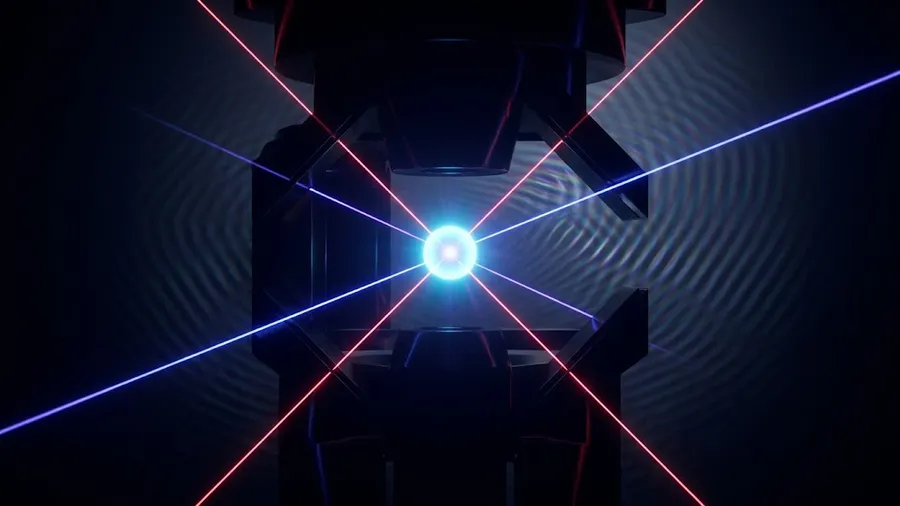
For decades, the Page-Wootters mechanism was treated as theoretical speculation. In 2013, an experimental team led by Ekaterina Moreva at the INRIM in Italy built a physical realization using entangled photons:
- One photon acted as the “clock,” while the other acted as the “evolving system.”
- When measured globally as a combined system, the setup showed zero change over time—it remained completely static.
- When probed only through correlations relative to the “clock” photon, the system appeared to evolve dynamically in accordance with standard time-dependent quantum mechanics.
The experiment demonstrated in a laboratory setting that time can emerge purely from quantum entanglement within an otherwise static reality.
Beyond Timelessness
While the Wheeler-DeWitt equation established canonical quantum cosmology, modern theories continue to explore the Problem of Time:
- In Loop Quantum Gravity (LQG), spacetime is woven from discrete, quantized loops of gravitational flux, transitioning discretely through spin foams.
- In the holographic AdS/CFT correspondence, the boundary field theory possesses ordinary time, while the bulk interior experiences time as an emergent property of quantum information processing.
The enduring lesson of the Wheeler-DeWitt equation remains profound: space and time are not the immutable stage of reality, but dynamic actors emerging from a timeless quantum foundation.