· mathematics · 7 min read
The Banach-Tarski Paradox: How Mathematics Can Duplicate a Sphere
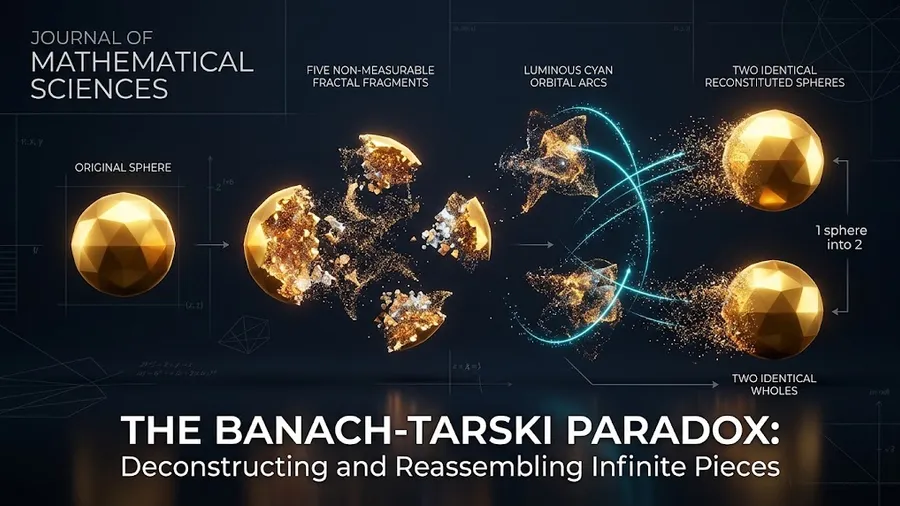
Take a solid three-dimensional ball, cut it into just five non-measurable pieces, rotate them, and reassemble them into two identical spheres of the exact same size. How a bizarre geometric theorem exposed the strange price of the Axiom of Choice.
In the physical world, the law of conservation of mass is inviolable. If you cut an apple into five pieces, no amount of twisting, turning, or rearranging will yield two apples identical in weight and volume to the original. Our deepest physical and geometric intuitions tell us that volume is an unchangeable property of solid objects under rigid spatial movement.
Yet, in 1924, Polish mathematicians Stefan Banach and Alfred Tarski proved a rigorous geometric theorem that challenged this intuition.
Using standard axioms of modern mathematics, they demonstrated that it is possible to take a solid, three-dimensional ball, decompose it into a finite number of disjoint pieces—as few as five—rotate and translate those pieces through space without stretching or distorting them, and reassemble them into two identical, solid balls, each possessing the exact same volume and shape as the original.
Known as the Banach-Tarski Paradox, this mathematical result is not a cheap trick of perspective, a semantic riddle, or an optical illusion. It is a mathematically airtight theorem.
It stands as one of the most provocative results in the history of mathematics, exposing the profound divide between physical reality and the bizarre landscape of infinite sets.
The Nature of the Paradox
To appreciate the scale of Banach and Tarski’s discovery, one must clarify what the theorem does not do:
- It does not stretch, deform, or magnify any piece (unlike turning a small lump of clay into two hollow balls).
- It does not leave any hollow cavities inside the resulting spheres.
- It uses only isometries—rigid motions consisting exclusively of standard spatial rotations and translations.
Even more unsettling is the theorem’s universal corollary: you can take a solid sphere the size of a green pea, cut it into a finite number of pieces, rotate them, and reassemble those exact pieces into a solid sphere the size of the Sun.
How can a rigid reassembly multiply volume out of thin air without breaking the fundamental logic of geometry?
The answer lies in the counterintuitive nature of mathematical points and the discovery of non-measurable sets.
The Illusion of Pieces: Beyond Atomic Matter
When human beings imagine “cutting a sphere,” we instinctively think of a sharp knife slicing through physical matter like wood or stone.
In physics, matter is atomic. A solid gold ball contains a finite, discrete number of atoms. If you separate the atoms into piles, the total count and total volume are strictly conserved.
In pure mathematics, however, a solid ball is not made of atoms. It is an uncountably infinite continuum of zero-dimensional points in three-dimensional space:
- The pieces described by Banach and Tarski are not smooth, clean geometric wedges or slices.
- They are infinitely jagged, infinitely dense, cloud-like dust swarms of points that are so structurally tangled that they cannot be depicted visually.
- Crucially, these pieces are so complex that they do not possess a mathematically definable volume.
In modern mathematics, the branch that assigns a precise number to the “size” or “volume” of a geometric region is called Measure Theory, formalized by French mathematician Henri Lebesgue.
Lebesgue measure assigns zero volume to a single point, finite volume to a cube, and calculates the volume of combined shapes by simply adding their individual volumes together.
Banach and Tarski proved that in three dimensions, there exist clouds of points that are non-measurable. You cannot assign them a volume of five cubic centimeters, zero cubic centimeters, or any number at all.
When you disassemble a sphere into non-measurable pieces, the concept of “total volume” temporarily ceases to exist. Volume only reappears when the pieces are reunited into complete geometric spheres. Because you started with an undefined sum, you are not multiplying volume; you are synthesizing volume where it was previously undefined.
The Engine of the Paradox: Free Groups and Rotations
The mathematical engine driving Banach-Tarski relies on the unique geometry of three-dimensional space and the abstract algebraic concept of a free group.
Imagine rotating a sphere around two distinct axes:
- Axis A (rotating by an irrational angle, say around the vertical axis).
- Axis B (rotating by an irrational angle around the horizontal axis).
Because the rotation angle is chosen to be an irrational fraction of a circle, you can rotate the sphere indefinitely around either axis without ever returning to your exact starting position.
Banach and Tarski proved that the group of rigid three-dimensional rotations contains an algebraic structure called the Free Group on Two Generators ($F_2$).
In a free group, any sequence of rotations (such as rotating around A, then B, then the inverse of A) yields a completely unique spatial orientation. Remarkably, this algebraic structure exhibits a paradoxical self-similarity: you can divide the infinite set of all possible rotation sequences into four subsets, and by applying a single rotation to one subset, it magically expands to recreate the entire set of rotations.
Because three-dimensional space permits non-commutative rotations (rotating around A then B produces a different result than rotating around B then A), this algebraic infinity can be projected onto the surface of a physical sphere.
In two-dimensional space, rotations commute (rotating around the center is always two-dimensional and symmetric), which is why the Banach-Tarski paradox is mathematically impossible in a two-dimensional flat plane. You cannot duplicate a circular disk by cutting it into pieces. The paradox requires at least three spatial dimensions to unlock the rotational freedom of the free group.
The Culprit: The Axiom of Choice
To construct these non-measurable, infinitely intricate pieces, Banach and Tarski had to rely on a cornerstone axiom of modern mathematics: the Axiom of Choice (abbreviated as AC).
Formulated by Ernst Zermelo in 1904, the Axiom of Choice sounds deceptively obvious:
Given any collection of non-empty bins, you can always choose exactly one item from each bin to form a new set.
If you have ten bins of shoes, the Axiom of Choice is trivial: just reach into each bin and pick a shoe.
Even if you have infinitely many bins of pairs of shoes, you can construct a clear rule: “pick the left shoe from every bin.”
However, imagine an infinite collection of bins containing identical pairs of socks, where there is no left or right, and no rule exists to distinguish one item from another. The Axiom of Choice asserts that you can still form a new set by selecting one sock from each bin simultaneously, even though you cannot provide an explicit mathematical rule for which one you chose.
The Axiom of Choice guarantees the existence of the selection without providing an algorithm to construct it.
Banach and Tarski used the Axiom of Choice to partition the infinite points of a sphere into an infinite number of distinct equivalence classes, and then plucked one point from each infinite class to assemble their five non-measurable pieces.
Without the Axiom of Choice, the Banach-Tarski paradox cannot be proven.
The Great Axiomatic Dilemma
When Banach and Tarski published their theorem, many mathematicians were horrified. Some argued that any axiom that produces a result so violently contradictory to human geometric intuition must be fundamentally flawed. They demanded that the Axiom of Choice be purged from standard set theory (ZFC).
However, logicians soon realized that abandoning the Axiom of Choice extracts an immense mathematical cost:
- Without the Axiom of Choice, fundamental theorems across modern mathematics immediately collapse.
- You can no longer prove that every vector space has a basis, paralyzing linear algebra and quantum mechanics.
- You can no longer prove Tychonoff’s Theorem, crippling modern topology.
- You can no longer guarantee the Hahn-Banach Theorem, devastating functional analysis.
Mathematicians found themselves trapped in a stark philosophical dilemma: either accept that every solid three-dimensional ball can be disassembled and duplicated into two, or sacrifice half of the most elegant, powerful theorems in modern analysis.
Ultimately, the mathematical community embraced the trade-off. Today, ZFC (Zermelo-Fraenkel set theory with the Axiom of Choice) remains the standard operating foundation of mathematics.
Mathematicians accepted that infinite sets do not play by the rules of finite physical matter.
Where the Real and the Ideal Diverge
The Banach-Tarski Paradox serves as an enduring reminder of what mathematics is—and what it is not.
Mathematics is not an empirical science tasked with describing the atomic, discrete nature of rocks, apples, and gold coins. Mathematics is the rigorous exploration of logical structures and infinite systems.
The Banach-Tarski paradox does not mean that an alchemist will ever duplicate gold in a furnace. It means that when human intellect dares to conceptualize a continuum made of uncountably infinite points, space acquires a breathtaking, counterintuitive flexibility—one where a single sphere quietly holds the seeds of two.