· mathematics · 6 min read
Gödel's Incompleteness Theorems: The Inescapable Limits of Mathematical Truth
In 1900, mathematicians believed all mathematical truths could eventually be proven from foundational axioms. In 1931, Kurt Gödel shattered that dream by proving that mathematics will always contain true statements that can never be proven.
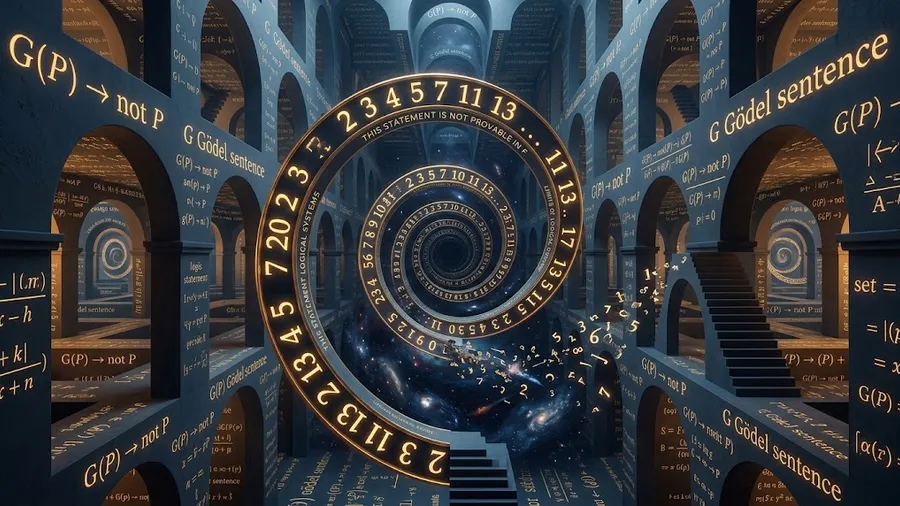
At the International Congress of Mathematicians in Paris in 1900, legendary German mathematician David Hilbert presented a grand vision for the 20th century. Hilbert believed that mathematics was approaching its ultimate, definitive triumph. He challenged the scientific world to construct an unshakeable, universal axiomatic foundation—a master framework from which every mathematical statement could be rigorously proven either true or false.
Hilbert’s program rested on three fundamental convictions:
- Completeness: Every valid mathematical statement can either be proven true or disproven false.
- Consistency: The system is entirely free of contradictions; you can never prove both a statement and its exact opposite.
- Decidability: There exists a mechanical, step-by-step procedure that can determine the truth value of any mathematical claim in a finite number of steps.
Hilbert famously summarized this boundless optimism with an epitaph on his tombstone: “We must know. We will know.”
However, in 1931, a quiet 25-year-old Austrian logician named Kurt Gödel published a paper that delivered a fatal intellectual shock to Hilbert’s program. Gödel proved mathematically that Hilbert’s dream was an impossibility.
No matter how powerful, elegant, or comprehensive you make a set of mathematical axioms, there will always exist truths that lie forever beyond the reach of formal proof.
The Ancient Paradox Made Rigorous
To appreciate Gödel’s breakthrough, one must look at an ancient linguistic paradox known since antiquity: the Liar Paradox.
Consider the simple statement: “This statement is false.”
If the statement is true, then by its own definition, it must be false. But if it is false, then the claim that it is false is true. The sentence traps the human mind in a perpetual, self-referential loop of contradiction.
For centuries, mathematicians dismissed the Liar Paradox as an irritating flaw of informal human language. They believed that formal mathematics—operating purely with sterile symbols, rigid deduction, and precise logical operators—was completely immune to such linguistic traps.
Gödel realized that formal mathematics was not immune at all. By inventing an ingenious encoding scheme, he forced mathematics to speak about itself.
Gödel Numbering: Arithmetic Talking to Itself
Gödel’s first masterstroke was Gödel Numbering.
In standard mathematics, numbers are used to count, measure, and calculate. Gödel recognized that every logical symbol, variable, mathematical expression, and formal proof could be assigned a unique, immutable integer using the prime factorization theorem:
- Every basic symbol (such as plus, equals, or not) was assigned a unique code number.
- Entire mathematical formulas were converted into unique composite numbers by raising sequential prime numbers to the powers of those symbol codes.
- Entire sequences of deductive steps—formal proofs—could similarly be compressed into a single, extraordinarily massive integer.
Through this numbering scheme, a statement about a mathematical proof was translated directly into a statement about arithmetic properties.
Checking whether a proof was logically valid was no longer a philosophical debate; it was transformed into a mechanical question of whether one number evenly divides another.
The First Incompleteness Theorem
Once formal logic was mapped onto arithmetic, Gödel constructed a mathematical formula that mirrored the Liar Paradox, but with a subtle and critical distinction: he replaced the word truth with the concept of provability.
Gödel formulated an arithmetical statement, often designated as Statement G, which mathematically asserts:
“Statement G cannot be proven within this formal axiomatic system.”
Now, analyze the logical consequences of Statement G:
- Possibility 1 (Statement G is provable): If you can prove Statement G using the axioms of the system, then Statement G is true. But Statement G explicitly states that it cannot be proven. Therefore, the system has proven a statement that is false. The system is contradictory and inconsistent.
- Possibility 2 (Statement G is not provable): If you cannot prove Statement G using the axioms, then what Statement G claims is entirely correct—it is indeed unprovable. This means Statement G is true, yet it cannot be reached by the deductive machinery of the system.
Assuming that mathematics is free of contradictions (consistent), Possibility 2 is the only logical reality.
This is the First Incompleteness Theorem: any consistent formal axiomatic system capable of performing basic arithmetic is inherently incomplete. There will always be true statements expressible within the system that cannot be proven using the rules of that system.
Truth is fundamentally larger than proof.
The Second Incompleteness Theorem: The Inner Lock
Mathematicians desperately sought a workaround. Could we at least prove rigorously that our mathematical system is guaranteed to be consistent and free of contradictions, even if it cannot prove every truth?
Gödel addressed this question in his Second Incompleteness Theorem, and the answer was even more devastating.
Gödel proved that no consistent formal system capable of basic arithmetic can ever demonstrate its own consistency from within its own rules.
If a mathematical framework manages to produce a formal proof of its own internal consistency, that very fact proves that the framework is actually broken and harboring a hidden contradiction.
To prove that System A is consistent, you are forced to step outside of it into a broader, more powerful System B. But to prove that System B is consistent, you must invent System C, initiating an infinite regress of unproven foundations.
Mathematics cannot validate its own sanity from within its own borders.
The Birth of Computer Science: Turing’s Halting Problem
Gödel’s work did not just reshape pure mathematics; it laid the direct theoretical foundation for modern computing.
In 1936, British mathematician Alan Turing analyzed Gödel’s results through the lens of automated machines. Turing conceptualized what is now known as the Universal Turing Machine—the theoretical blueprint for all digital computers.
Turing asked a practical question that mirrored Hilbert’s decidability: can an algorithm be written that analyzes any computer program and its input, and determines whether that program will eventually finish running or run forever in an infinite loop?
Turing proved that such an algorithm is mathematically impossible to build. This barrier is known as the Halting Problem.
Just as Gödel showed that there are mathematical truths that can never be reached by logical deduction, Turing proved that there are computational questions that can never be answered by an algorithmic procedure. The limits of formal logic became the operational limits of computer code.
Misconceptions and the True Meaning of Incompleteness
Because of its profound philosophical implications, Gödel’s theorem is frequently misunderstood and misapplied:
- It does not mean that all knowledge is arbitrary, subjective, or useless.
- It does not mean that scientific laws are uncertain or invalid.
- It applies specifically to formal axiomatic systems capable of expressing arithmetic.
What Gödel accomplished was not the destruction of mathematics, but its liberation from mechanical reductionism. Before Gödel, mathematicians feared that math was merely a dead, sterile game of moving predefined symbols across paper according to fixed algorithmic rules.
Gödel demonstrated that mathematics cannot be automated into a closed box. Human mathematical intuition, creativity, and understanding transcend rigid algorithmic procedures.
The Infinite Frontier of Mathematics
Gödel’s Incompleteness Theorems revealed that mathematics is not a tidy, finite puzzle waiting to be permanently solved and shelved in an archive. It is an inexhaustible, open-ended universe.
Every set of axioms we define opens a doorway into a vast landscape of truths, while simultaneously casting a shadow of unprovable mysteries that require new insights, bolder axioms, and deeper conceptual leaps.
Incompleteness is not a defeat of the human intellect; it is the ultimate guarantee that the quest for knowledge will never have a final page.