· cosmos · 3 min read
The 1.44 Solar Mass Ceiling: The Math That Decides How Stars Die
In 1930, a 19-year-old student solved stellar evolution on a steamship to England. His calculation proved that beyond a precise mathematical mass, even quantum mechanics cannot stop a star from collapsing.
The Calculation on a Steamship
In the summer of 1930, a 19-year-old Indian student named Subrahmanyan Chandrasekhar boarded a steamship from Madras to Southampton to study at the University of Cambridge. To pass the weeks at sea, he combined two brand-new branches of physics that had never been mathematically synthesized: Albert Einstein’s Special Relativity and the Pauli Exclusion Principle of quantum mechanics.
By the time the ship docked in England, the teenager had uncovered a grim cosmic reality: there is an absolute, non-negotiable ceiling on the mass of a dead star.
Beyond this threshold, no physical mechanism known to science can prevent total gravitational annihilation.
The Quantum Shield: Electron Degeneracy Pressure
When a star like our Sun exhausts its hydrogen fuel, nuclear fusion ceases. Without thermal radiation pushing outward, the star’s immense gravity crushes its core inward until it shrinks to the size of Earth.
What halts the collapse is not heat, but pure quantum mechanics:
- According to the Pauli Exclusion Principle, no two identical fermions (such as electrons) can occupy the same quantum state simultaneously.
- As gravity compresses the stellar remnant into an ultra-dense white dwarf, free electrons are shoved into the same microscopic volume.
- Resisting this confinement, the electrons exert a massive outward push known as Electron Degeneracy Pressure.
For white dwarfs below a specific mass, this quantum resistance balances gravity permanently. A teaspoon of white dwarf material weighs over 5 metric tons, yet it remains stable for billions of years.
The Relativistic Breaking Point
Chandrasekhar asked a question the leading physicists of his era had overlooked: What happens when gravity becomes so strong that compressed electrons are forced to move close to the speed of light?
Under classical physics, compressing electrons increases their velocity and pressure indefinitely. But Special Relativity imposes an inviolable speed limit: nothing can travel faster than c.
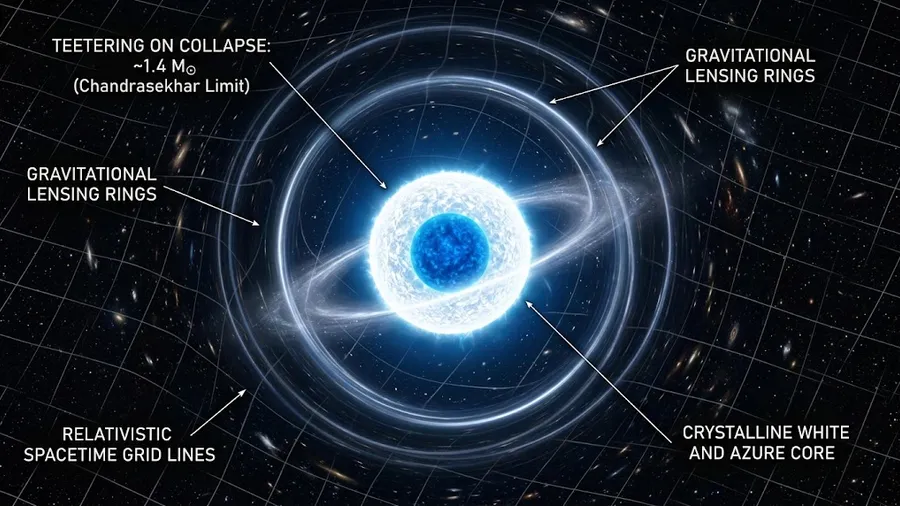
Because electrons cannot exceed light speed, their degeneracy pressure cannot scale to infinity. Chandrasekhar derived the maximum mass a degenerate electron core can support:
M_(Ch) ≈ [(ω₃⁰ · √(3π)) / 2] · (ħc / G)^(3/2) · [1 / (μₑ · m_H)]² ≈ 1.44 M☉
Where:
- ħ (h-bar) is the reduced Planck constant (quantum scale).
- c is the speed of light (relativistic limit).
- G is Newton’s gravitational constant (cosmic scale).
- M☉ is the mass of our Sun (1 Solar Mass).
This number—1.44 Solar Masses—is the Chandrasekhar Limit.
If a dying star’s core exceeds this ceiling by even a fraction of a percent, the quantum shield shatters. The electrons are crushed into atomic nuclei, merging with protons to form neutrons. The star collapses catastrophically into a city-sized Neutron Star or tears through reality entirely to form a Black Hole.
The Mockery of the Establishment
When Chandrasekhar presented his findings to the Royal Astronomical Society in London, Sir Arthur Eddington—the most influential astronomer of the Western world—publicly mocked the mathematics. Eddington refused to believe that nature could permit an object to collapse indefinitely, dismissing the math as unphysical trickery.
Chandrasekhar was sidelined, but he refused to withdraw his work. Decades later, observations of Type Ia supernovae and X-ray binaries confirmed his equations down to the decimal point. In 1983, fifty-three years after his steamship voyage, Subrahmanyan Chandrasekhar was awarded the Nobel Prize in Physics.
The universe does not care about human comfort or scientific consensus. It bows only to the iron constraints of its own fundamental constants.