· physics · 6 min read
False Vacuum Decay: Why the Universe Might Be Trapped in a Fragile Illusion
Precise measurements of the Higgs boson and top quark suggest our universe does not sit at the true ground state of energy, but in a metastable false vacuum capable of catastrophic collapse.
In everyday physics, systems inevitably seek their lowest available energy state. A ball perched atop a hill rolls downhill until it rests securely in the valley floor. Water flows downward to sea level, and excited atomic electrons shed photons to descend into their ground states. In classical physics, when a system arrives at its absolute lowest energetic basin, it reaches permanent, immutable stability.
For decades, cosmologists assumed the vacuum of empty space represented this exact ultimate equilibrium—the absolute basement of cosmic energy where no further decay is possible.
However, when physicists at CERN’s Large Hadron Collider measured the precise mass of the Higgs boson in 2012, calculations in quantum field theory revealed an unsettling reality: our universe may not reside in the true ground state of energy at all. Instead, everything we know could be trapped in a metastable false vacuum—a precarious valley separated from an infinitely deeper energetic abyss by a finite quantum barrier.
The Geometry of the Higgs Potential
In Quantum Field Theory (QFT), empty space is not an inert void. It is permeated by quantum fields that dictate how matter interacts. Among these, the Higgs field is unique because its expectation value in empty space is non-zero. Particles acquire mass through their continuous drag against this pervasive quantum background.
The stability of the Higgs field depends on the shape of its effective potential curve, governed mathematically by its self-coupling parameter, $\lambda$. At everyday energy scales, the Higgs potential resembles the classic “Mexican hat” or wine-bottle curve: a local hilltop at zero field strength surrounded by a circular valley where the field safely rests at roughly 246 GeV.
Yet, quantum mechanics dictates that coupling constants are not truly constant—they “run” depending on the energy scale of interactions. When theoretical physicists extrapolate the Higgs field up toward the Planck scale ($10^{19}\text{ GeV}$), two competing particle forces tug on the curve:
- The Higgs boson itself acts to curve the potential upward, preserving cosmic stability.
- The top quark, possessing immense mass and an unusually strong Yukawa coupling to the Higgs, exerts a relentless quantum pull downward.
Because the top quark is exceptionally heavy (around $173\text{ GeV}$) and the Higgs boson sits at a relatively modest $125\text{ GeV}$, the top quark wins the tug-of-war. At ultra-high energy thresholds, the self-coupling parameter $\lambda$ crosses below zero. Rather than curving upward into a protective barrier, the potential drops precipitously into a radically deeper energy state: the True Vacuum.
The Valley and the Abyss: Metastability
This mathematical discovery places our universe squarely inside what particle physicists classify as a metastable regime:
- Stable Universe: The current vacuum is the absolute lowest possible energy state across all scales. No decay can ever occur.
- Unstable Universe: The current vacuum possesses no protective barrier and collapses spontaneously within microscopic fractions of a second.
- Metastable Universe: The current vacuum sits inside a local energetic hollow (a false vacuum). It is stable against small, classical perturbations, but remains vulnerable to quantum mechanical escape.
Our universe behaves like a lake high in the mountains, nestled securely behind an earthen dam. As long as the water remains classical, it cannot climb over the dam to reach the ocean below.
In the quantum domain, however, matter does not need to climb over a barrier to escape it.
The Bubble of True Vacuum: Quantum Tunneling
Under the principles of quantum mechanics, a quantum field can bypass an energetic barrier through quantum tunneling.
In 1977, physicists Sidney Coleman and Curtis Callan derived the mathematical mechanics of vacuum decay. At any arbitrary coordinate in the cosmos, quantum fluctuations could randomly permit a microscopic patch of the Higgs field to tunnel through the barrier and transition into the true vacuum state.
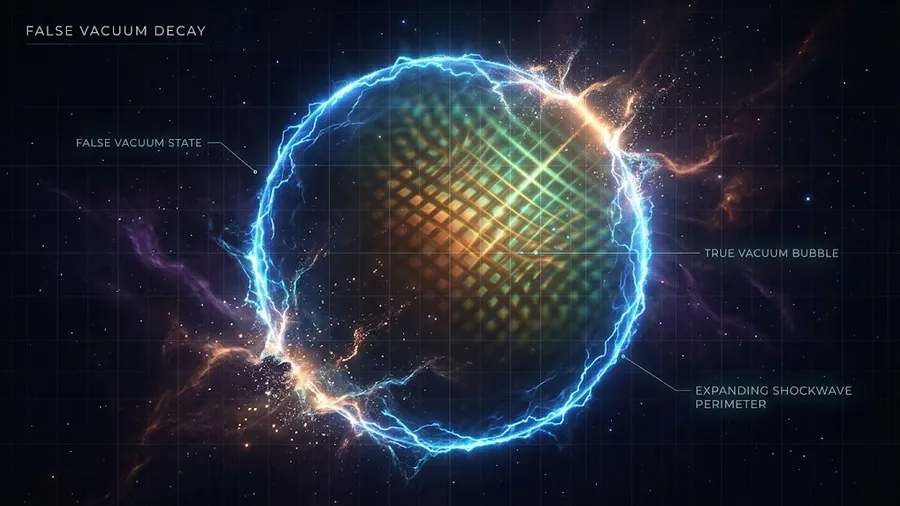
When this occurs, it forms a microscopic spherical bubble of true vacuum—an event known as a Coleman-De Luccia instanton.
Because the interior of this bubble represents a lower, more thermodynamically favorable energy density, the energy difference between the false vacuum outside and the true vacuum inside exerts an outward pressure on the bubble wall. The bubble does not collapse; it instantly begins expanding outward in all directions.
Within fractions of a second, the expansion accelerates until the bubble wall travels at virtually the speed of light ($c$).
Inside the Boundary: The Erasure of Physics
If a bubble of true vacuum were nucleated, the consequences of its passage would be absolute:
- Zero Warning: Because the bubble boundary expands at the speed of light, no electromagnetic or gravitational signal can outrun it. Observers cannot observe its approach; the boundary simply arrives instantaneously.
- Radical Transformation of Mass: As the wall of the bubble sweeps across space, the expectation value of the Higgs field inside abruptly shifts. The masses of electrons, quarks, and W/Z bosons change fundamentally or vanish entirely.
- Immediate Atomic Disassembly: Without stable electron binding energies, atomic nuclei fall apart. Protons disintegrate, covalent and ionic chemical bonds cease to exist, and all complex matter—from stars to biological cells—instantly dissolves into an unstructured sea of elementary particles.
- Gravitational Collapse: In most standard models, the true vacuum carries a massive negative energy density. The interior of the expanding bubble acts as a region of extreme negative cosmological curvature (Anti-de Sitter space), triggering a rapid, localized gravitational collapse toward an inescapable singularity.
Cosmic Timescales: Why We Are Safe
While the existential implications of false vacuum decay sound catastrophic, the actual cosmological mathematics offer immense reassurance.
The probability of a tunneling event depends exponentially on the height and width of the quantum barrier separating our false vacuum from the true vacuum. Calculations based on LHC data indicate that the expected lifetime of our metastable false vacuum state exceeds $10^{100}$ to $10^{600}$ years.
To put that scale into perspective:
- The current age of our universe is merely $13.8 \times 10^9$ years (13.8 billion years).
- All stars in the universe will exhaust their nuclear fuel and burn out within $10^{14}$ years.
The lifetime of our metastable state dwarfs the entire active lifespan of every star, galaxy, and black hole in existence. The probability of a vacuum decay bubble forming within our observable Hubble volume during human civilization is indistinguishable from zero.
The Deeper Lesson for Fundamental Physics
The fact that our universe sits so extraordinarily close to the knife-edge boundary separating absolute stability from metastability is one of the greatest conceptual riddles in modern theoretical physics.
If the top quark were just a tiny fraction lighter, or the Higgs boson just a few gigaelectronvolts heavier, the universe would be completely stable across infinite time. Conversely, a slightly heavier top quark would have made our universe decay long before the first atoms could condense after the Big Bang.
Why our fundamental constants hover precisely along this razor-thin frontier remains unanswered. Whether this balance points to undiscovered supersymmetric particles that stabilize the curve at higher energies, or serves as evidence for an expansive multiverse where only metastable domains survive long enough to produce observers, false vacuum decay reminds us of a humbling truth: even the seemingly eternal fabric of empty space is governed by delicate quantum laws.