· anomalies · 4 min read
The Two-Billion-Year-Old Nuclear Reactor Built Without Human Hands
In 1972, physicists inspecting uranium ore from Gabon discovered something thought impossible: an ancient, self-moderating underground fission reactor engineered purely by geology.
The Missing Isotope of Pierrelatte
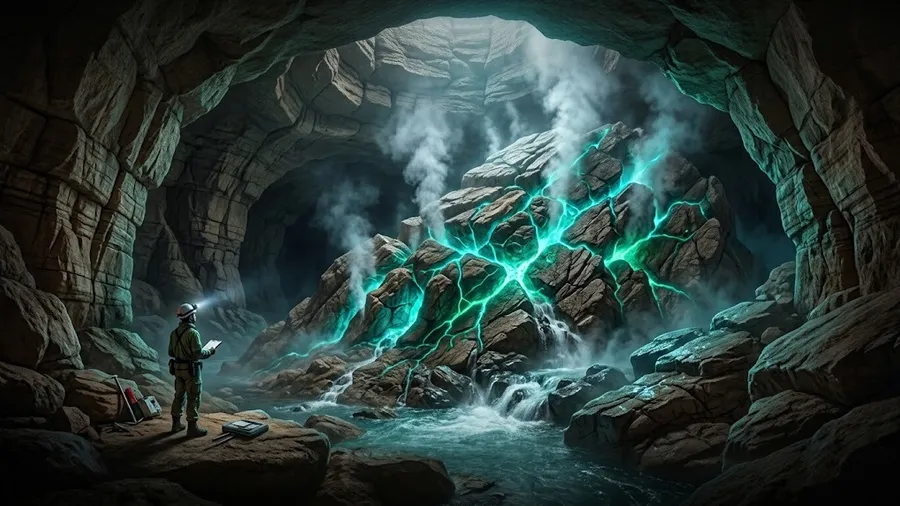
In May 1972, an analyst at the Pierrelatte uranium enrichment facility in France ran a routine mass spectrometry test on raw uranium ore mined from Oklo, in the Republic of Gabon. The numbers refused to add up.
Everywhere on Earth, the moon, and even in ancient meteorites, the concentration of the fissile isotope Uranium-235 (²³⁵U) is an invariant cosmic constant: exactly 0.7202% of all natural uranium atoms.
Yet the Oklo samples registered only 0.7171%, with some vein segments dipping as low as 0.4400%.
A difference of three parts in ten thousand might sound trivial, but in nuclear physics it is an alarm bell. That missing fraction represented roughly 200 kilograms of fissile material—enough to construct dozens of nuclear warheads. Suspecting clandestine diversion or theft, the French Atomic Energy Commission (CEA) launched an urgent international investigation.
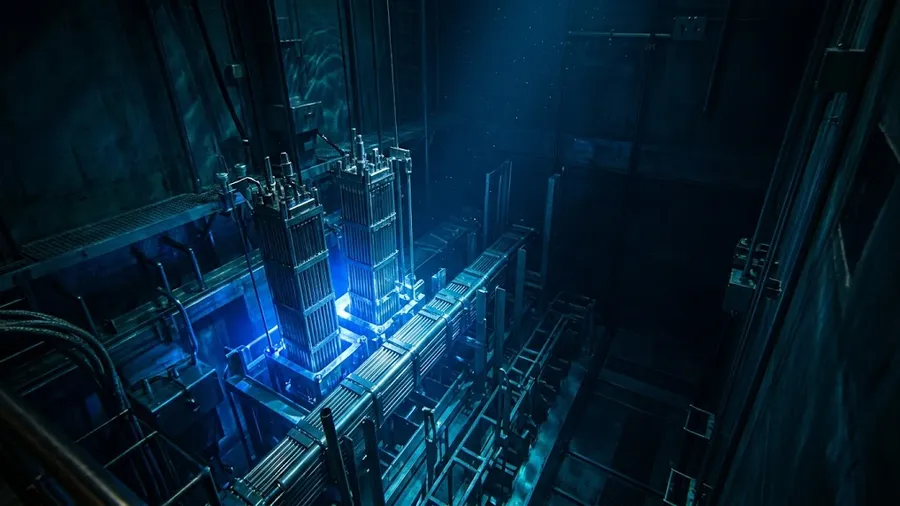
When physicists traced the isotope ratios back to the subterranean rock faces of equatorial Africa, they uncovered something far stranger than geopolitical espionage: Two billion years ago, Earth designed and operated its own nuclear power plant.
The Physics of Natural Criticality
How could raw rock sustain nuclear fission without human intervention, graphite rods, or computer-controlled cooling towers?
The answer lies in deep geological time and the laws of quantum decay:
1. The Radioactive Clock
Uranium-235 has a half-life of roughly 700 million years, decaying much faster than the abundant Uranium-238 (half-life of 4.5 billion years). Two billion years ago—in the Paleoproterozoic era—natural uranium ore was naturally enriched to roughly 3.1% ²³⁵U. This matches the exact isotopic concentration human engineers engineer into modern light-water nuclear fuel today.
2. The Great Oxidation Trigger
When cyanobacteria saturated early Earth with free oxygen, groundwaters oxidized insoluble uranium minerals into soluble uranyl ions. Rivers flushed this uranium into sandstone basins, concentrating heavy deposits in dense seams over five meters thick.
3. The Four-Factor Formula
To sustain a chain reaction, the neutron multiplication factor (k) must reach critical balance:
k_(∞) = η · ε · p · f = 1.0
Where:
- k_(∞) is the infinite multiplication factor.
- η (eta) is the neutron yield per fission.
- ε (epsilon) is the fast fission factor.
- p is the resonance escape probability.
- f is the thermal fuel utilization factor.
If k < 1, the reaction dies. If k > 1, the reaction accelerates uncontrollably. For hundreds of millennia, the Oklo deposits sat precisely on the razor’s edge: k ≈ 1.0.
The Geyser Valve: Nature’s Automated Control Rod
A critical pile of uranium generates immense heat. Without a cooling mechanism, modern reactors risk catastrophic thermal runaway and core meltdown. Why did Oklo never detonate?
The reactor relied on a natural negative feedback loop: groundwater acting as both moderator and coolant.
Water molecules slowed down the fast neutrons shot out by splitting uranium atoms, reducing their kinetic energy to “thermal” speeds where they could be captured by neighboring ²³⁵U nuclei.
As fission ignited, temperatures rose to hundreds of degrees Celsius, boiling the groundwater into steam. Because steam is vastly less dense than liquid water, it cannot effectively moderate neutrons. Without thermal neutrons, the chain reaction shut down completely.
Once the seam cooled, groundwater seeped back through porous sandstone, re-moderating the neutrons and reigniting the reactor.
This primordial subterranean geyser pulsed with mechanical perfection: roughly 30 minutes of boiling criticality, followed by two and a half hours of cooling, cycling continuously for over 100,000 to 500,000 years.
The Ultimate Nuclear Waste Repository
The Oklo natural reactor generated roughly 100 kilowatts of steady thermal power and produced tons of radioactive byproducts: plutonium-239, neptunium, technetium, and hazardous fission fragments.
Yet modern isotopic analysis revealed that virtually all of those dangerous transuranic elements remained locked within millimeters of their original mineral lattices for two billion years, sealed away by clay layers and impermeable rock.
Long before humans split the first atom beneath the bleachers of Chicago Pile-1 in 1942, our planet was already quietly running, regulating, and safely sequestering its own nuclear fire.