· physics · 3 min read
The Arrow of Time: Why Fundamental Physics Has No Yesterday
Every law of fundamental physics works identically backward and forward. Why, then, can you never unscramble an egg? Ludwig Boltzmann solved the mystery with a single statistical equation.
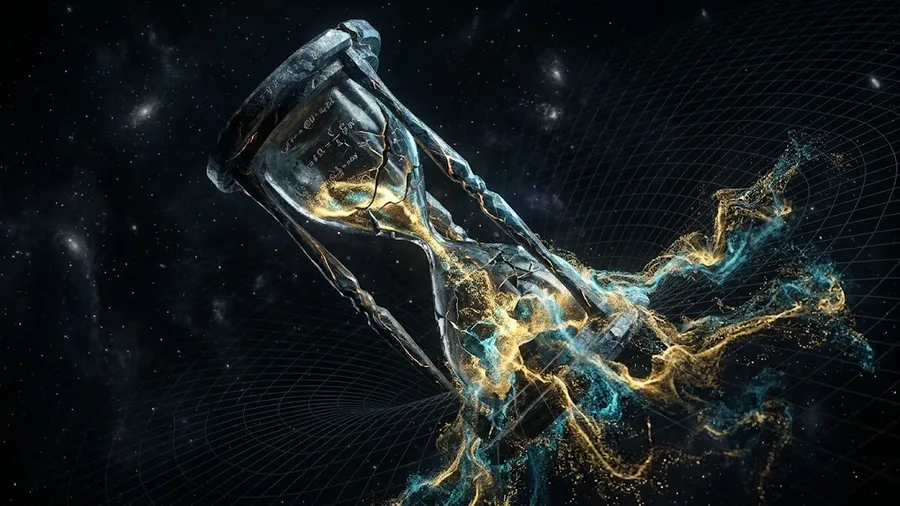
The Great Symmetry Paradox
Take a high-definition recording of a billiard ball colliding with another on a felt table. If you run the footage in reverse, no physicist on Earth can tell which direction time is flowing.
Newton’s laws of classical motion, Maxwell’s electrodynamics, Einstein’s general relativity, and Schrödinger’s quantum wave equations all share an astonishing property: they are entirely time-symmetric. The equations do not care whether the variable t runs forward or backward. Mathematically, the universe has no inherent past or future.
Yet everyday reality laughs at this mathematical symmetry:
- A ceramic coffee mug drops and shatters into a hundred jagged pieces; the pieces never assemble themselves and leap back onto the table.
- Smoke billows from a cigarette and disperses into the air; it never funnels back into the tobacco.
- You remember yesterday, but nobody remembers tomorrow.
If the fundamental building blocks of nature do not distinguish between past and future, what creates the relentless forward march of reality known as The Arrow of Time?
Ludwig Boltzmann’s Statistical Insight
In 1877, Austrian physicist Ludwig Boltzmann cracked the paradox by realizing that order is not a mystical property. It is pure combinatorics.
Boltzmann proposed that thermodynamic Entropy (S)—the measure of disorder in a physical system—is simply the logarithmic count of the number of microscopic arrangements (W) that produce the exact same macroscopic state:
S = k · ln W
Where:
- S is entropy.
- k is the universal Boltzmann constant (1.380649 × 10⁻²³ J/K).
- W (Wahrscheinlichkeit) is the number of possible microscopic arrangements (microstates).
Consider an intact ceramic mug. There is essentially only one precise arrangement of molecules that forms a functioning, unbroken mug (W = 1).
Now smash it on the floor. There are trillions upon trillions of alternative positions, angles, and fractures that satisfy the macroscopic state of a “broken mug” (W is astronomically large).
The second law of thermodynamics does not forbid broken shards from reassembling. Instead, Boltzmann showed that spontaneous reassembly is not impossible—it is merely statistically absurd. The probability of thermal vibrations kicking every microscopic shard back into its solitary unbroken state is on the order of 1 in 10 raised to the power of 10²³. The universe simply does not have enough time for that lottery ticket to hit.
The Big Bang’s Low-Entropy Gift
Boltzmann’s equation leads to an inescapable cosmological deduction: if entropy is constantly climbing toward greater disorder, yesterday must always have possessed lower entropy than today.
Follow that chain of logic backward through cosmic history, past the formation of stars, past the coalescence of galaxies, all the way to 13.8 billion years ago.
The universe did not begin in chaos. It began in an extraordinarily rare, ultra-compact, hyper-ordered state of exceptionally low entropy.
Every breath you take, every star that burns in the night sky, and every memory inscribed into human synapses is powered by that single starting reserve of order unwinding toward thermal equilibrium.
The Epitaph of a Tragic Visionary
In Boltzmann’s lifetime, the scientific establishment fiercely rejected his ideas. Prominent rivals like Ernst Mach insisted that atoms and statistical microstates were unscientific fantasies that could never be seen or verified.
Despairing over the rejection of his life’s work, suffering from severe depression, Boltzmann took his own life in 1906 while on vacation in Duino, Italy.
Just two years later, experimental measurements of Brownian motion confirmed the atomic reality Boltzmann had modeled. Today, on his tombstone in Vienna’s Central Cemetery, beneath his bust, carvers chiseled only a single line of enduring truth:
S = k · log W
Time does not flow forward because nature decrees a direction. Time flows forward because disorder has infinitely more ways to exist than order.