· chemistry · 7 min read
The Belousov-Zhabotinsky Reaction: When Chemistry Learns to Beat Like a Heart
For decades, classical chemistry insisted that chemical reactions must march monotonically toward dead equilibrium. The discovery of pulsating chemical clocks shattered that assumption, revealing how non-equilibrium chemistry mimics the rhythmic pulses of life.
In the 1950s, Soviet biochemist Boris Belousov was working in a military laboratory attempting to model how organic cells extract energy from glucose during the Krebs cycle. He mixed citric acid, potassium bromate, sulfuric acid, and a cerium salt catalyst into a glass beaker, expecting to watch the pale yellow liquid slowly turn transparent as the reaction spent itself and settled into chemical equilibrium.
Instead, Belousov witnessed something that defied everything taught in contemporary chemistry textbooks.
The clear liquid suddenly flared into bright yellow. Moments later, it drained back to colorless clarity. Then it turned yellow again. The beaker did not fade into a uniform, static resting point; it beat like an organic heart, cycling rhythmically between color states for over an hour.
Astonished, Belousov documented the phenomenon meticulously and submitted a paper to leading Soviet scientific journals. The paper was summarily rejected without peer review.
The editors and referees claimed that Belousov’s observations were physically impossible. According to the classical Second Law of Thermodynamics, an isolated closed chemical reaction must proceed monotonically toward maximum entropy. A chemical system that swung back and forth between distinct states appeared as absurd as a dropped egg spontaneously reassembling itself and jumping back onto a table.
Deeply discouraged by the scientific establishment’s refusal to replicate his work, Belousov filed his notes away in a laboratory drawer, swearing never to attempt publishing it again.
It took more than a decade for the scientific world to realize that Belousov had not made an error—he had discovered the gateway to an entirely new branch of science: non-equilibrium thermodynamics.
The Breakthrough: Zhabotinsky and the Visual Waves
In 1961, a young biophysics graduate student at Moscow State University named Anatol Zhabotinsky was handed Belousov’s discarded recipe by an advisor.
Zhabotinsky recognized the profound significance of the reaction immediately. He refined the chemical cocktail, replacing citric acid with malonic acid and switching the metal catalyst to ferroin—an iron-based redox indicator.
The effect was visually arresting:
- In a stirred beaker, the solution flashed rhythmically between deep scarlet red (reduced iron state) and brilliant sky blue (oxidized iron state).
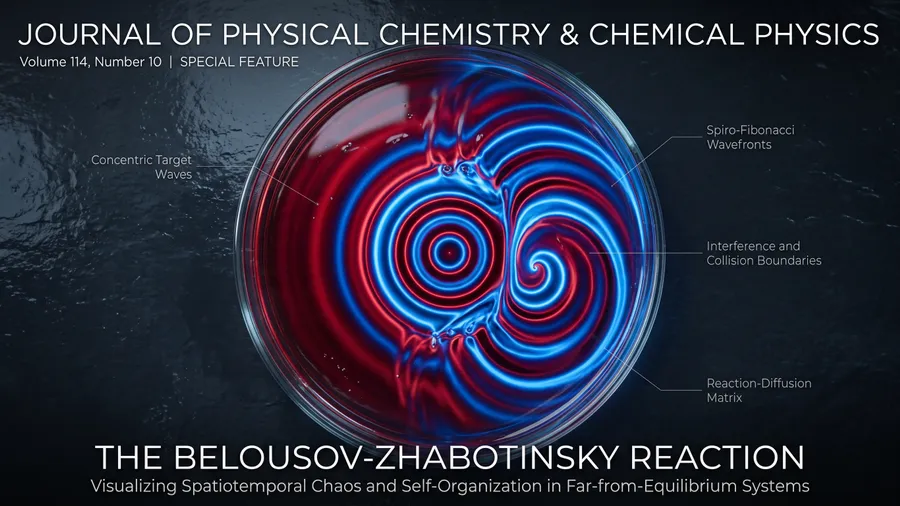
- When Zhabotinsky poured a thin, unstirred layer of the solution into a flat glass Petri dish, the reaction organized itself across space.
- Blue dots spontaneously crystallized in the red liquid, expanding into concentric circular target rings and swirling, rotating spiral waves that propagated across the dish.
In 1968, during a symposium in Prague, Zhabotinsky’s mesmerizing demonstrations stunned international researchers. The phenomenon became known globally as the Belousov-Zhabotinsky (BZ) reaction.
The Physics Behind the Clock: Why the Second Law Is Not Broken
Why did peer reviewers initially believe the BZ reaction was a physical impossibility?
Classical 19th-century thermodynamics, developed by Rudolf Clausius and Sadi Carnot, focused almost exclusively on systems at or very near thermodynamic equilibrium—closed boxes where temperature, pressure, and chemical potentials gradually smooth out until all gradients vanish.
If the BZ reaction were oscillating back and forth across the exact same chemical pathway, it would indeed violate the Second Law.
However, theoretical work pioneered by Belgian physical chemist Ilya Prigogine (who earned the Nobel Prize in Chemistry in 1977) revealed that the BZ reaction does not violate thermodynamics because it is a dissipative system operating far from equilibrium:
- The overall reaction is not reversible; it constantly burns chemical free energy, converting malonic acid and bromate into carbon dioxide, brominated organic compounds, and water.
- The total entropy of the system and its environment continuously increases, strictly satisfying the Second Law.
- While the overall energetic descent is monotonic, the intermediate chemical steps take wildly non-linear detours through complex feedback loops.
The Engine: Autocatalysis and Delayed Inhibition
In 1972, American chemists Richard Field, Endre Körös, and Richard Noyes at the University of Oregon mapped the complex network of over twenty individual elementary reactions driving the oscillation, boiling them down to an elegant mathematical mechanism known as the FKN Mechanism (or the Oregonator model).
The BZ clock operates on an interplay between two competing sub-systems: an explosive chemical accelerator and a delayed chemical brake.
- The Autocatalytic Accelerator: When the concentration of bromide ions drops below a critical threshold, an autocatalytic pathway ignites. Bromous acid reacts with bromate ions in an explosive feedback loop where the product of the reaction acts as a catalyst to produce even more of itself. The concentration of oxidized metal catalyst skyrockets, turning the solution rapidly from red to blue.
- The Bromide Trap: The explosion of oxidation cannot continue indefinitely because the reaction consumes bromate and begins creating bromide ions as a byproduct.
- The Chemical Brake: Once the newly created bromide ions accumulate to a critical density, they aggressively attack and consume the bromous acid, slamming the brakes on the autocatalytic process.
- The Reset: The system transitions back to its reduced, quiet state (turning red again). Over the next several minutes, malonic acid slowly consumes the accumulated bromide, gradually clearing the field until the inhibitor drops below the trigger threshold—igniting the cycle all over again.
The system acts like a chemical siphon flush: building up tension slowly, releasing it in a sudden, violent pulse, and resetting to begin the accumulation anew.
Dissipative Structures and Morphogenesis
The significance of the Belousov-Zhabotinsky reaction extends far beyond an entertaining laboratory demonstration.
In 1952, British polymath Alan Turing published a landmark paper titled The Chemical Basis of Morphogenesis. Turing predicted that under certain non-linear reaction-diffusion conditions, reacting chemicals could spontaneously break spatial symmetry, generating stable stationary spots, stripes, and spirals out of a completely homogeneous liquid.
The BZ reaction provided the very first physical proof that Turing’s mathematical equations were real:
- Simple chemical molecules containing zero biological information or genetic blueprints can spontaneously coordinate across centimeters of physical space.
- The rotating chemical spirals in a BZ dish are examples of dissipative structures—ordered architectures that exist solely because energy is actively flowing through the system.
The reaction proved that order, pattern, and complexity do not require a central programmer. Under the right non-equilibrium conditions, physical matter possesses an intrinsic drive to organize itself.
The Biological Connection: The Rhythm of Life
Once scientists understood the principles of the BZ reaction, they began recognizing chemical oscillators everywhere across the biological world:
- The Human Heart: The rhythmic contraction of cardiac muscle is not coordinated by a mechanical pendulum. It is an excitable biochemical wave driven by non-linear ion flows across cell membranes. When cardiac waves devolve into lethal ventricular fibrillation, the electrical activity of the heart maps directly onto the spiral wave chaos seen in an unstable BZ dish.
- Circadian Clocks: The 24-hour biological clocks that govern sleep, metabolism, and gene expression in virtually all terrestrial organisms are built from interlocking genetic feedback loops functioning on delayed negative inhibition—the identical architectural logic of the BZ mechanism.
- Glycolytic Oscillations: Inside living yeast cells and human muscle tissues, the enzymatic breakdown of sugar does not occur at a steady, flat pace; it pulses in rhythmic waves.
From Inert Chemistry to Living Matter
Before the discovery of oscillating reactions, science drew a rigid philosophical line between dead matter and living organisms. Inert chemicals were seen as passive and doomed to slide down into cold equilibrium, while living creatures somehow cheated entropy by generating continuous rhythmic activity, coordination, and form.
The Belousov-Zhabotinsky reaction obliterated that rigid divide.
It proved that dead matter, when pushed far enough from equilibrium and given non-linear feedback loops, naturally begins to exhibit the defining hallmarks of life: it pulses, communicates across space, coordinates collective behaviors, and adapts to its boundaries.
Boris Belousov died in 1970, before the world fully recognized the magnitude of his discovery. Today, his once-rejected beaker of pulsing chemicals is celebrated as one of the pivotal discoveries of modern science—the moment we realized that life is not a violation of physical law, but the ultimate expression of chemistry’s built-in drive to dance.