· biology · 6 min read
Quantum Biology: How Migratory Birds Use Quantum Entanglement to See Earth's Magnetic Field
Physicists long assumed that warm, wet living cells were far too noisy to sustain fragile quantum effects. Yet migratory songbirds rely on light-activated entangled electron pairs inside their eyes to literally visualize Earth's geomagnetic field.
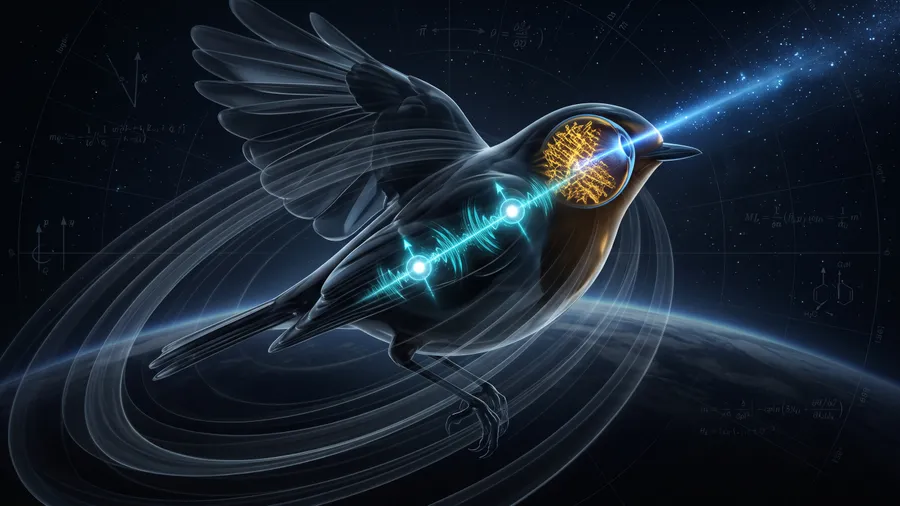
Every autumn, millions of migratory songbirds—such as the European robin (Erithacus rubecula)—embark on solitary nocturnal journeys spanning thousands of kilometers from northern Europe to the Mediterranean coast. Flying through overcast nights with no stars, landmarks, or coastal lights to guide them, these tiny birds navigate across continents with astonishing accuracy.
For decades, biologists knew that migratory birds possess an internal biological compass tuned to Earth’s geomagnetic field. Yet explaining how a living organism detects that field posed a major physical puzzle.
Earth’s magnetic field is extraordinarily weak—measuring roughly 50 microtesla, more than a hundred times weaker than a common refrigerator magnet. According to classical physics, the thermal energy of molecules jiggling inside a warm, living bird’s body at 40 degrees Celsius should completely drown out any mechanical pull exerted by Earth’s faint magnetism.
The solution emerged from one of the most unexpected intersections in modern science: quantum biology. Rather than relying on miniature iron compass needles, migratory birds harness light-triggered quantum entanglement inside their retinas—allowing them to literally see Earth’s magnetic field overlaid onto their normal vision.
The Inclination Compass Mystery
In the late 1960s and 1970s, German ornithologists Wolfgang and Roswitha Wiltschko conducted a series of behavioral experiments with caged European robins during migration season. Using surrounding magnetic coils to alter the artificial magnetic field inside the laboratory, they uncovered two baffling clues about the birds’ internal compass:
- Polarity Blindness: Unlike a human hiking compass, which distinguishes magnetic north from magnetic south, a robin’s compass cannot tell north from south. Instead, it operates as an inclination compass—measuring the angle at which magnetic field lines dip toward Earth’s surface, distinguishing “poleward” (where field lines dive steeply downward) from “equatorward” (where field lines run parallel to the ground).
- Dependence on Blue Light: The birds’ magnetic sense only functioned when their eyes were illuminated by short-wavelength blue or green light. Under pure red light, the robins became completely magnetically disoriented—proving that their magnetic compass was intimately tied to vision.
Classical magnetoreception models—which assumed tiny crystals of magnetic iron oxide (magnetite) physically twisted inside nerve cells—could not explain why a magnetic compass required blue light or why it ignored magnetic polarity.
Klaus Schulten and the Radical Pair Mechanism
In 1978, theoretical biophysicist Klaus Schulten proposed a radical hypothesis. He suggested that birds sense magnetism not through mechanical force, but through a delicate quantum-chemical reaction known as the Radical Pair Mechanism.
To understand how a chemical reaction can feel a magnetic field, one must look at the quantum property of electrons called spin. Electrons behave like microscopic quantum bar magnets whose spin orientations can point either “up” or “down.”
When a molecule absorbs an energetic photon of blue light, it can kick an electron from one chemical group to a neighboring site, creating a pair of molecules each holding a single unpaired electron. Because the two electrons originated from the exact same molecular orbital before separating, they remain linked in a state of quantum entanglement:
- Singlet vs. Triplet States: Immediately after separation, the entangled electrons begin in a singlet state, where their spins point in opposite directions. However, interactions with nearby atomic nuclei cause the pair to oscillate rapidly—millions of times per second—between the anti-parallel singlet state and a triplet state, where their spins align in the same direction.
- Geomagnetic Steering: Crucially, the external magnetic field of the Earth tilts the quantum energy landscape of the molecule, altering the rate at which the entangled pair flips between singlet and triplet states depending on the bird’s head orientation relative to Earth’s magnetic field lines.
- Chemical Output: Because singlet and triplet radical pairs follow different chemical reaction pathways, changing the singlet-to-triplet ratio alters the final yield of signaling molecules produced inside the cell.
In effect, the entangled electron pair acts as a quantum amplifier—translating an imperceptibly weak magnetic tilt into a measurable biochemical signal.
Cryptochrome: The Quantum Sensor in the Eye
For twenty years, Schulten’s radical pair hypothesis lacked a known biological molecule capable of hosting such a reaction inside a bird’s eye. That missing piece arrived in the late 1990s with the discovery of cryptochromes—a family of ancient, blue-light-sensitive flavoproteins found in the retinas of birds, insects, and mammals.
Within the double-cone photoreceptor cells of a migratory bird’s retina, a specific variant known as Cryptochrome 4 (Cry4) sits anchored in orderly arrays:
- Embedded inside the heart of the Cry4 protein is a light-absorbing pigment molecule called flavin adenine dinucleotide (FAD), positioned alongside a neat stepping-stone chain of four tryptophan amino acids.
- When a blue photon enters the bird’s eye and strikes the FAD molecule, an electron hops sequentially along the tryptophan chain—creating a spatially separated, spin-entangled radical pair spanning roughly two nanometers inside the protein.
- In 2021, an international team led by Henrik Mouritsen and Peter Hore purified recombinant Cry4 directly from European robins and demonstrated in laboratory spectroscopy tests that the protein’s photochemistry is genuinely sensitive to weak magnetic fields—and notably more sensitive than the non-migratory cryptochromes found in chickens and pigeons.
Testing Quantum Coherence in Living Birds
How can scientists be certain that living birds are truly using quantum spin dynamics rather than some undiscovered classical mechanism?
In quantum physics, coherent spin states can be disrupted by exposing them to ultra-weak oscillating radiofrequency fields tuned to the exact resonant frequency of the electron spins—a disturbance far too weak to affect classical chemical bonds or magnetite crystals.
When researchers exposed European robins in wooden orientation cages to faint broadband radiofrequency electromagnetic noise—thousands of times weaker than a mobile phone signal—the birds completely lost their ability to orient toward their migratory direction. The moment the radiofrequency noise was switched off, their magnetic compass snapped back online.
This extreme vulnerability to resonant radiofrequency interference serves as a smoking-gun signature of a quantum radical-pair compass operating inside a living, breathing vertebrate.
Painting Magnetic Maps Across the Sky
Because cryptochrome proteins are embedded inside retinal photoreceptor cells that fire nerve impulses straight into the visual processing centers of the bird’s brain, neuroscientists believe birds experience geomagnetism as a visual phenomenon.
As a robin turns its head during nocturnal flight, the angle between Earth’s magnetic field and the aligned cryptochrome molecules across the curved surface of its retina shifts continuously. This modulation likely produces a subtle, translucent pattern of light and shadow—such as a dark ring or luminous gradient—superimposed directly onto the bird’s normal field of view, visibly pointing the way toward the equator or the poles.
For decades, physicists assumed that quantum entanglement could survive only inside pristine laboratory vacuum chambers cooled near absolute zero. Migratory birds proved otherwise—demonstrating that over millions of years of evolution, life learned to shelter delicate quantum states inside warm biological proteins, turning subatomic physics into an evolutionary compass across the sky.