· biology · 6 min read
Prions: The Rogue Proteins That Replicate Without DNA or RNA
For decades, biology held an unbreakable rule: nothing can infect, replicate, and evolve without genetic material. Then scientists discovered prions—misfolded proteins that hijack healthy brain molecules through pure three-dimensional geometry.
Modern molecular biology rests on a foundational rule known as the Central Dogma: genetic information flows from DNA to RNA, and from RNA into proteins. Every known living organism—and even non-living infectious agents like viruses—relies on nucleic acids (DNA or RNA) as an instruction manual to replicate and spread. Without a genetic blueprint, biological replication was thought to be physically impossible.
In 1982, American neurologist Stanley Prusiner shattered that consensus by proposing something that sounded like scientific heresy: an infectious agent composed exclusively of protein, containing zero DNA, zero RNA, and zero genetic code.
Prusiner named these bizarre agents prions—short for proteinaceous infectious particles.
Initially dismissed and ridiculed by much of the virology community, prions were eventually proven to be the cause behind a devastating family of fatal neurodegenerative diseases, including Creutzfeldt-Jakob disease in humans, mad cow disease in cattle, and scrapie in sheep. More profoundly, prions revealed that biological information can be stored, copied, and transmitted purely through three-dimensional molecular shape.
Clues from Radiation-Proof Pathogens
Long before the word “prion” existed, researchers studying scrapie—a fatal brain-wasting disease in sheep—noticed that the infectious agent refused to behave like any known bacterium or virus.
In the 1960s, radiobiologist Tikvah Alper and mathematician J.S. Griffith conducted a landmark series of experiments in London that baffled microbiologists:
- They bombarded brain tissue infected with scrapie using massive doses of ultraviolet and ionizing radiation—radiation intense enough to shred the DNA and RNA of every known virus and bacterium into useless fragments.
- Astonishingly, the scrapie agent survived intact and remained fully infectious.
- Because nucleic acids strongly absorb ultraviolet light at specific wavelengths while proteins do not, Alper deduced that whatever was transmitting the disease could not contain genetic material.
At the same time, medical researchers investigating kuru—a mysterious neurological disorder among the Fore people of Papua New Guinea linked to funerary cannibalism—realized that the condition could lie dormant for decades before destroying the brain from the inside out.
Shape Is Destiny: Normal Proteins Gone Rogue
How can a single protein molecule multiply inside the brain if it has no genes to copy itself? The secret lies in the physics of protein folding.
Every healthy mammalian brain naturally produces millions of copies of a harmless, normal protein called cellular prion protein ($PrP^C$), which sits anchored on the outer membranes of neurons and helps protect cells against oxidative stress.
A pathogenic prion—designated $PrP^{Sc}$—has the exact same chemical formula and identical sequence of amino acids as the healthy protein. The sole difference between a harmless brain protein and a lethal infectious agent is its three-dimensional origami fold:
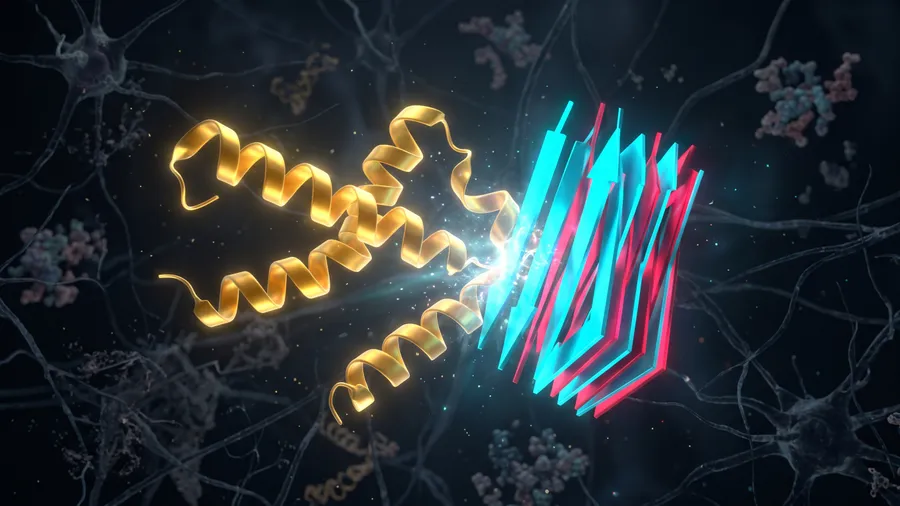
- Healthy Form ($PrP^C$): Folded primarily into flexible, spring-like spiral coils called alpha-helices. In this configuration, the protein dissolves easily in water and is routinely broken down and recycled by cellular enzymes.
- Infectious Form ($PrP^{Sc}$): Refolded into flat, rigid, accordion-like pleated structures called beta-sheets. Once snapped into this flat geometry, the protein becomes insoluble, sticky, and virtually immune to cellular recycling enzymes.
The Domino Cascade of Templated Misfolding
Because both forms share identical building blocks, a rogue prion does not need to build new proteins from scratch. Instead, it hijacks the healthy proteins your brain is already manufacturing through a physical chain reaction known as templated conformational conversion:
- Physical Contact: A misfolded beta-sheet prion drifts through neural tissue until it bumps directly into a healthy alpha-helix prion protein.
- Forced Refolding: Like a corrupted physical mold, the rigid beta-sheet forces the flexible alpha-helix to unwind and snap into the exact same flat beta-sheet geometry.
- Exponential Amplification: One rogue prion converts one healthy protein, creating two rogue prions. Those two convert two more, producing four, then eight, then millions.
- Amyloid Plaque Formation: As thousands of flat beta-sheet proteins stack tightly together like Lego bricks, they form long, needle-like fibers called amyloid fibrils. These toxic clumps accumulate inside and around neurons, killing brain cells and leaving behind microscopic fluid-filled cavities that give diseased brains a sponge-like appearance.
In effect, prions replicate not by copying genetic letters, but by spreading a physical shape like a falling row of molecular dominoes.
Nearly Indestructible Architecture
The tightly packed beta-sheet geometry of prion fibrils makes them among the most resilient biological structures on Earth.
Ordinary hospital sterilization procedures—such as boiling instruments in water, soaking them in alcohol, exposing them to formaldehyde, or running standard steam autoclave cycles—completely destroy bacteria and viruses by uncoiling their fragile proteins and melting their genetic material.
Prions, however, shrug off standard sterilization. Their interlocking hydrogen bonds lock the beta-sheets together so tightly that destroying surgical prion contamination requires extreme measures, such as prolonged immersion in concentrated sodium hydroxide followed by high-pressure incineration. Even buried in soil, prions can remain infectious for years.
Functional Prions: How Evolution Harnessed Shape Memory
While pathogenic prions cause devastating diseases, evolutionary biologists have discovered that nature also domesticated prion-like shape-switching for vital, beneficial functions across the tree of life.
In baker’s yeast, several benign prion proteins act as rapid evolutionary bet-hedging switches: when yeast encounter sudden environmental stress, a protein flips into a self-sustaining prion shape that alters how the cell reads its genes, instantly unlocking new survival traits without waiting for slow DNA mutations.
Even more remarkably, neurobiologists Eric Kandel and Kausik Si discovered that a prion-like protein called CPEB operates inside human and animal synapses to stabilize long-term memories:
- Every time you learn a new skill or form a lasting memory, specific synaptic connections between neurons must remain strengthened for years—even though individual protein molecules inside a synapse degrade and get replaced every few days.
- When a synapse is strongly activated, CPEB molecules switch into a self-perpetuating, prion-like aggregated state that continuously recruits newly synthesized CPEB proteins to adopt the same active shape—preserving the physical trace of your memory long after the original molecules have vanished.
Beyond the Genetic Code
In 1997, Stanley Prusiner was awarded the Nobel Prize in Physiology or Medicine for discovering prions and establishing a completely new principle of biological infection.
Prions expand our understanding of what constitutes biological information. Life does not store its instructions solely in linear sequences of DNA bases; it also encodes stability, function, and pathology inside the three-dimensional geometry of folded molecules—where a single twist in shape can spell the difference between a lasting memory and a runaway molecular cascade.