· biology · 4 min read
Peto's Paradox: Why Massive Whales Rarely Die of Cancer
With a thousand times more cells than a human and a lifespan exceeding two centuries, a bowhead whale should mathematically succumb to cancer early in life. Instead, evolution equipped giant animals with extraordinary cellular defenses.
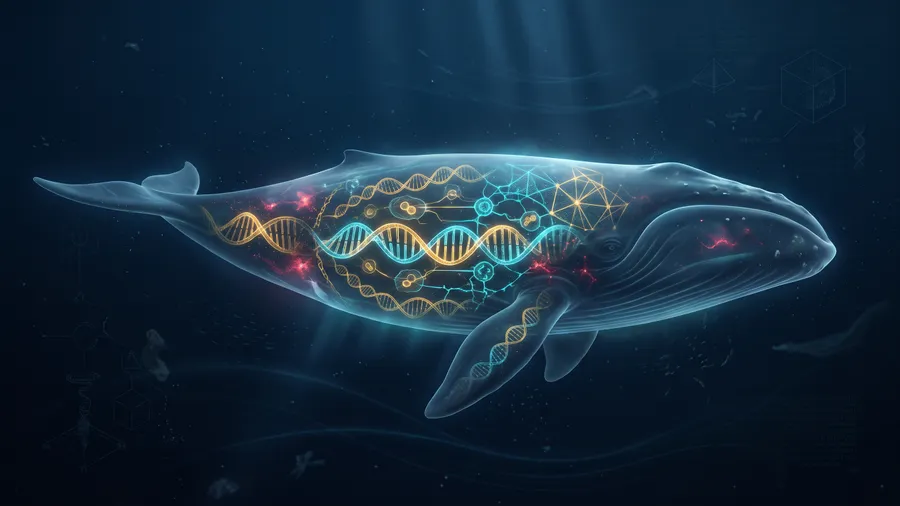
At its most fundamental biological level, cancer is a game of statistical probability. Every time a living cell divides to build or repair tissue, it must copy billions of base pairs of DNA. Despite remarkable molecular proofreading machinery, random copying errors—somatic mutations—inevitably occur.
Most mutations are harmless, and the immune system eliminates the vast majority of rogue cells. However, if a single cell accumulates the wrong combination of mutations—disabling its growth brakes while jamming its division accelerator—it begins multiplying uncontrollably into a malignant tumor.
From this straightforward mathematical premise, two logical predictions follow:
- More Cells Equal Higher Risk: An organism composed of trillions of cells has far more cellular “lottery tickets” than an organism made of billions, multiplying the probability that at least one cell will turn malignant.
- Longer Lifespans Equal Higher Risk: An animal living for a century undergoes vastly more cumulative cell divisions than an animal living for two years.
Within a single species, this rule holds true. Taller humans exhibit a statistically higher lifetime incidence of cancer than shorter humans, and giant dog breeds like Great Danes suffer dramatically higher cancer rates than Chihuahuas.
Yet, when British epidemiologist Richard Peto compared cancer rates across different animal species in 1977, he uncovered a startling contradiction. A blue whale weighs roughly 2,000 times more than a human, and a bowhead whale can live for more than 200 years. Mathematically, whales should develop lethal tumors before reaching adulthood. In reality, whales and elephants show remarkably low rates of cancer—lower even than humans.
This biological contradiction is known as Peto’s Paradox.
Evolution’s Silent Filter
If the basic mathematics of cell division applies equally to all mammals, how do giants survive?
The answer lies in evolutionary selective pressure. Early mammalian ancestors were small, mouse-sized creatures with short lifespans. They needed only modest cellular defenses against cancer because they were far more likely to be eaten by predators or freeze in winter before tumors had time to develop.
As certain evolutionary lineages began growing larger and living longer, they hit an invisible biological ceiling:
- Any lineage that grew to the size of an elephant without upgrading its DNA protection died out rapidly from early-onset cancer before passing on its genes.
- Consequently, gigantism and extreme longevity could only evolve in tandem with sophisticated, multi-layered tumor suppression mechanisms.
Nature did not solve this engineering problem just once. Comparative genomics reveals that different lineages of giant animals independently evolved radically different strategies to defeat cancer.
The Elephant’s Strategy: Zero-Tolerance Cellular Suicide
Elephants weigh roughly 100 times more than humans and live up to 70 years, yet fewer than five percent of elephants die from cancer—compared to roughly 20 to 25 percent of humans.
When geneticists sequenced the genome of the African savanna elephant, they discovered an astonishing redundancy in one of biology’s most critical genes: TP53, often called the “guardian of the genome.”
- Humans carry just one copy (two alleles) of the TP53 gene. Whenever a human cell suffers DNA damage from ultraviolet radiation or chemical stress, the p53 protein halts cell division so repair enzymes can fix the broken strand. If the damage is too severe, p53 triggers apoptosis—programmed cellular suicide. (Humans born with a defective copy of TP53 suffer from Li-Fraumeni syndrome, carrying a nearly 90 percent lifetime risk of developing cancer).
- African Elephants carry 20 copies (40 alleles) of the TP53 gene.
Because of this massive genetic arsenal, elephant cells do not waste time trying to repair risky DNA damage. When exposed to low doses of ionizing radiation in laboratory tests, elephant lymphocytes undergo apoptosis at more than double the rate of human cells.
Working alongside TP53 is a resurrected pseudogene called LIF6—a “zombie gene” that lay dormant in ancestral mammals for millions of years before being switched back on in the elephant lineage. Once activated by p53, LIF6 proteins punch holes directly into the cell’s mitochondria, destroying the damaged cell before it ever has a chance to divide and mutate further.
The Whale’s Strategy: Precision Repair and Slow Burn
If aggressive cellular suicide works so well for elephants, do bowhead whales use the exact same mechanism?
When researchers examined the genome of the bowhead whale—which weighs up to 100 tons and regularly lives past 200 years—they expected to find dozens