· biology · 7 min read
Quantum Biology: How Life Harnesses the Subatomic Realm
Living cells are warm, wet, and chaotic—environments thought to destroy delicate quantum states instantly. Yet birds, plants, and enzymes routinely exploit quantum coherence and entanglement to survive.
For nearly a century, physicists and biologists operated under an unspoken scientific truce. Quantum mechanics—with its bizarre repertoire of wave-particle duality, superposition, and spooky entanglement—was presumed to belong exclusively to the subatomic sterile laboratory: isolated in ultra-high vacuum chambers and cooled to fractions of a degree above absolute zero.
Living organisms, by contrast, are warm, wet, and chaotic. A biological cell is a turbulent soup of water molecules, proteins, and thermal noise colliding trillions of times every second. Under standard quantum field theory, such constant environmental bombardment should cause immediate quantum decoherence, destroying delicate quantum states within femtoseconds before they could ever influence biological function.
Yet, over the past two decades, precision spectroscopic measurements and ultrafast laser experiments have revealed an astonishing truth.
Life did not wait for physicists to invent cryogenics. Across billions of years of natural selection, biological organisms evolved molecular machinery capable of shielding, maintaining, and actively exploiting quantum mechanics to perform feats of efficiency that baffle human engineers.
This rapidly expanding frontier is known as Quantum Biology.
Photosynthesis: The Quantum Superhighway
The most striking evidence of quantum mechanics in living systems occurs at the very foundation of Earth’s food chain: photosynthesis.
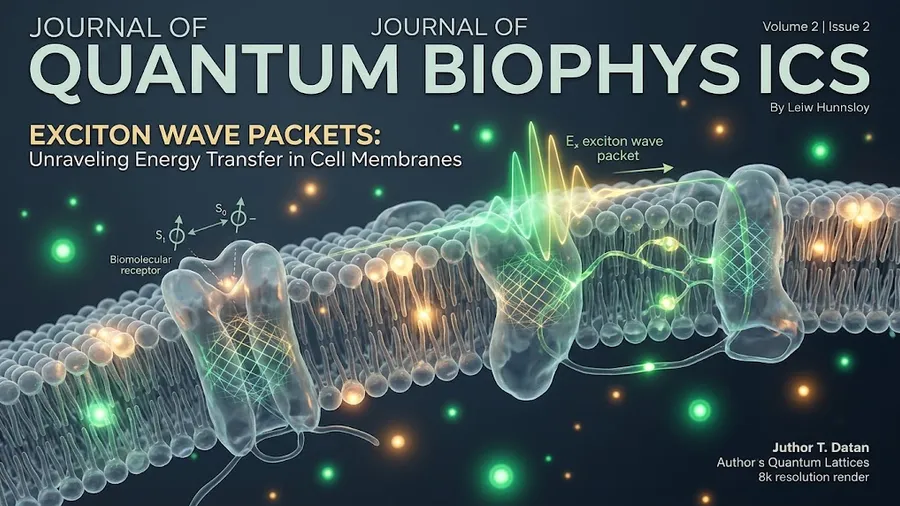
When sunlight strikes a green leaf or photosynthetic bacterium, a photon is absorbed by a light-harvesting antenna pigment, exciting an electron into a packet of energy known as an exciton. To produce chemical fuel, this exciton must travel through a complex web of chlorosome proteins to reach the reaction center, where its energy is converted into stable chemical bonds.
The central puzzle was its efficiency. In systems such as the Fenna-Matthews-Olson (FMO) protein complex found in green sulfur bacteria, the energy transfer efficiency approaches an incredible 100 percent. Almost every photon absorbed reaches the reaction center without being lost as waste heat.
In classical physics, this is mathematically impossible. A classical exciton would have to hop randomly from one molecule to another like a drunkard stumbling through an unfamiliar city, inevitably taking wrong turns and dissipating energy into the surrounding protein lattice.
In 2007, an experimental team led by Graham Fleming at the University of California, Berkeley, used two-dimensional electronic spectroscopy to track exciton transport inside the FMO complex at biological temperatures:
- They discovered that the exciton does not behave like a localized physical particle hopping blindly.
- Instead, it delocalizes into a coherent quantum superposition, behaving like a wave that travels through all permissible molecular pathways simultaneously.
- The exciton effectively samples every route through the protein complex at once, naturally selecting the shortest and most energetically optimal path to the reaction center.
Subsequent studies demonstrated that the surrounding protein structure is not mere passive background noise. The vibrating protein scaffold vibrates in precise resonance with the quantum energy states, actively protecting the fragile coherence from thermal destruction.
Avian Magnetoreception: Navigation via Entanglement
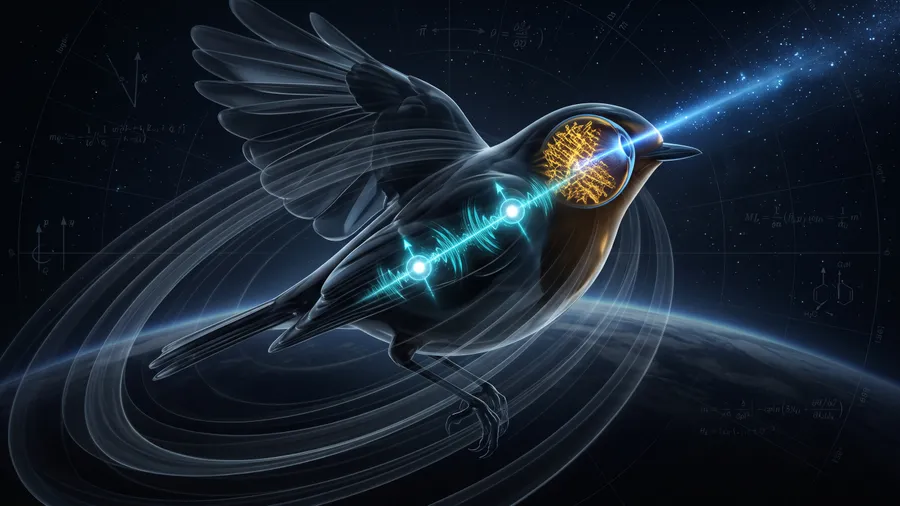
Every autumn, millions of migratory songbirds—such as the European robin—undertake journeys spanning thousands of kilometers across continents, navigating through dense fog and pitch-black nights with pinpoint accuracy.
Behavioral experiments in the 1970s revealed that birds possess an internal magnetic compass capable of detecting Earth’s faint magnetic field, which is thousands of times weaker than a typical refrigerator magnet.
Crucially, the avian compass exhibits peculiarities that classical physics cannot explain:
- It is inclination-based: birds do not distinguish magnetic north from south, but detect the angle at which magnetic field lines dip into the ground.
- It is light-dependent: birds can only navigate if their eyes are illuminated by blue light.
- It can be disrupted by minuscule amounts of high-frequency radio waves that carry far too little energy to alter chemical reaction kinetics classically.
In 2000, biophysicist Thorsten Ritz proposed the Radical Pair Mechanism, pinpointing specialized light-sensitive proteins in the bird’s retina called cryptochromes.
The quantum mechanism unfolds in a precise sequence:
- A blue photon enters the bird’s eye and strikes a cryptochrome protein.
- The absorbed photon causes an electron to leap along a chain of tryptophan amino acids to a flavin cofactor molecule.
- This charge transfer creates a pair of separated molecules, each holding an unpaired electron whose quantum spins are quantum mechanically entangled.
- The entangled radical pair oscillates between two quantum configurations: a singlet state (spins antiparallel) and a triplet state (spins parallel).
- Earth’s ultra-weak magnetic field subtly alters the ratio between these two states, changing the chemical lifespan of the signaling molecules before they recombine.
By translating sub-microscopic quantum spin correlations into visual signals in the brain, the bird literally perceives Earth’s magnetic contours as subtle patterns of light and shade overlaid on its normal vision.
Enzymes and Quantum Tunneling
Life could not exist without enzymes. These biological catalysts accelerate metabolic chemical reactions by factors of up to trillions, allowing processes that would otherwise take millennia to occur in fractions of a second.
The classical textbook explanation states that enzymes lower the activation energy barrier: thermal energy shakes the molecules until they randomly possess enough kinetic energy to climb over the energy hill.
However, detailed kinetic isotope experiments revealed that enzymes utilize a far more direct subatomic shortcut: Quantum Tunneling.
Under quantum mechanics, subatomic particles possess a finite wave nature. If an energy barrier is narrow enough, a particle does not need the energy to climb over the peak; its wave packet can penetrate straight through the barrier to appear on the other side.
Biochemists have confirmed that enzymes actively compress their internal binding pockets to widths of less than a fraction of an angstrom:
- Hydrogen nuclei (protons) and electrons tunnel directly through the physical barrier during critical metabolic steps, such as cellular respiration and DNA synthesis.
- When researchers replace hydrogen with its heavier isotope, deuterium, the reaction rate drops precipitously—a definitive mathematical signature of quantum wave tunneling.
Enzymes are precision-engineered quantum tunneling machines, fine-tuned by evolutionary pressures down to the subatomic scale.
The Vibrational Sense of Smell
A more controversial yet provocative hypothesis in quantum biology involves olfaction.
The traditional “lock and key” model posits that the human nose identifies odorants based purely on their physical three-dimensional shape: molecules fit into matching receptors like puzzle pieces.
However, molecules with identical molecular shapes can smell completely different, while structurally diverse molecules with identical chemical bonds can produce virtually indistinguishable aromas.
Biophysicist Luca Turin proposed an alternative: the Vibrational Theory of Olfaction.
According to this model, an olfactory receptor does not merely measure shape. When an odorant docks inside a receptor cavity:
- An electron attempts to jump from a donor site to an acceptor site via inelastic quantum tunneling.
- The electron can only complete the jump if the odorant molecule absorbs the exact energy difference through its internal molecular bonds.
- The receptor acts as a microscopic scanning spectrometer, identifying an odor by reading the quantized vibrational frequencies of its chemical bonds.
While still actively debated, recent experiments demonstrating that fruit flies and humans can distinguish between deuterated and non-deuterated versions of identical molecules lend compelling weight to the quantum sensing model.
Redefining the Nature of Life
The rise of quantum biology shatters the historic assumption that biology is merely complex organic chemistry built entirely on Newtonian mechanics.
Living cells are not clunky macroscopic factories governed solely by classical diffusion and thermodynamic collisions. Instead, life exists at the absolute boundary between quantum and classical physics—mastering the art of using thermal noise not to destroy quantum coherence, but to fuel, sustain, and steer subatomic phenomena for biological survival.
Understanding how life maintains quantum coherence in warm, noisy, and wet environments holds enormous potential for human technology. If science can reverse-engineer how a simple leaf routes excitons with 100 percent efficiency, or how a protein coordinates room-temperature quantum entanglement, it could revolutionize the design of room-temperature quantum computers, ultra-sensitive medical sensors, and biomimetic solar energy grids.
Life did not bypass the laws of the quantum universe; it harnessed them from the very beginning.