· biology · 7 min read
Endogenous Retroviruses: How Ancient Viral Infections Built the Mammalian Placenta
Roughly eight percent of the human genome is composed not of ancestral animal genes, but of ancient viral fossils. Without the molecular hijacking of a prehistoric viral envelope gene, mammals might never have evolved live birth.
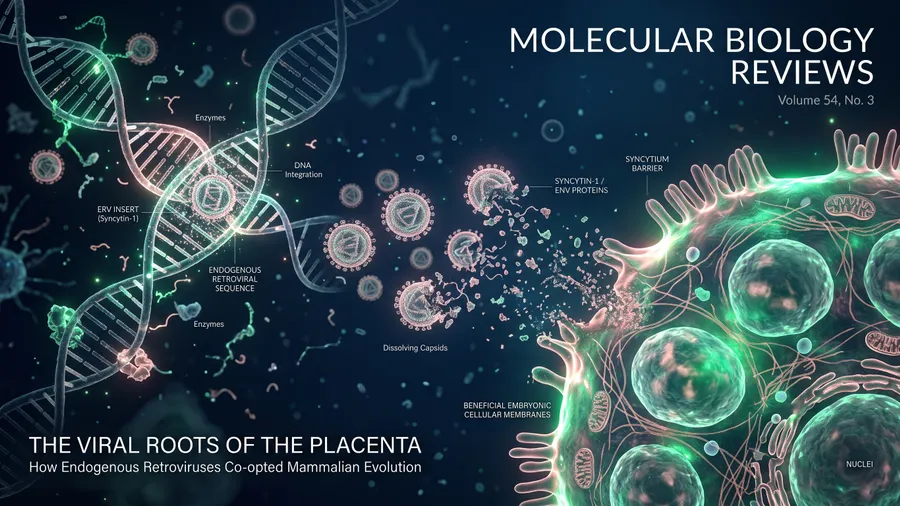
When the Human Genome Project published its landmark first draft in 2001, biologists were prepared to discover the genetic blueprint that separates human beings from the rest of the natural world. Instead, the sequencing data delivered a humbling revelation: the protein-coding genes that construct our muscles, brains, and internal organs make up less than two percent of our total DNA.
The remaining 98 percent—long dismissed in popular literature as useless “junk DNA”—turned out to be packed with a dark, enigmatic genomic graveyard.
Roughly eight percent of the human genetic sequence is composed entirely of Endogenous Retroviruses (ERVs). To put that figure into perspective, your cells carry more genetic material derived from ancient viral pathogens than all your protein-coding human genes combined.
For millions of years, these viral sequences were treated by science as parasitic genomic scars—molecular debris left behind by prehistoric epidemics.
However, modern molecular genetics has uncovered an astonishing evolutionary twist. We are not merely passive survivors of ancient viral plagues; our biology was fundamentally sculpted by them. Without a specific gene captured from a rampaging retrovirus tens of millions of years ago, human beings—and all placental mammals—would never have evolved live birth.
The Anatomy of a Genomic Invasion
To understand how a virus becomes a permanent part of our genome, one must examine the unique lifecycle of a retrovirus.
Most viruses infect an organism, hijack its cellular machinery to copy themselves, burst the host cell, and spread to the next victim. A retrovirus, such as HIV, operates with far greater stealth:
- A retrovirus carries its genetic code in the form of single-stranded RNA.
- Upon invading a host cell, it uses an enzyme called reverse transcriptase to convert its viral RNA into double-stranded DNA.
- It then uses another enzyme, integrase, to physically snip open the host’s chromosome and stitch the viral sequence directly into the host genome.
Once integrated, the virus becomes a permanent provirus within that cell. Usually, this infection occurs in somatic cells—such as blood or lung tissue—and dies with the individual.
However, on rare occasions throughout deep evolutionary time, an ancient retrovirus infected a germline cell—a sperm cell or an egg cell.
When that infected sperm or egg was fertilized, every cell in the resulting offspring inherited a copy of the viral DNA. The viral sequence entered the species’ gene pool, becoming an endogenous retrovirus passed down faithfully from parent to child across millions of generations.
Over time, random genetic mutations neutralized the viral elements, preventing them from assembling infectious viral particles, effectively turning them into domesticated genomic fossils.
The Great Evolutionary Paradox of Live Birth
Before the rise of placental mammals, terrestrial vertebrates laid eggs. The calcium shell provided a physical barrier that protected the developing embryo from physical trauma, pathogens, and critically, the mother’s own immune system.
When ancestral mammals made the monumental evolutionary transition from laying eggs to growing offspring internally, they encountered a severe immunological crisis known as the Fetal-Maternal Conflict:
- A developing mammalian fetus inherits half of its genetic material from the father.
- To the mother’s immune system, the paternal proteins expressed by fetal cells are biologically foreign antigens, indistinguishable from a parasitic worm or a foreign tissue graft.
- Left unmanaged, maternal killer T-cells and antibodies would rapidly swarm the uterus and destroy the embryo.
To survive, mammals had to invent an entirely new organ: the placenta.
The placenta had to accomplish two contradictory tasks at the exact same physical interface. It had to tap aggressively into the mother’s arterial bloodstream to extract oxygen and nutrients for the fetus, while simultaneously building an impenetrable biological wall that blocked maternal immune cells from attacking.
How could random biological mutation invent such an intricate, multi-layered physiological organ from scratch? Evolution did not invent it; it hijacked it from a virus.
The Syncytin Miracle
In 2000, geneticist Thierry Heidmann and his research team at the Institut Gustave Roussy in France made an extraordinary discovery while screening human placental cDNA libraries.
They identified a human gene that was expressed exclusively in the placenta. When they analyzed its amino acid sequence, they realized that the gene was not mammalian in origin. It was the intact envelope (env) gene of an ancient retrovirus called HERV-W, which had infected the germline of our primate ancestors roughly 25 to 30 million years ago.
The researchers named the captured gene Syncytin-1.
In an active retrovirus, the env protein serves two critical functions:
- Cellular Fusion: It binds to host cell receptors and forces the viral envelope to fuse seamlessly with the host cell membrane, allowing the virus to enter.
- Immunosuppression: It carries a specialized peptide sequence that actively suppresses the host’s immune cells, preventing the immune system from neutralizing the invading pathogen.
In mammalian evolution, nature co-opted these exact two viral weapons to construct the maternal-fetal boundary:
- During pregnancy, Syncytin-1 forces billions of fetal placental cells to lose their individual cell walls and fuse into a continuous, multi-nucleated cellular sheet called the syncytiotrophoblast.
- Because this layer is a seamless, fused syncytium without intercellular gaps, maternal immune cells cannot squeeze between the cells to reach the fetus.
- Simultaneously, the ancestral immunosuppressive sequence inherited from the virus blunts the local maternal immune response in the uterine wall, allowing the placenta to drink deeply from maternal arteries without triggering an immune assault.
The very mechanism that an ancient virus developed to invade host cells and evade the immune system became the molecular mechanism that protects developing human embryos in the womb.
Convergent Viral Capture Across the Tree of Life
The story of Syncytin becomes even more profound when comparing different mammalian lineages.
When researchers examined other placental mammals, they discovered that mice also rely on syncytin genes to construct their placentas. However, mouse syncytin genes (Syncytin-A and Syncytin-B) are completely different from human syncytin. Mice acquired their genes from an entirely distinct retrovirus that infected rodent ancestors roughly 20 million years ago.
When researchers analyzed sheep, cows, dogs, and cats, they discovered the same phenomenon:
- Ruminants independently co-opted a retroviral envelope gene called syncytin-rum1.
- Carnivores (cats and dogs) independently captured a distinct viral gene called syncytin-car1.
This represents one of the most striking examples of convergent evolution in natural history. Across dozens of independent mammalian lineages, different animals facing the exact same physiological dilemma repeatedly captured different retroviruses from the wild to construct their placentas.
Live birth was not invented once by mammals; it was repeatedly enabled by recurrent viral epidemics across the last 100 million years.
Beyond the Placenta: The Viral Mind
The influence of endogenous retroviruses extends far beyond the reproductive system. Recent neuroscience research reveals that ancient viral proteins also play an indispensable role in the architecture of the human brain.
In 2018, researchers discovered that a mammalian gene called Arc—which is critical for synaptic plasticity, long-term memory formation, and learning—is derived from the gag gene of an ancient retrotransposon.
The Arc protein in human neurons still behaves like a viral shell:
- When a neuron fires during a learning event, Arc proteins assemble into hollow capsids that look identical to viral coats.
- These capsids package messenger RNA (mRNA) inside themselves, bud out of the parent neuron, and travel across the synapse to deliver their genetic cargo into neighboring neurons.
Our conscious ability to form memories and retain knowledge relies on neuronal communication systems repurposed directly from prehistoric retroviruses.
The Chimeric Species
The discovery of endogenous retroviruses dismantles the classical Victorian view of evolution as a sterile tree where species diversify exclusively through slow, isolated internal mutations.
Life is not a clean, solitary lineage. It is an intricate, chimeric mosaic.
We carry the scars, the weapons, and the biological machinery of the very pathogens that once threatened to drive our ancestors to extinction. The virus that once terrorized an ancient primate was tamed, woven into our chromosomes, and transformed into the biological shield that allows every human mother to carry a child to term.
We are not merely the descendants of primates. We are living, thinking products of an ancient and enduring partnership with the viral world.