· neuroscience · 6 min read
Blindsight: How the Human Brain Can See Without Conscious Awareness
Patients with damage to the primary visual cortex insist they are completely blind—yet they can accurately reach for objects, identify facial expressions, and navigate obstacle courses they genuinely cannot see.
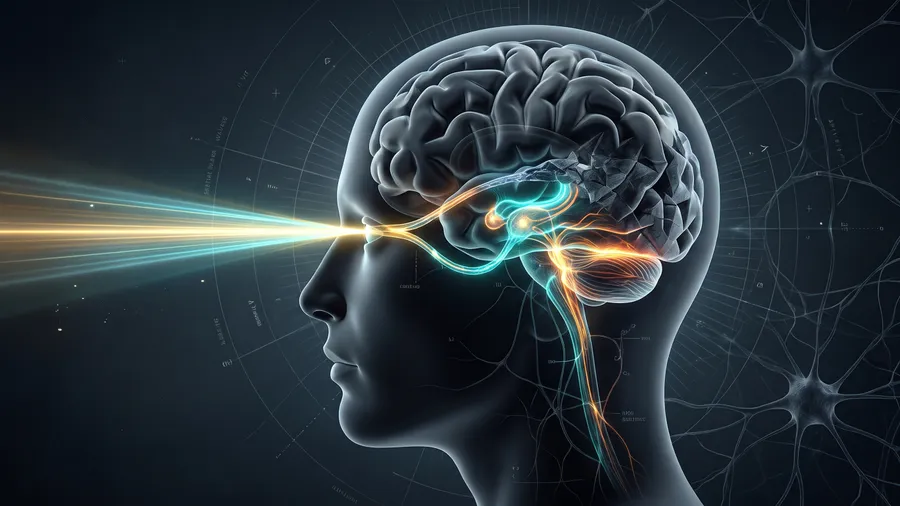
In 1973, a young man known in medical literature as Patient D.B. underwent brain surgery at the National Hospital in London to remove a malformed cluster of blood vessels pressing against the back of his brain. The surgery saved his life, but it required removing a section of his right primary visual cortex.
When D.B. recovered, he had lost all conscious sight in the left half of his visual field. To his subjective experience, everything to the left of his nose had vanished into total, featureless darkness.
Yet, when neuropsychologist Lawrence Weiskrantz began testing D.B., something extraordinary happened. Weiskrantz held up a stick in D.B.’s blind visual field and asked him to guess whether it was tilted horizontally or vertically. D.B. protested that the exercise was absurd—he could see nothing at all.
When pressed to simply guess anyway, D.B. answered correctly over 90 percent of the time. When asked to point toward a dot of light flashed in his blind zone, his finger landed on the exact target repeatedly, even as he insisted he was making wild, blind guesses.
Weiskrantz coined a paradoxical term for this phenomenon: blindsight.
Blindsight demonstrates one of the most startling truths in modern cognitive neuroscience: the human brain can receive, process, and act upon complex visual information with astonishing precision while generating zero conscious awareness that anything was seen at all.
Cortical Blindness: Healthy Eyes, Dark Mind
To understand how someone can “see” without knowing it, one must separate the biological camera from the conscious screen.
In most cases of ordinary blindness, damage occurs in the eyes, the retina, or the optic nerve—preventing light signals from ever reaching the brain. In cortical blindness, however, the eyes, lenses, and optic nerves remain completely intact and functional.
Instead, the damage occurs at the back of the brain in the occipital lobe, specifically within the primary visual cortex (also known as Area V1 or the striate cortex).
- Area V1 serves as the brain’s primary conscious visual gateway.
- When V1 is destroyed by a stroke, traumatic injury, or tumor, the brain loses its ability to assemble incoming light signals into a conscious visual image.
- Crucially, patients with blindsight do not experience “blackness” in the way a sighted person sees a dark room; rather, they experience a complete absence of visual qualia—similar to how you perceive the space directly behind your head.
For decades, neurologists assumed that destroying V1 severed all visual processing entirely. Blindsight proved that V1 is merely the main highway to conscious awareness, not the only visual pathway inside the skull.
The Two Visual Highways of the Brain
Evolution did not build the human visual system all at once. Instead, our brains retain two distinct anatomical pathways that carry visual data from the retina into the central nervous system:
- The Geniculostriate Pathway (Conscious Vision): Roughly 90 percent of the nerve fibers leaving the retina travel through the lateral geniculate nucleus (LGN) of the thalamus directly into Area V1. From there, signals radiate outward to specialized cortical areas that process color, fine detail, object recognition, and conscious visual awareness.
- The Retinotectal Pathway (Ancient Subcortical Vision): The remaining 10 percent of retinal fibers bypass V1 altogether. Instead, they route directly into ancient, deep-brain structures—most notably the superior colliculus in the midbrain and the pulvinar nucleus of the thalamus.
This secondary retinotectal circuit is hundreds of millions of years older than the mammalian neocortex. Amphibians, reptiles, and birds rely on this exact subcortical architecture to track fast-moving prey and dodge incoming predators without possessing a complex human cerebral cortex.
In humans with V1 damage, the conscious highway is blocked, but the ancient evolutionary detour remains open. Visual signals still enter the eyes, travel down the optic nerve, bypass the damaged V1 region via the superior colliculus and pulvinar, and directly feed motor and emotional circuits in the rest of the brain.
Navigating an Obstacle Course in the Dark
The capabilities of this unconscious visual system extend far beyond detecting simple points of light.
In 2008, neuroscientist Beatrice de Gelder and her colleagues conducted a landmark experiment with a patient known as T.N., a physician who had suffered two consecutive strokes that completely destroyed Area V1 in both hemispheres of his brain. T.N. was totally cortically blind and relied on a white cane to walk.
Researchers asked T.N. to walk down a long hospital corridor without his cane. Unknown to him, they had cluttered the hallway with boxes, chairs, and office equipment.
- T.N. stepped forward, genuinely believing he was walking down an empty hallway in total blindness.
- As he walked, he smoothly sidestepped the boxes, angled his shoulders to slip past chairs, and navigated around every single obstacle without colliding with a single object.
- When he reached the end of the corridor and was asked how he had avoided the clutter, T.N. was bewildered—he had no conscious memory or awareness that any obstacles had ever been in his path.
His unconscious visuomotor pathways had mapped the three-dimensional geometry of the room and steered his body around hazards while his conscious mind remained completely in the dark.
Affective Blindsight: Feeling an Unseen Face
Even more remarkable is a subtype of the condition known as affective blindsight—the ability to perceive human emotions without seeing a human face.
When researchers flash photographs of human faces displaying strong emotions—such as fear, anger, or joy—into the blind visual field of a blindsight patient:
- The patient reports seeing nothing.
- Yet, when forced to guess the emotion, they identify fearful and angry expressions far above chance levels.
- Functional MRI scans reveal why: visual signals bypass V1 and travel rapidly via the superior colliculus and pulvinar straight into the amygdala, the brain’s threat-detection and emotional processing hub.
In milliseconds, the patient’s pupils dilate, their heart rate shifts subtly, and their facial muscles unconsciously mimic the expression of the unseen photograph. The brain registers emotional danger long before the conscious mind is ever invited to the table.
Rethinking the Purpose of Consciousness
Blindsight forces neuroscientists and philosophers to confront a profound question: if our unconscious neural circuits can track moving objects, guide our hands to grasp targets, steer our bodies around obstacles, and read emotional expressions on human faces, why do we need conscious visual awareness at all?
The phenomenon reveals a fundamental division of labor in the human nervous system:
- Unconscious Vision for Action: Fast, automatic, and subcortical, designed for immediate survival, spatial navigation, and reflexive threat avoidance in the present moment.
- Conscious Vision for Deliberation: Slower, richer, and cortical, designed to construct a unified, stable model of the world that allows us to plan into the future, reflect on memories, communicate abstract ideas, and make deliberate strategic choices.
The Hidden Pilot Inside the Brain
Blindsight is not merely a rare neurological curiosity confined to medical textbooks. Every healthy human being relies on these exact unconscious visual pathways every single day.
When you instinctively duck before consciously realizing a ball is flying toward your head, or automatically adjust your footing on an uneven staircase while deep in conversation, your ancient retinotectal pathways are steering your body before conscious perception catches up.
We like to believe that our conscious self sits at the helm of the mind, observing the world clearly and issuing every command. Blindsight gently reminds us that beneath the spotlight of conscious awareness lies a vast, silent intelligence—watching, calculating, and protecting us in the dark.