· neuroscience · 6 min read
The Readiness Potential: How the Brain Decides Before the Mind Is Aware
Benjamin Libet's landmark experiments revealed that the brain initiates motor actions hundreds of milliseconds before a person feels the conscious urge to act—challenging our deepest assumptions about free will.
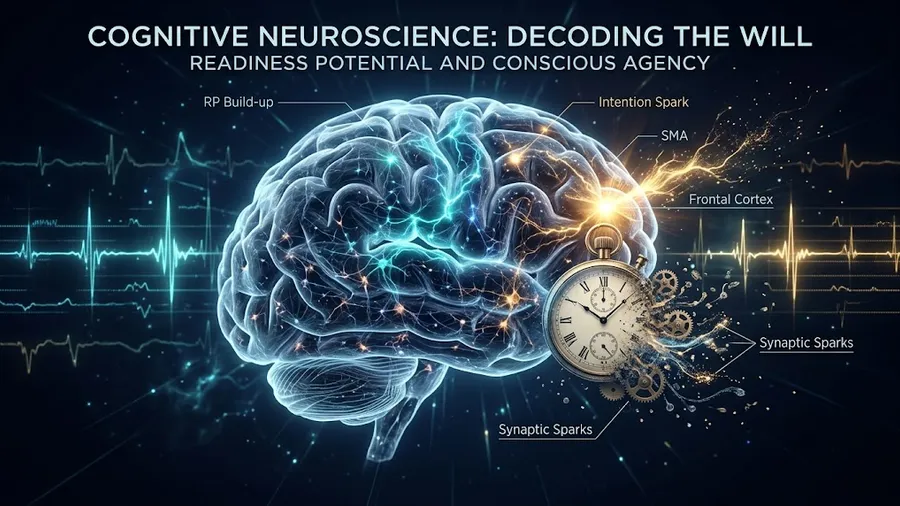
In daily conscious life, nothing feels more immediate or unquestionable than subjective agency. You decide to reach for a cup of coffee, and your arm extends. You choose to read the next word, and your eyes track across the screen. For centuries, Western philosophy and classical psychology treated this conscious intent as the uncaused prime mover of human behavior: the conscious mind issues a command, and the physical machinery of the nervous system executes it.
However, modern neurobiology has exposed a disquieting truth beneath this intuition.
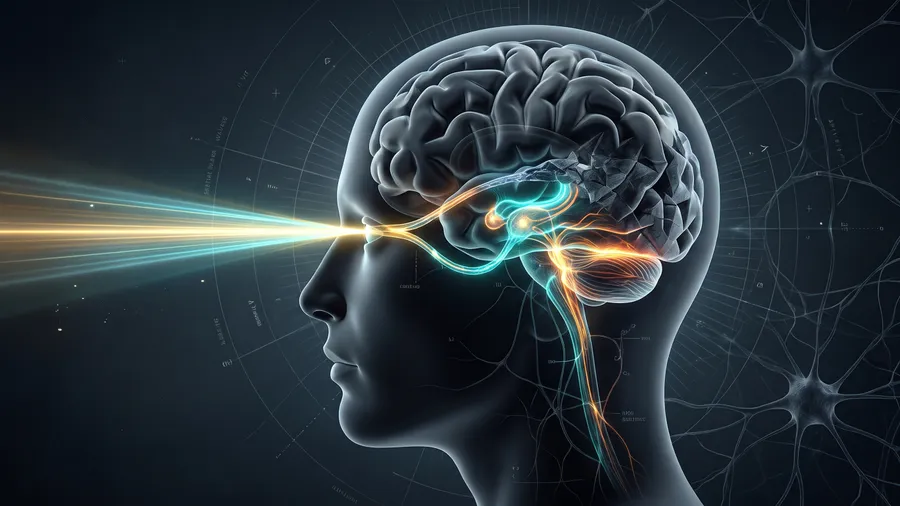
Through precise electrophysiological recordings of the human brain, neuroscientists discovered that before you ever experience the conscious urge to move a muscle, the physical circuits of your motor cortex have already been preparing that exact action for hundreds of milliseconds.
This neural precursor—known as the Readiness Potential (or Bereitschaftspotential)—ignited one of the most contentious scientific debates in modern history: is conscious free will an active pilot, or merely a retrospective storyteller?
The Discovery of the Bereitschaftspotential
The story of the readiness potential began in 1964 at the University of Freiburg, where German neurologists Hans Helmut Kornhuber and Lüder Deecke set out to record electrical activity in the brain preceding spontaneous movement.
Using electroencephalography (EEG) on human volunteers, they instructed subjects to flex a finger whenever they felt like it, at self-determined intervals:
- By continuously recording cortical brainwaves and averaging hundreds of trials together, Kornhuber and Deecke detected a subtle, negative electrical voltage shift.
- This electrical wave did not begin at the instant of movement.
- It began building up in the supplementary motor area and primary motor cortex nearly a full second before the physical muscle contraction occurred.
Kornhuber and Deecke named this electrical wave the Bereitschaftspotential, translated into English as the Readiness Potential.
While their discovery proved that voluntary movement requires measurable preparatory neural energy, it left a profound philosophical question unanswered: at what point during that electrical build-up does the subject actually make the conscious decision to act?
Benjamin Libet and the Chronometry of Intent
In the late 1970s and early 1980s, neurophysiologist Benjamin Libet at the University of California, San Francisco, designed an experiment to pinpoint the exact timing of conscious awareness.
To measure conscious intent with millisecond precision, Libet constructed an ingenious setup:
- The Oscilloscope Clock: Participants watched a specialized cathode-ray clock with a bright dot revolving rapidly around its circumference (completing a full loop in roughly 2.5 seconds).
- The Task: Participants were instructed to let an urge to flex their wrist arise spontaneously. Whenever they felt the urge, they moved their wrist.
- The Judgment (Time W): Immediately after flexing, participants reported the exact position of the revolving dot on the clock face at the precise instant they first became consciously aware of their intention to move.
- The Physiological Sensors: EEG electrodes measured the readiness potential in the brain, while electromyogram (EMG) sensors on the wrist recorded the exact millisecond of physical muscle contraction.
The Troubling Timeline
When Libet correlated the electrical recordings with the subjective reports of conscious awareness, the chronological sequence stunned the scientific community:
- Readiness Potential Onset: The electrical buildup in the motor cortex began approximately 550 milliseconds before muscle movement.
- Conscious Awareness (Time W): The participant reported the first conscious awareness of wanting to move approximately 200 milliseconds before muscle movement.
- Physical Action: The muscles fired at 0 milliseconds.
The conscious feeling of making a decision did not precede the brain’s electrical preparation. Instead, the brain initiated the cascade of motor preparations approximately 350 milliseconds before the person consciously registered the intention to act.
The implication was staggering: the brain had already determined the course of action well before the conscious “self” arrived on the scene. The conscious will was not initiating the action; it was being informed of a decision that unconscious neural networks had already made.
The Modern Escalation: Seconds Ahead of Awareness
Early critics argued that Libet’s 350-millisecond gap was too small to draw sweeping conclusions, pointing to potential delays in human reporting or measurement error.
However, in 2008, neuroscientist John-Dylan Haynes and his team at the Bernstein Center for Computational Neuroscience in Berlin revisited the experiment using high-resolution functional Magnetic Resonance Imaging (fMRI).
Haynes presented subjects with two buttons and asked them to freely choose whether to press the left or right button with their index fingers, noting when they consciously decided:
- By training machine-learning classifiers to analyze spatial patterns of brain activity in the frontopolar and parietal cortex, the researchers could predict which button the subject was going to press.
- The predictive patterns emerged not hundreds of milliseconds ahead, but up to 7 to 10 seconds before the participant was consciously aware of their choice.
Subsequent studies in 2011 led by neurosurgeon Itzhak Fried, recording directly from single neurons inside the human brain during awake neurosurgery, confirmed that firing rate changes in small clusters of neurons in the medial frontal cortex could predict voluntary choices with high accuracy over a full second before conscious awareness.
Libet’s “Free Won’t”: The Veto Window
Confronted with the unsettling conclusion that conscious agency might be an illusion, Benjamin Libet proposed a crucial qualification: The Conscious Veto.
While conscious intent arrives too late to initiate voluntary action, Libet noted that there remains a window of approximately 100 to 150 milliseconds between conscious awareness (Time W) and the final physical muscle trigger:
- The unconscious brain generates the motor impulse.
- The conscious mind becomes aware of the impending impulse.
- In those final 100 milliseconds, consciousness retains the executive power to either approve the action or veto it.
In Libet’s view, human agency does not reside in “free will” (originating thoughts or impulses), but in “free won’t”—the inhibitory capacity of the prefrontal cortex to abort actions proposed by deeper neural networks.
The Stochastic Alternative: Noise Accumulation
In 2012, cognitive neuroscientist Aaron Schurger at the Swiss Federal Institute of Technology (EPFL) offered a groundbreaking reinterpretation of the readiness potential that challenged the idea of unconscious determinism.
Schurger demonstrated that the human brain continuously produces spontaneous, background neural noise. When a person is instructed to perform an arbitrary, purposeless action (like randomly tapping a finger):
- The motor cortex does not generate a deliberate, unconscious plan.
- Instead, spontaneous fluctuations of background neural activity ebb and flow.
- When that random background fluctuation happens to cross a critical decision threshold, the motor movement is triggered.
Because Libet averaged trials backward from the moment of the movement, the mathematical averaging artificially creates the appearance of a smooth, rising ramp of electrical buildup.
Under Schurger’s model, the readiness potential is not an unconscious decision already made; it is the crest of a neural wave of background noise, upon which conscious deliberation and hesitation ride.
Reconstructing Agency in Cognitive Science
The exploration of the readiness potential does not reduce human beings to mindless biological automatons. Rather, it dismantles the Cartesian myth that the conscious mind exists in a detached control tower, pulling physical levers in real time.
Complex human actions—such as playing a musical instrument, solving an equation, or making long-term moral decisions—do not rely on isolated 200-millisecond motor twitches. They rely on vast, hierarchical networks of past learning, reflective planning, and executive inhibition operating across seconds, days, and years.
The readiness potential teaches us that our consciousness is not a separated, magical spectator commanding the body from outside. Consciousness is woven into the physical substrate of the brain itself—an exquisite emergent process that monitors, integrates, and guides the vast unconscious machinery that keeps us moving forward.