· neuroscience · 5 min read
Synesthesia: How Crossed Neural Wiring Allows the Brain to Hear Colors and Taste Words
For roughly four percent of the human population, sensory boundaries dissolve: musical notes trigger vivid flashes of color, spoken words evoke distinct flavors, and numbers carry fixed personalities. Inside the neurobiology of a brain that blends the senses.
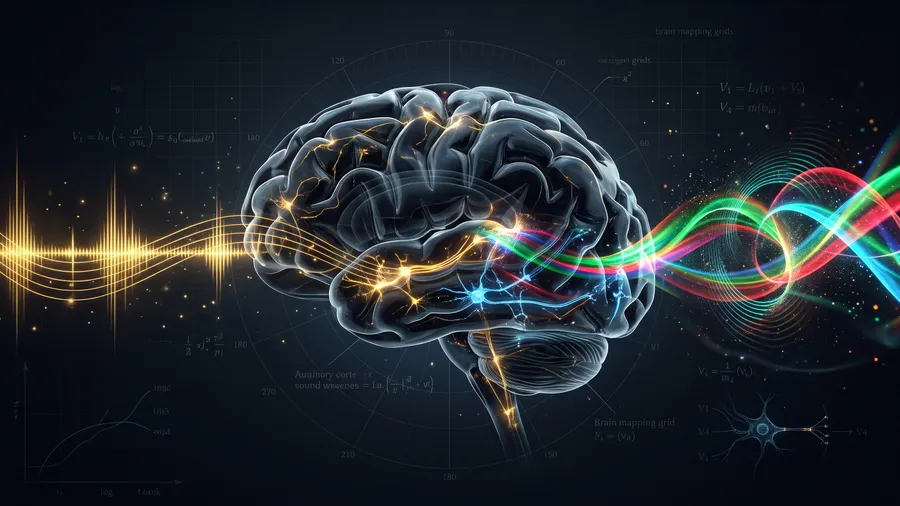
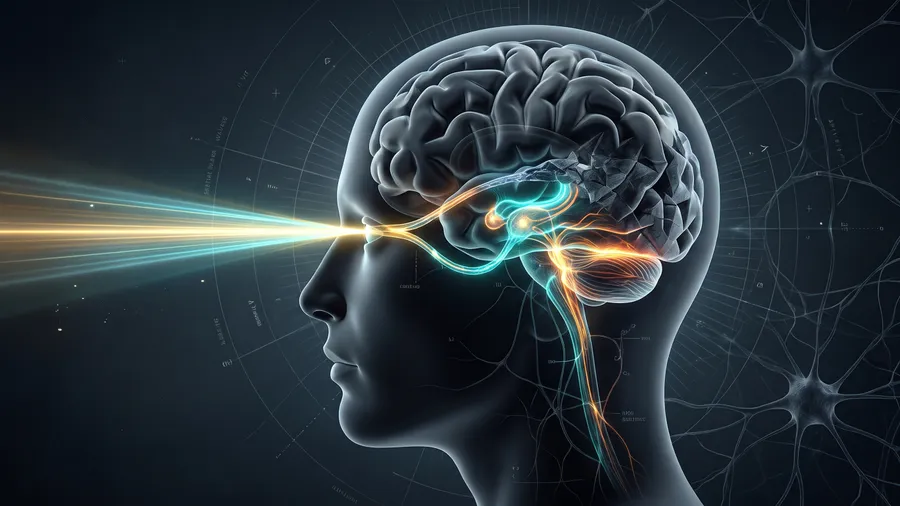
For most human beings, the five senses operate like strictly segregated departments inside a well-organized office. Light entering the eyes is routed to the visual cortex at the back of the brain; sound waves vibrating in the ears travel to the auditory cortex near the temples; molecules on the tongue register in the gustatory cortex. You see a painting, hear a cello, and taste a lemon—and those sensory channels never leak into one another.
Yet, for roughly four percent of the human population, those neural walls are porous.
In a neurological phenomenon known as synesthesia—from the ancient Greek syn (together) and aisthesis (perception)—the stimulation of one sensory or cognitive pathway automatically and involuntarily triggers an experience in a completely different sensory channel.
For a person with synesthesia, the number 5 might always appear emerald green, the sound of a trumpet might burst across their field of vision as scarlet ribbons, or reading the word “table” might flood their mouth with the distinct taste of cold butter.
Far from being a poetic metaphor or an active imagination, neuroimaging reveals that synesthesia is a genuine, measurable difference in the physical wiring of the human brain.
A Kaleidoscope of Blended Senses
Neuroscientists have cataloged more than sixty distinct forms of synesthesia, each linking different sensory or conceptual networks:
- Grapheme-Color Synesthesia: The most common form, in which individual letters, numbers, or days of the week are automatically perceived with specific, unchangeable colors. To a grapheme-color synesthete, the letter “A” is never just black ink on a white page—it carries an intrinsic, consistent hue such as crimson or cobalt blue.
- Chromesthesia (Sound-to-Color): Everyday sounds, voices, or musical chords evoke vivid, moving shapes, textures, and colors. Composers such as Franz Liszt, Olivier Messiaen, and Duke Ellington famously experienced musical keys as distinct color palettes.
- Lexical-Gustatory Synesthesia: One of the rarest variants, where hearing, reading, or thinking about specific words triggers unmistakable, physical sensations of taste and texture on the tongue—such as bacon, peppermint, or wet cardboard.
- Mirror-Touch Synesthesia: Observing another person being touched on the cheek or shoulder activates the observer’s own somatosensory cortex so strongly that they physically feel a phantom sensation of touch on the corresponding part of their own body.
Regardless of the specific variant, true synesthesia obeys two strict clinical rules: it is involuntary (synesthetes cannot simply turn the experience off) and lifelong consistent (if the letter “R” was forest green at age seven, it will still be the exact same shade of forest green at age seventy).
Proof Inside the Brain: The Pop-Out Experiment
For decades, skeptical psychologists dismissed synesthesia as childhood memory associations—assuming, for instance, that someone saw the letter “A” as red simply because they played with red refrigerator magnets as a toddler.
In the early 2000s, neuroscientist V.S. Ramachandran and his colleagues devised an ingenious perceptual test that proved synesthesia occurs at the earliest stages of visual processing, long before conscious memory is involved:
- Researchers presented participants with a dense grid filled with black digital-clock style “5”s, with a triangle of black “2”s hidden subtly inside the pattern.
- Because the digital “2” and “5” are exact mirror shapes composed of identical horizontal and vertical lines, non-synesthetes must scan the page line by line—taking several seconds to spot the hidden triangle.
- Grapheme-color synesthetes, however, spotted the hidden triangle instantaneously. Because their brains automatically painted all the “5”s green and all the “2”s red, the red triangle popped out of the green background immediately, just as if it had been printed in colored ink.
Functional MRI scans confirmed what the behavioral test implied: when grapheme-color synesthetes look at black-and-white numbers, Area V4—the specialized color-processing hub in the visual cortex—lights up immediately alongside the visual word-form area.
The Pruning Hypothesis: Why Infants May All Be Synesthetes
How does a human brain end up with cross-wired sensory regions? The answer lies in how the brain sculpts itself during the first few months of life.
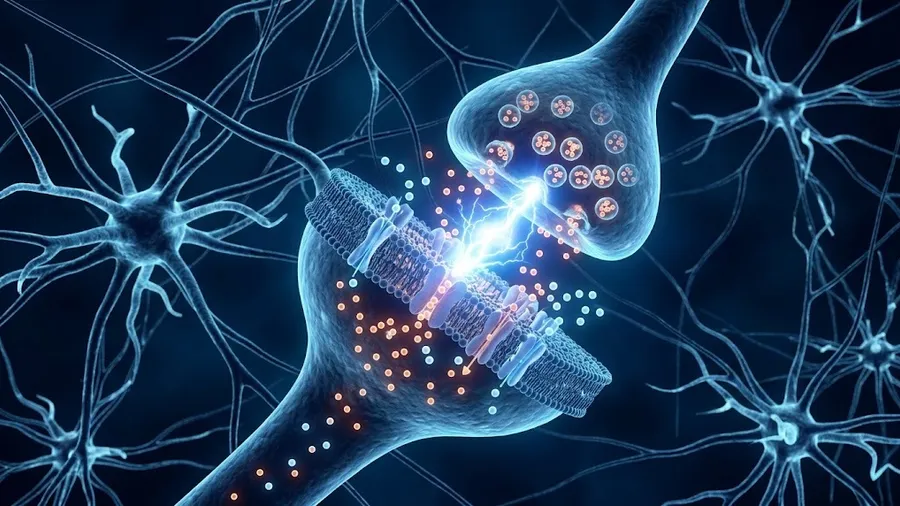
When a human infant is born, the brain contains a vast overabundance of synaptic connections linking nearly every cortical region to its neighbors—meaning the auditory cortex, visual cortex, and tactile centers are heavily interconnected.
During normal infant development, a process called synaptic pruning systematically trims away unused, redundant pathways, carving out isolated, specialized sensory modules.
Neuroscientists hypothesize that synesthesia arises from a genetic variation that slows down or reduces synaptic pruning between adjacent cortical areas:
- In the human temporal lobe, the visual word-form area (which recognizes printed letters and numbers) sits directly next to Area V4 (which processes color).
- When residual cross-wiring remains intact between these neighboring hubs, electrical signals identifying the shape of a number spill straight across the boundary into the color center.
- Similarly, the brain’s auditory processing regions sit adjacent to visual motion and color pathways, explaining why sound-to-color synesthesia is so prevalent.
Diffusion tensor imaging (DTI)—an MRI technique that maps white-matter nerve fiber tracts—has directly confirmed that synesthetes possess denser, hyper-connected white-matter bridges linking sensory territories compared to the general population.
A Window Into Consciousness and Metaphor
Studying synesthesia has opened an extraordinary window into how the human brain constructs subjective reality—and even how human language evolved.
Consider how effortlessly non-synesthetes use cross-sensory metaphors in everyday speech: we describe cheddar cheese as “sharp,” a voice as “velvety,” a color as “loud,” or a musical melody as “sweet.”
In a classic experiment known as the Bouba/Kiki effect, researchers show people two abstract shapes—one jagged and spiky, the other rounded and blob-like—and ask which one is named “Bouba” and which is “Kiki.” Across cultures and languages worldwide, roughly 95 percent of people assign “Kiki” to the sharp shape and “Bouba” to the round shape, reflecting a natural, hardwired cross-talk between the visual cortex and the auditory-motor centers of the brain.
Synesthesia is not a neurological defect or hallucination; rather, it is an amplified expression of the latent cross-sensory architecture shared by all human minds—revealing that the seamless world we perceive is actively stitched together behind the scenes by billions of whispering neurons.