· neuroscience · 8 min read
The Split-Brain Phenomenon: Can a Single Skull Harbor Two Separate Conscious Minds?
When surgeons severed the corpus callosum to treat intractable epilepsy, neuroscientists uncovered a haunting reality: two distinct, self-contained conscious agents residing within the same brain, each capable of independent perception, memory, and intent.
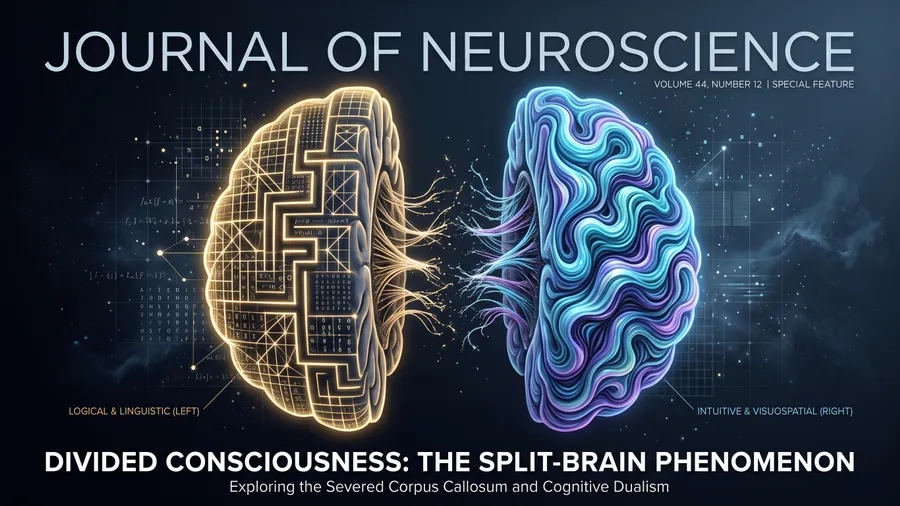
Throughout human history, virtually every philosophical tradition and personal intuition has agreed on one foundational premise: the indivisible unity of the conscious self. You perceive the world from a single vantage point, deliberate choices with a single inner monologue, and experience your memories, sensations, and motor actions as belonging to one unified entity—the “I.”
René Descartes famously argued that because our subjective experience of thought is whole and unified, the soul must interact with the brain at a single, centralized anatomical point—which he speculated to be the pineal gland.
However, in the mid-20th century, a drastic surgical procedure for severe medical epilepsy shattered this ancient conviction.
By physically cutting the massive neural superhighway connecting the two halves of the human brain, neurosurgeons and cognitive scientists revealed a haunting truth: our feeling of possessing a single, unified mind is an illusion maintained by an ultra-fast biological communications cable.
Sever that cable, and a single human skull reveals two separate, self-contained minds operating side by side—each perceiving its own reality, harboring its own private memories, and making independent choices.
The Great Commissure and the Radical Cure
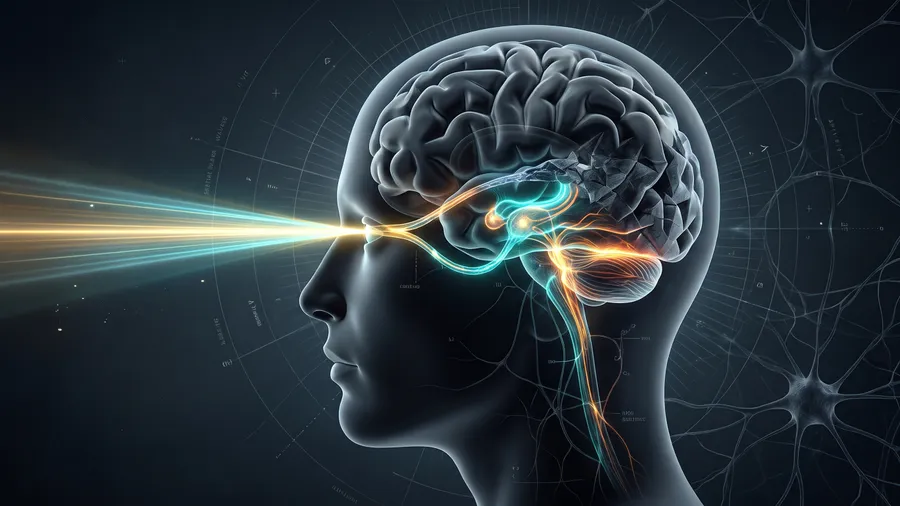
The human brain is physically split into two distinct cerebral hemispheres: the left and the right. While each hemisphere possesses its own specialized cortical architecture, they are bridged by the corpus callosum—a thick, dense cable of over 200 million myelinated nerve fibers.
In the 1940s and 1960s, neurosurgeons encountered patients suffering from catastrophic, life-threatening epilepsy. Electrical storms generated in one hemisphere would propagate across the corpus callosum, bouncing violently back and forth between both halves of the brain in an uncontrollable feedback loop.
To save these patients, surgeons William van Wagenen, Philip Vogel, and Joseph Bogen performed a procedure called a complete corpus callosotomy: they meticulously cut the corpus callosum, severing the anatomical connection between the left and right hemispheres.
At first glance, the surgery seemed like an unqualified miracle. The devastating seizures dropped dramatically or vanished entirely. Even more astonishing to early observers was that the patients appeared completely normal in casual conversation. Their IQ remained intact, their personalities were recognizable, and their everyday motor coordination seemed unaffected.
For a brief period, physicians half-jokingly wondered whether the massive corpus callosum served any functional purpose at all other than mechanically keeping the two halves of the brain from falling apart.
Sperry, Gazzaniga, and the Split Laboratory
In the early 1960s, neurobiologist Roger Sperry (who later received the Nobel Prize in Physiology or Medicine for this work) and his graduate student Michael Gazzaniga realized that standard clinical observations were too coarse to detect what had actually happened.
To investigate the inner lives of these split-brain patients, Sperry and Gazzaniga exploited the hardwired anatomy of the human sensory nervous system:
- Contralateral Visual Wiring: Visual inputs from the right visual field (everything to the right of where your eyes focus) are routed exclusively to the left hemisphere. Visual inputs from the left visual field are routed exclusively to the right hemisphere.
- Motor Control: The left hemisphere directs the motor movements of the right hand and right side of the body, while the right hemisphere directs the left hand and left side of the body.
- The Speech Center: In roughly 95 percent of right-handed humans, the neural circuits capable of producing articulate, spoken language (such as Broca’s area) reside exclusively in the left hemisphere. The right hemisphere is largely mute, possessing only basic comprehension.
In an intact brain, information received by one hemisphere instantly crosses the corpus callosum within milliseconds, allowing both halves to know what the other is seeing and feeling.
In a split-brain patient, that bridge was gone.
The Experiment: Two Realities in One Head
Gazzaniga designed a testing apparatus where patients focused on a central dot on a screen. Words or pictures were flashed for a tenth of a second—too fast for the patient’s eyes to shift gaze:
- Flashing to the Right Visual Field: A picture of an apple flashed to the right of the dot. The signal traveled to the left hemisphere. Because the left hemisphere possesses speech, the patient immediately said: “I saw an apple.”
- Flashing to the Left Visual Field: A picture of a spoon flashed to the left of the dot. The signal traveled exclusively to the mute right hemisphere. When Gazzaniga asked the patient what they saw, the vocal left hemisphere answered truthfully based on its own awareness: “I saw nothing.”
However, Gazzaniga placed an array of physical objects hidden behind a curtain, shielded from the patient’s sight. He instructed the patient to reach behind the curtain with their left hand (controlled by the right hemisphere) and pick up whatever felt familiar.
The patient’s left hand felt through the objects and immediately picked up the spoon.
When the researchers asked the patient why their hand was holding a spoon, the speaking left hemisphere was completely bewildered. It had watched the left hand move, but had zero knowledge of why it had done so.
The right hemisphere was fully conscious, recognized the image, understood the verbal instruction, remembered the target, and executed the physical choice—all while the verbal left hemisphere sitting inches away was completely oblivious to its existence.
The Alien Hand and Internal Rebellion
In clinical settings, this sensory segregation occasionally escalated into direct physical conflict between the two hemispheres, a condition known as Alien Hand Syndrome.
Without the continuous unifying signal of the corpus callosum, each hemisphere acted on its own distinct intentions:
- One patient reported picking out an outfit in the morning: her left hand would grab a dress from the closet, only for her right hand to shove it back and pull out a different dress.
- Another patient reported that while he was driving, his left hand suddenly grabbed the steering wheel and attempted to turn the vehicle toward oncoming traffic, forcing his right hand to physically grapple and pry the left hand away.
- In another trial, a patient reached out to embrace his spouse with his right arm, while his left hand unexpectedly struck her across the face.
These bizarre cases were not involuntary muscular spasms. Electromyography confirmed that both hands were executing deliberate, coordinated, goal-oriented motor sequences.
Two distinct wills were issuing contradictory physical commands to the same body.
The Left-Brain “Interpreter” Module
One of Michael Gazzaniga’s most profound discoveries during split-brain research was what he coined The Interpreter: a specialized neural module in the left hemisphere dedicated to weaving fragmented events into a seamless, sensible narrative.
In one iconic experiment, Gazzaniga presented two images simultaneously:
- A picture of a chicken claw flashed to the left hemisphere (right visual field).
- A picture of a snow-covered house flashed to the right hemisphere (left visual field).
The patient was then shown an array of pictures and asked to choose matching items with both hands. The right hand picked a picture of a chicken (matching the claw), while the left hand picked a snow shovel (matching the winter scene).
When asked: “Why did you choose those items?”, a rational observer would expect the verbal left hemisphere to say: “I don’t know why my left hand chose the shovel, but I chose the chicken because I saw a claw.”
Instead, without missing a beat, the left hemisphere instantly invented a fictional explanation:
“Oh, that’s easy. The chicken claw goes with the chicken, and you need a shovel to clean out the chicken coop.”
The left hemisphere had zero access to the snowy scene perceived by the right hemisphere. Rather than admitting ignorance, its internal Interpreter fabricated a post-hoc, retroactive story to justify the physical action taken by the other half of the brain, completely believing its own fiction.
This demonstrated that much of what we experience as conscious deliberation is actually a retroactive public relations campaign—a cognitive module that observes actions generated by disconnected neural networks and invents a logical rationale to maintain the illusion of control.
Philosophical Fallout: What Is the Self?
The split-brain phenomenon dismantled two thousand years of Cartesian dualism and forced modern philosophy of mind to confront deeply unsettling questions:
- If cutting a four-inch band of nerve fibers cuts conscious identity into two autonomous thinking agents, consciousness cannot be an indivisible metaphysical entity. It is an emergent biological network.
- Are intact human beings truly a single conscious agent, or are we an integrated confederation of semi-autonomous modules held in check by continuous interhemispheric dialogue?
- Does the mute right hemisphere possess its own moral standing, its own existential hopes, and its own personal suffering that it simply cannot articulate to the outside world?
Subsequent experiments showed that the right hemisphere possesses its own distinct sense of self, its own emotional responses, and can even disagree with the left hemisphere on personal preferences, career goals, and religious beliefs.
The Illusion of the Solitary Pilot
The split-brain patients did not have two minds created by the neurosurgeon’s scalpel; the scalpel merely revealed the hidden architecture that was already there.
Our perception of a single, continuous, indivisible “self” is not a fundamental fact of nature. It is a biological construction—a brilliantly coordinated symphony played across hundreds of millions of axonal bridges.
Beneath the calm surface of our daily thoughts lies a vast congress of specialized neural processors, conversing so rapidly that we mistake their harmony for a solitary voice.