· earth-science · 6 min read
Geomagnetic Reversals: What Happens When Earth's Magnetic Poles Flip
Written into ancient volcanic lava and ocean-floor sediments is a startling geological record: Earth's magnetic north and south poles have traded places hundreds of times—and our planet's protective shield weakens dramatically during the transition.
If you pull out a hiking compass today, its magnetized needle swings reliably toward the Arctic. For virtually all of human civilization, “magnetic north” has pointed toward the top of the globe—an invisible navigational anchor that guided ancient mariners across uncharted oceans and shields modern satellites from solar radiation.
Yet, when geophysicists examine ancient volcanic rocks and deep-sea sediments, they find undeniable proof that Earth’s magnetic field is neither permanent nor fixed.
Roughly 780,000 years ago, during the Pleistocene epoch when early human ancestors were already walking the planet, a compass needle would have pointed south toward Antarctica instead of north. Over the past 83 million years alone, Earth’s magnetic north and south poles have completely swapped places 183 times.
Known as geomagnetic reversals, these planetary flips occur at irregular, unpredictable intervals—sometimes separated by tens of thousands of years, and other times paused for tens of millions of years. Understanding how and why Earth’s magnetic shield collapses and rebuilds itself upside down remains one of the great frontiers of modern geophysics.
The Geodynamo: Churning Liquid Iron
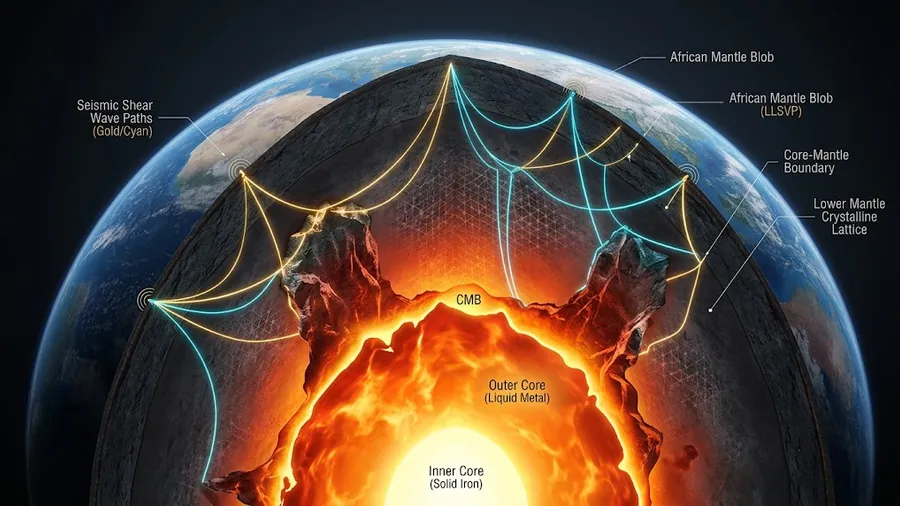
To understand why Earth’s magnetic field flips, one must look nearly 3,000 kilometers beneath our feet to the planet’s outer core.
Unlike the solid iron inner core—which is crushed into a crystalline sphere by immense pressure—the outer core is a seething ocean of molten iron and nickel hotter than the surface of the Sun. Driven by heat escaping from the cooling inner core and twisted by the Coriolis force of Earth’s daily rotation, this electrically conducting liquid metal swirls in towering helical columns.
This process operates as a self-sustaining geodynamo:
- As liquid iron flows through existing weak magnetic fields, it generates powerful electric currents.
- Those electric currents, in turn, generate new magnetic fields that reinforce the system.
- Because liquid metal turbulence is inherently chaotic, the geodynamo never settles into a perfectly static state. Occasionally, turbulent eddies inside the outer core grow large enough to tangle, weaken, and eventually invert the entire planetary dipole.
Stripes on the Ocean Floor: Paleomagnetism
How can scientists be certain that Earth’s magnetic poles traded places hundreds of times before humans existed to record them?
The answer is frozen inside iron-rich volcanic rocks through a phenomenon called thermoremanent magnetization. When molten basaltic lava erupts from a volcano or a mid-ocean ridge, microscopic crystals of magnetic minerals—such as magnetite—float freely inside the liquid rock.
As the lava cools below a critical temperature (known as the Curie point), those microscopic magnetic grains lock into place like billions of tiny frozen compass needles, permanently preserving the exact direction and intensity of Earth’s magnetic field at the moment the rock solidified.
In the 1960s, marine geophysicists towing magnetometers across the Atlantic and Pacific oceans discovered a breathtaking pattern:
- Parallel to the mid-ocean ridges where new seafloor is continuously born, the oceanic crust is striped with alternating bands of normal and reversed magnetic polarity.
- The magnetic stripes on the eastern side of a ridge form an exact mirror image of the stripes on the western side.
This discovery not only proved that Earth’s magnetic field flips repeatedly over geological time, but also provided the decisive smoking-gun evidence confirming plate tectonics and seafloor spreading.
What Happens During a Magnetic Flip?
A geomagnetic reversal does not happen overnight like flipping a light switch. Paleomagnetic records show that a full polarity reversal typically unfolds over 1,000 to 10,000 years.
During this transitional period, Earth’s magnetic field undergoes dramatic structural disruption:
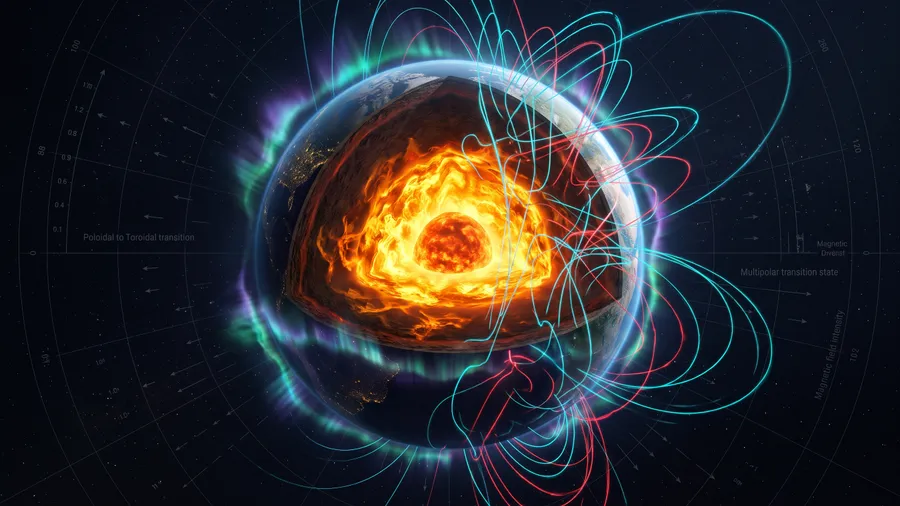
- Dipole Collapse: The familiar, orderly bar-magnet dipole field weakens significantly, dropping to roughly 10 to 20 percent of its normal strength.
- Multipolar Chaos: Rather than having a single magnetic north pole and a single magnetic south pole, the geomagnetic field fractures into a tangled web of multiple weak poles scattered across the globe—meaning magnetic north poles could temporarily emerge over South America, Africa, or the Pacific Ocean simultaneously.
- Rebuilding in Reverse: Eventually, convective currents in the outer core reorganize, re-establishing a strong, unified dipole—this time pointing in the opposite direction.
The Laschamps Excursion: A Near-Flip 42,000 Years Ago
While the last full reversal occurred 780,000 years ago, Earth experienced a dramatic near-flip—known as a geomagnetic excursion—roughly 41,000 to 42,000 years ago during an event called the Laschamps Excursion.
During the Laschamps event, Earth’s magnetic poles wandered wildly and the magnetic field’s strength plummeted to roughly 5 percent of modern levels for several centuries before snapping back to its original orientation.
In 2021, researchers analyzing ancient, sub-fossilized New Zealand kauri trees whose growth rings spanned the exact centuries of the Laschamps Excursion uncovered a striking environmental record:
- With Earth’s magnetic shield temporarily crippled, high-energy galactic cosmic rays and solar particles penetrated deep into the upper atmosphere.
- This bombardment triggered a sharp spike in atmospheric radiocarbon-14 and stripped away significant portions of the stratospheric ozone layer—altering global wind patterns, shifting rainfall belts, and bathing the surface in elevated ultraviolet radiation.
Could a Reversal Threaten Modern Civilization?
Whenever news headlines mention magnetic pole drift, fears of a cinematic planetary catastrophe quickly follow. In reality, the fossil record demonstrates that geomagnetic reversals do not cause mass extinctions. Earth’s thick atmosphere and oceans continue to absorb the vast majority of harmful cosmic radiation even when the magnetic field weakens.
For a technological civilization, however, a transitional weak-field era presents serious engineering challenges:
- Satellite Vulnerability: Low-Earth-orbit communications, weather, and navigation satellites rely heavily on the magnetosphere to deflect high-energy solar protons. A weakened magnetic shield would expose spacecraft electronics to frequent radiation damage and atmospheric drag surges during solar storms.
- Power Grid Disruption: Without a robust magnetosphere dampening geomagnetic storms, coronal mass ejections from the Sun would induce powerful electric currents in long-distance high-voltage transmission lines, risking widespread transformer failures.
- Aviation and Navigation: High-altitude polar flight routes would experience elevated radiation exposure, while navigation systems would require continuous calibration as magnetic poles drift erratically.
Watching the South Atlantic Anomaly
Over the past two centuries, direct observatory measurements show that Earth’s magnetic field has weakened by roughly 9 percent, while the magnetic north pole has accelerated its drift across the Arctic from northern Canada toward Siberia.
At the same time, geophysicists are closely monitoring the South Atlantic Anomaly—a vast region stretching between South America and southern Africa where Earth’s magnetic shield is unusually weak, forcing orbiting satellites and the International Space Station to take extra radiation precautions when passing overhead.
Whether these modern shifts signal the early prelude to a full geomagnetic reversal in the coming millennia—or merely represent normal, temporary fluctuations inside the turbulent liquid iron core—remains an open question. Either way, the wandering compass needle serves as a vivid reminder that beneath our seemingly solid world churns a restless, dynamic planetary engine.