· earth-science · 3 min read
The Deep Biosphere: Inside the Vast Hidden Ecosystem Living Miles Beneath Earth's Crust
Far below the reach of sunlight, miles beneath ocean floors and continental bedrock, thrives a colossal subterranean biosphere containing more carbon biomass than all humans on Earth combined.
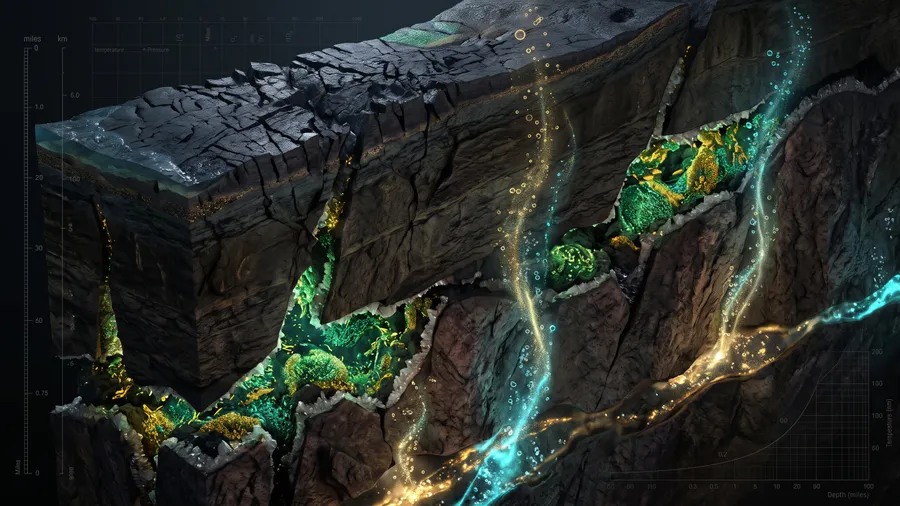
For centuries, biology operated under a foundational assumption: all complex ecosystems on Earth ultimately depend on the Sun. Plants and marine phytoplankton capture solar photons through photosynthesis, forming the energetic base of every food web across forests, grasslands, and oceans.
Follow that logic downward, and life should quickly vanish once you dig past the soil layer and descend into solid bedrock, where temperatures climb, pressures crush, and total darkness reigns.
Yet, over the past three decades, deep-sea drilling expeditions and ultra-deep mining surveys have shattered that surface-centric view of biology.
Miles beneath the seafloor and kilometers deep inside fractured continental granite, scientists have discovered a sprawling, planetary-scale subterranean ecosystem known as the Deep Biosphere.
According to decade-long surveys conducted by the Deep Carbon Observatory, roughly 70 percent of all bacteria and archaea on Earth live underground. Collectively, these subterranean microorganisms contain an estimated 15 to 23 billion tons of carbon—roughly 245 to 385 times the total carbon mass of every human being alive today.
How Deep Does Life Go?
Every time geobiologists drill deeper into Earth’s crust, they push the boundary of the habitable zone further downward:
- Deep Continental Mines: Nearly four kilometers beneath South Africa’s Witwatersrand Basin, inside the scorching tunnels of the Mponeng gold mine, researchers discovered Candidatus Desulforudis audaxviator—a rod-shaped bacterium living inside 60-degree-Celsius fracture water isolated from the surface world for millions of years. Remarkably, it forms a single-species ecosystem, carrying every gene needed to extract energy from rocks, fix carbon, and synthesize its own amino acids.
- Beneath the Ocean Floor: Using specialized ocean drilling vessels, scientists have extracted living microbial communities from coal beds and basaltic crust 2.5 kilometers below the seabed off the coast of Japan—surviving under crushing hydrostatic pressures exceeding 250 atmospheres.
- Subduction Zones: Microbes have even been detected inside mud volcanoes rising from ten kilometers deep along the Mariana forearc, surviving in hyper-alkaline fluids where almost no conventional organism could endure.
The ultimate lower limit of the deep biosphere appears to be dictated not by pressure or darkness, but by temperature—specifically the 122-degree-Celsius threshold, beyond which the molecular bonds of DNA, proteins, and cell membranes begin to unravel faster than cells can repair them.
Living Without Sunlight: Radiolysis and Serpentinization
Without solar photons, how does an ecosystem spanning millions of cubic kilometers power itself? Deep-crustal microbes abandon photosynthesis entirely, relying instead on chemolithoautotrophy—eating chemical energy harvested directly from rocks and water.
Geobiologists have identified two primary planetary engines that feed the subterranean world:
- Natural Radiolysis of Water: Earth’s continental crust contains trace amounts of naturally radioactive elements, including uranium, thorium, and potassium. Over millions of years, the ionizing radiation emitted by these decaying isotopes strikes water molecules trapped inside microscopic rock fractures, splitting them apart into molecular hydrogen ($H_2$) and reactive oxygen compounds. Subterranean microbes consume this radiolytic hydrogen as fuel, combining it with dissolved sulfates or carbon dioxide to generate cellular energy.
- Serpentinization: Beneath the ocean floor, seawater seeps down through tectonic cracks and reacts chemically with iron- and magnesium-rich mantle rocks such as olivine. This geological reaction—known as serpentinization—transforms the rock into serpentine minerals while releasing massive plumes of hydrogen gas and methane, creating a continuous chemical buffet for deep-sea crustal microbes.
In essence, the deep biosphere runs on nuclear and geochemical power generated by the planet itself.
Aeonophiles: Life in Extreme Slow Motion
Because geochemical energy trickles into deep rock fractures at an extraordinarily slow pace, subterranean organisms live on an energetic budget so microscopic that it challenges standard definitions of being alive.
On Earth’s surface, a well-fed E. coli bacterium divides