· astronomy · 6 min read
The Great Filter: Why Finding Alien Life Could Be the Worst News in Human History
If the universe is billions of years older than Earth and packed with habitable worlds, where is everyone? Robin Hanson's Great Filter hypothesis reveals a chilling dilemma: our greatest barrier might not be behind us, but waiting ahead.
On a summer afternoon in 1950, physicist Enrico Fermi was walking to lunch with colleagues at the Los Alamos National Laboratory. The conversation turned to recent UFO reports and the probability of extraterrestrial intelligence. After sitting down, Fermi suddenly blurted out a simple question that would echo through modern astronomy for decades: “Where is everybody?”
The mathematical logic behind Fermi’s question is disarmingly straightforward.
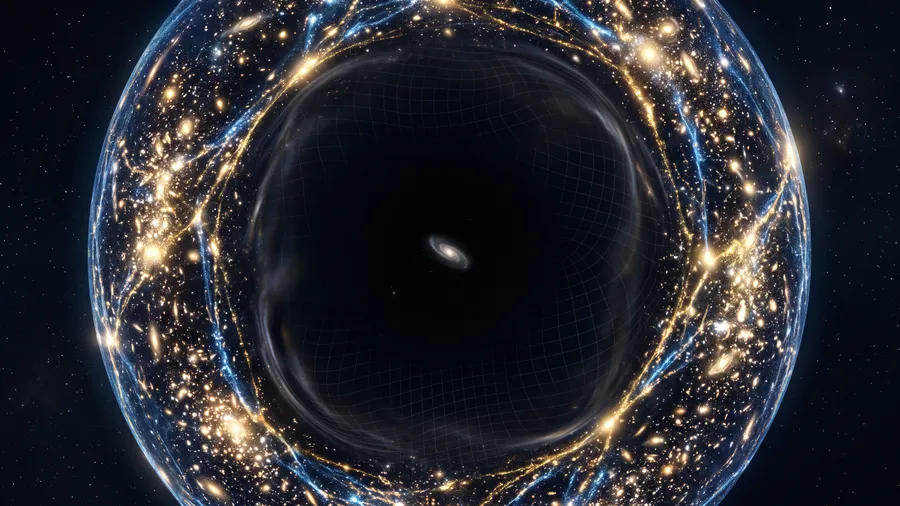
Our Milky Way galaxy is roughly 13.6 billion years old and contains between 100 billion and 400 billion stars. Recent data from the Kepler and James Webb space telescopes confirm that roughly one in every five Sun-like stars hosts an Earth-sized planet within its habitable zone. Even if interstellar travel is restricted to modest sub-light speeds, a single technological species utilizing self-replicating probes could colonize or thoroughly explore every star system in the entire galaxy in less than 50 million years.
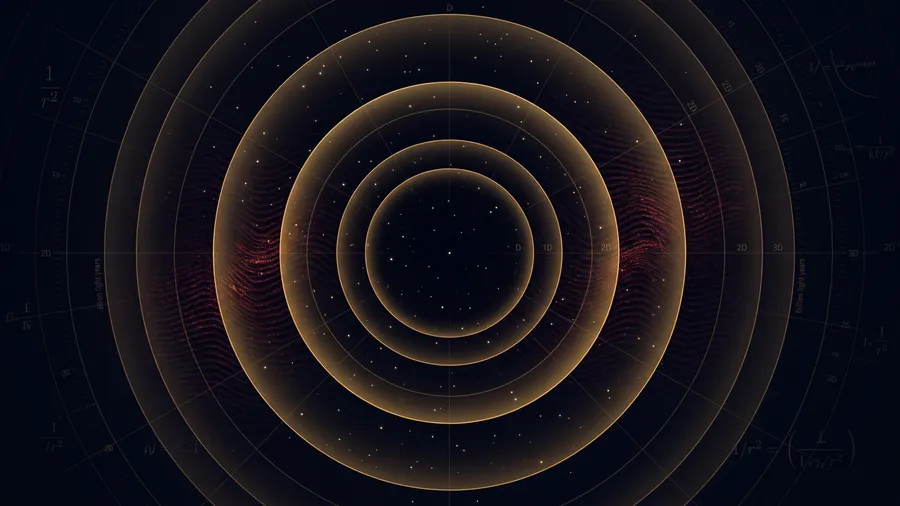
In the scale of cosmic time, 50 million years is an imperceptible blink—less than one-half of one percent of our galaxy’s age. If intelligent life were a natural byproduct of cosmic evolution, the night sky should be teeming with artificial signals, megastructures, and traveling civilizations.
Yet, our astronomical instruments are met with complete, deafening silence. This eerie contradiction between high statistical probability and zero physical evidence is the Fermi Paradox.
Robin Hanson and the Concept of the Filter
In 1998, economist and futurist Robin Hanson proposed a rigorous mathematical framework to diagnose this cosmic silence: The Great Filter.
Hanson reasoned that between the starting line of prebiotic chemistry on a young planet and the finish line of an expansive, interstellar civilization, life must successfully navigate a long sequence of critical evolutionary thresholds:
- A stable planetary system in a stellar habitable zone.
- Abiogenesis: the emergence of self-replicating biological polymers (such as RNA and DNA).
- The development of simple single-celled prokaryotic life.
- The evolutionary transition to complex single-celled eukaryotic life.
- The invention of sexual reproduction to accelerate genetic diversity.
- The emergence of multicellular organisms with specialized cellular organs.
- The evolution of tool-using intelligence with high cognitive capacity.
- The development of an advanced technological civilization capable of space travel.
- Interstellar expansion across planetary systems and star clusters.
The core premise of the Great Filter is an inescapable statistical reality: at least one of these steps must be so astronomically improbable, or so reliably lethal, that virtually nobody ever makes it to the other side.
The Great Dilemma: Behind Us or Ahead of Us?
Hanson’s framework splits the future of humanity into two radically different scenarios, depending on where the Great Filter sits relative to our current evolutionary position:
- Scenario A (The Filter Lies in Our Past): If the insurmountable barrier is behind us, humanity has already passed an almost impossible cosmic lottery. Perhaps abiogenesis is so rare that it occurs only once per observable universe, or perhaps the transition from simple bacteria to complex eukaryotic cells requires a freak biological accident that never happened on any other world. If the Filter is behind us, we are a cosmic miracle—the rare, solitary pioneers of the galaxy.
- Scenario B (The Filter Lies in Our Future): If the early steps of life and intelligence are relatively common throughout the cosmos, then the insurmountable barrier sits directly in front of us. This means that across billions of years, millions of alien species reached our exact stage of technological development—and every single one of them hit an unseen wall and perished before they could reach the stars.
Nick Bostrom’s Dark Deduction: Why Silence Is Golden
This mathematical reality led philosopher Nick Bostrom to make a counterintuitive assertion: the search for extraterrestrial life is a search for our own executioner.
Most people celebrate every announcement of potential signs of life on Mars, Europa, or Enceladus as an inspiring scientific milestone. Bostrom demonstrated that from an existential risk perspective, discovering alien life would be a catastrophe.
Consider what happens if astrobiologists find independent fossilized bacterial life beneath the Martian regolith:
- If life arose independently on two separate worlds within the same solar system, it proves that abiogenesis is not an impossible bottleneck.
- The emergence of life is easy, common, and repeatable.
- Therefore, the Great Filter cannot be the origin of life.
If researchers subsequently discover complex multicellular fossils on another world, the crisis deepens. It proves that the step from single-celled life to complex animals is also easy. Step by step, finding life on other worlds eliminates the historical candidates for the Great Filter.
If life is common, intelligence is common, and yet the stars remain empty, the probability that the Great Filter sits directly in our path approaches certainty.
As Bostrom famously wrote: “No news is good news. An empty sky is our best hope.”
What Could the Future Filter Be?
If the barrier lies ahead of technological civilizations, what forces extinguish them before they can expand into the galaxy? Theorists point to several recurring existential threats:
- Technological Self-Destruction: Scientific progress inherently grants smaller groups of individuals increasing destructive capacity. The invention of nuclear weapons, weaponized synthetic biology, or runaway autonomous artificial intelligence may represent technologies that civilizations invariably develop before they possess the geopolitical wisdom to control them.
- Environmental Overshoot and Collapse: Industrialization may inherently alter planetary equilibria—such as climate stability, biosphere diversity, and raw material availability—faster than an intelligent species can transition to off-world resources, causing an irreversible civilizational collapse back to pre-industrial conditions.
- The Berserker Hypothesis: Some civilizations may indeed survive, but the cosmos is stalked by ancient, automated killing machines programmed to sterilize any planetary system that begins broadcasting electromagnetic signals into space, enforcing cosmic silence through extermination.
The Alternate Route: Are We Truly the First?
There remains one optimistic interpretation of the Great Silence that does not require an impending catastrophe: the Cosmic Youth Hypothesis.
The universe has not existed forever. The first generation of stars contained only hydrogen and helium; they had to burn, collapse, and explode as supernovae over billions of years to seed the cosmos with the carbon, iron, and heavy elements required to build rocky planets and biological cells. Furthermore, early cosmic history was punctuated by violent gamma-ray bursts that periodically sterilized vast galactic sectors.
It is entirely possible that our galaxy has only recently entered an era of astrobiological stability. Earth may simply be among the very first planets where intelligent life has crossed the threshold.
We might not hear anyone calling out in the cosmic night because the other players in the cosmic drama are still looking up at their own primitive skies, wondering the exact same thing.
The Solitary Burden
The Great Filter transforms astronomy from a detached survey of distant stars into an urgent moral mirror.
If the Great Silence means that the Filter lies in our future, humanity is approaching a historic gauntlet that has claimed every civilization that came before us. If the Filter is in our past, our fragile blue world carries the sole flickering candle of consciousness in an otherwise dead and indifferent void.
In either scenario, our cosmic isolation carries an inescapable mandate: we cannot afford to treat the survival of our species as a passive certainty. The stars are either waiting for us to awaken them, or waiting to record our silence alongside all the rest.