· astronomy · 6 min read
The Boötes Void: Inside the Greatest Cosmic Desert in the Observable Universe
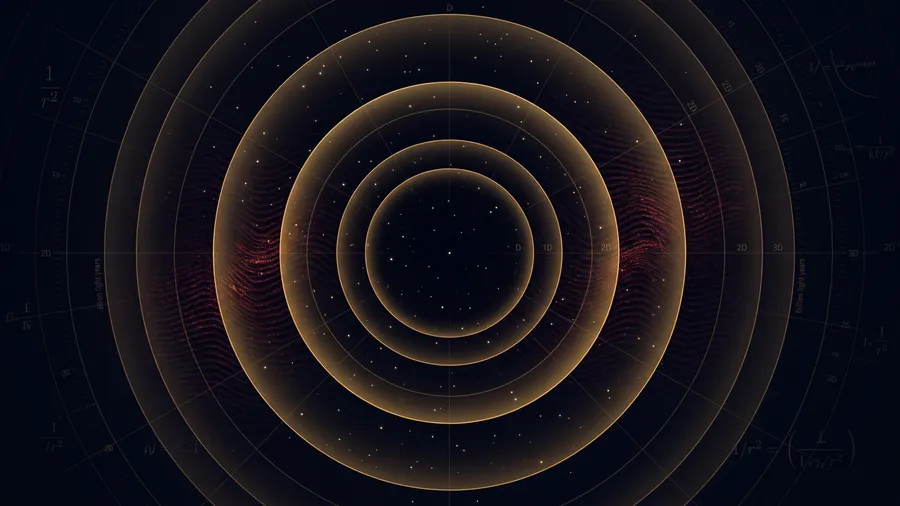
Spanning 330 million light-years across, the Boötes Void is an eerie spherical expanse of near-total emptiness where thousands of galaxies should exist. How did a bubble of nothingness this vast form in the cosmic web?
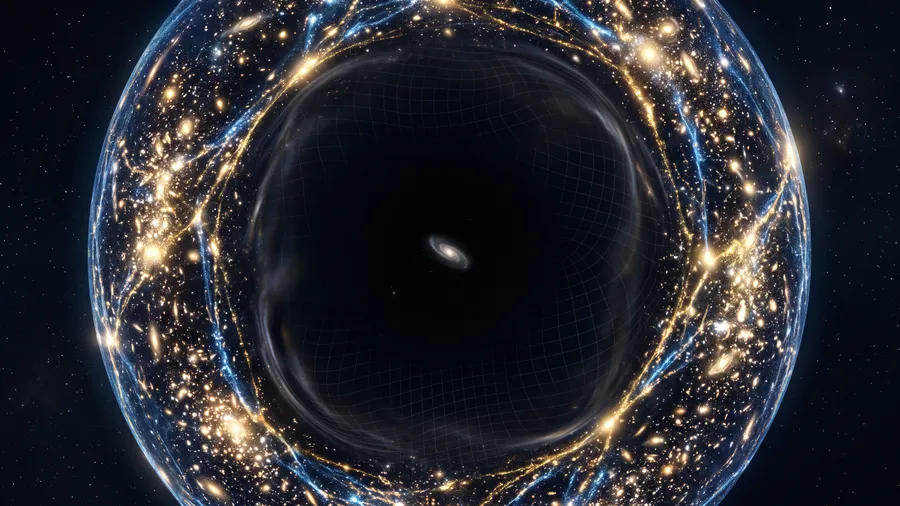
When astronomers map the distribution of galaxies across billions of light-years, the universe does not appear as a uniform scattering of stars. Instead, matter organizes itself into an intricate, three-dimensional lattice known as the Cosmic Web.
Driven by the gravitational pull of invisible dark matter, hundreds of billions of galaxies gather along immense, glowing filaments and dense galactic superclusters—separated by darker, low-density regions called cosmic voids.
In 1981, astronomer Robert Kirshner and his research team were conducting a deep-sky redshift survey in the direction of the constellation Boötes, roughly 700 million light-years from Earth, when their instruments encountered an anomaly that defied standard cosmological models.
As they plotted the three-dimensional positions of galaxies, the map suddenly went blank. They had stumbled upon a colossal, roughly spherical expanse of near-absolute emptiness measuring 330 million light-years in diameter.
Known today as the Boötes Void—or the Great Nothing—this supervoid is so vast that it spans nearly 0.27 percent of the diameter of the entire observable universe, standing as one of the largest and most unsettling structures ever discovered.
The Scale of Absolute Solitude
To grasp the sheer emptiness of the Boötes Void, consider what an average patch of the universe looks like.
Across standard cosmic neighborhoods, galaxies are separated by an average distance of a few million light-years. A spherical volume of space spanning 330 million light-years across should naturally contain approximately 2,000 galaxies.
When astronomers aimed their most sensitive telescopes into the heart of the Boötes Void, they found almost nothing. Decades of exhaustive surveys have identified only 60 galaxies within its entire volume—a density less than three percent of the cosmic average.
- If you were transported to a planet orbiting a star near the center of the Boötes Void, the night sky would be profoundly altered.
- You would see the familiar stars of your own local galaxy, but beyond its halo, there would be no Andromeda, no Virgo Cluster, and no neighboring spirals visible to the naked eye.
- As astronomer Greg Aldering famously remarked, “If the Milky Way had been in the center of the Boötes Void, we wouldn’t have known there were other galaxies until the 1960s.”
For virtually all of human history, any civilization evolving inside the Great Nothing would have believed their single island of stars constituted the entire universe.
The Architecture of the Cosmic Web
Why is the universe not smoothly filled with matter?
In the first fractions of a second after the Big Bang, quantum fluctuations stretched by cosmic inflation created microscopic variations in the density of primordial plasma. Some regions ended up fractionally denser than average, while neighboring regions ended up fractionally thinner.
Over the next 13.8 billion years, gravity acted as a relentless amplifier of inequality:
- Overdense Regions: Areas with slightly more dark matter and gas exerted a stronger gravitational pull, drawing in matter from their surroundings. These regions grew into dense galactic clusters and glowing filaments.
- Underdense Regions: Areas that started with slightly less matter lost their gas and dark matter to neighboring dense regions. As matter flowed outward toward the surrounding walls, these regions grew progressively emptier, expanding into cosmic voids.
However, standard cosmological simulations show that a single primordial density fluctuation is not enough to carve out a cavity 330 million light-years wide within the current age of the universe. The Boötes Void is simply too big to have formed through simple gravitational evacuation alone.
How Soap Bubbles Sculpted a Supervoid
To explain the existence of the Boötes Void, cosmologists turned to a phenomenon familiar in everyday physics: the merging of soap bubbles.
In a foam of soap bubbles, thin liquid walls separate pockets of trapped air. Over time, surface tension causes the fragile walls between smaller adjacent bubbles to rupture and dissolve, merging several small bubbles into a single, giant cavity.
In the early universe, gravity orchestrated a remarkably similar process across cosmic scales:
- Primordial Voids: Multiple smaller, ordinary voids formed independently in close proximity to one another.
- Filaments Collapse: As dark energy accelerated the expansion of space and gravity pulled matter outward toward the denser outer boundaries, the thin filaments of galaxies separating those adjacent voids stretched, thinned, and snapped.
- Hierarchical Merging: The smaller voids coalesced into one gargantuan, unified supervoid.
This soap-bubble merger model explains both the immense size of the Boötes Void and the peculiar arrangement of its few lonely inhabitants.
Strange Galaxies in the Wilderness
The 60 galaxies discovered inside the Boötes Void are not scattered randomly throughout the sphere. Instead, astronomers found that they are arranged in a curious, tubular or rod-like shape cutting straight through the void.
Cosmologists recognize this tubular formation as the skeletal fossil of a massive cosmic filament—the last remaining bridge between two smaller voids that merged billions of years ago.
Studying these isolated “void galaxies” has given astrophysicists an extraordinary natural laboratory. In dense clusters like Virgo or Coma, galaxies constantly collide, strip one another’s gas, and trigger violent bursts of star formation before settling into dead, elliptical hulks.
Inside the Boötes Void, galaxies live in pristine isolation:
- Because they rarely experience gravitational encounters or mergers with neighbors, void galaxies preserve their original, primordial spiral structures.
- Crucially, they retain massive reservoirs of pristine, unstripped hydrogen gas, allowing them to continue forming bright, hot young stars at a steady rate long after cluster galaxies have exhausted their fuel.
- Paradoxically, astronomers also discovered that an unusually high fraction of void galaxies harbor active galactic nuclei (feeding supermassive black holes), suggesting that isolated internal instabilities—rather than violent collisions—play a major role in awakening black holes.
Dark Energy and the Cosmic Microwave Background
Beyond its eerie emptiness, the Boötes Void serves as a critical testing ground for Dark Energy—the mysterious repulsive force accelerating the expansion of the cosmos.
As photons from the Cosmic Microwave Background (the ancient afterglow of the Big Bang) travel across billions of light-years to reach Earth, they occasionally pass straight through massive supervoids.
In a static universe, a photon falling into the gravitational rim of a void loses energy climbing out, resulting in zero net change. However, in an accelerating universe dominated by dark energy:
- While the photon is crossing the 330-million-light-year expanse of the Boötes Void, dark energy stretches the void and flattens its gravitational potential.
- As a result, the photon emerges with slightly altered energy—a phenomenon known as the Integrated Sachs-Wolfe Effect.
Measuring the subtle temperature shifts of ancient light passing through supervoids provides direct, independent confirmation that dark energy is actively tearing the cosmic web apart.
A Mirror of Cosmic Destiny
The Boötes Void is more than a bizarre geographical outlier in deep space; it is a preview of our own distant future.
As dark energy continues to accelerate the expansion of the universe over the next hundred billion years, the glowing filaments of the cosmic web will stretch, thin, and snap. Neighboring galaxy clusters will recede beyond our cosmic horizon faster than the speed of light.
Eventually, our own Local Group of galaxies will find itself stranded in an endless, pitch-black expanse indistinguishable from the heart of the Boötes Void. Looking into the Great Nothing today is like peering through a telescope at the ultimate destiny of the cosmos—a silent, boundless ocean where islands of starlight drift forever alone.