· astronomy · 6 min read
Strange Matter and Quark Stars: The Exotic Subatomic Substance That Could Rewrite Normal Matter
Deep inside the crushing cores of collapsed stars, protons and neutrons may dissolve into a primordial soup of free quarks. According to theoretical physics, a strange variant of this exotic matter could be more stable than ordinary atoms—and capable of converting normal matter on contact.
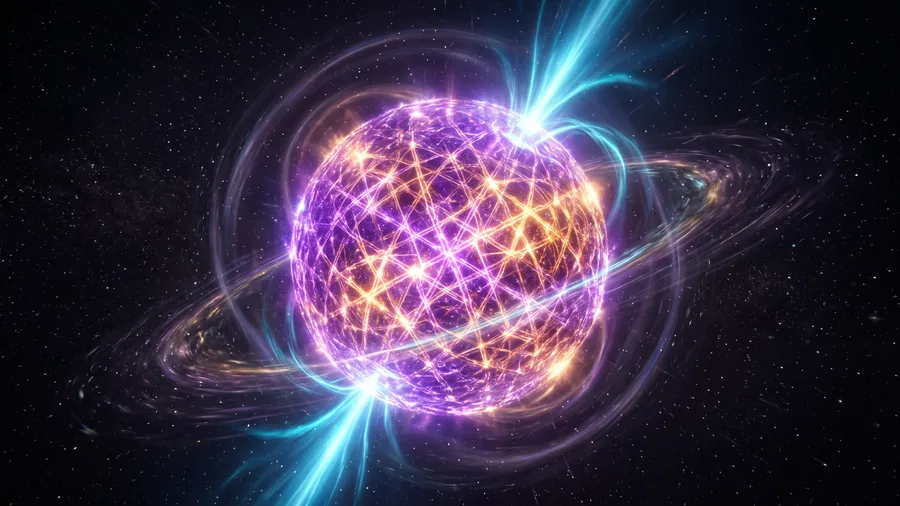
Every visible object in the universe—from the hydrogen gas in distant nebulae to the iron in your blood and the silicon in your smartphone—is constructed from atoms. At the center of every atom sit protons and neutrons, and inside each proton and neutron sit three elementary particles called quarks, bound together tightly by the strong nuclear force.
In all ordinary matter on Earth, atomic nuclei rely exclusively on the two lightest varieties of quarks: up quarks and down quarks. Under normal conditions, quarks are permanently imprisoned inside protons and neutrons; no amount of everyday heat or pressure can pry a single quark loose on its own.
Yet, out in the universe’s most extreme gravitational laboratories—the collapsing cores of dying massive stars—pressures climb trillions of times higher than anything found on Earth.
Under such unimaginable compression, theoretical physicists suspect that neutrons themselves may shatter, dissolving into an ultra-dense sea of liberated quarks known as strange quark matter—a bizarre substance that could form entire quark stars and represent the true, ultimate ground state of matter in the cosmos.
Beyond Neutrons: The Birth of a Quark Star
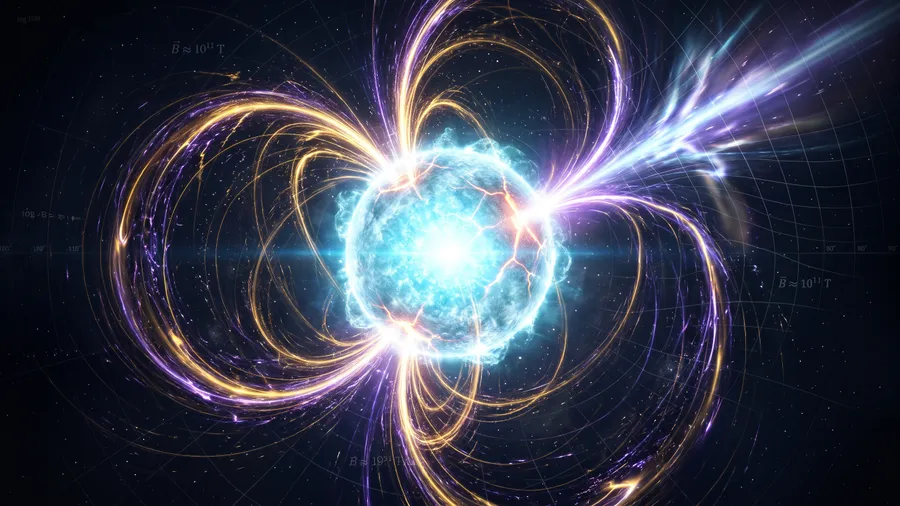
When a giant star runs out of nuclear fuel and explodes as a supernova, its core implodes under its own gravity. If the core is heavy enough, electrons and protons are crushed together into neutrons, forming a city-sized neutron star.
However, if the collapsing star is slightly heavier—hovering right on the razor’s edge before collapsing completely into a black hole—even the quantum degeneracy pressure of tightly packed neutrons gives way:
- Deconfinement: Crushed beyond nuclear density, individual neutrons overlap and melt, releasing their constituent up and down quarks into a continuous, free-flowing quark-gluon plasma.
- The Strange Conversion: In this hyper-dense environment, packing more up and down quarks together requires enormous quantum energy due to the Pauli Exclusion Principle. To relieve this pressure, weak nuclear interactions convert roughly one-third of the down quarks into a heavier third flavor: strange quarks.
- Self-Bound Stability: By spreading energy across three distinct quark flavors (up, down, and strange) instead of just two, the resulting strange quark matter settles into a remarkably compact, lower-energy state—transforming the stellar corpse into a strange quark star.
Unlike ordinary stars or even neutron stars—which are held together solely by gravity—a strange star would be bound together primarily by the strong nuclear force itself, acting like a single, colossal atomic nucleus twenty kilometers wide.
The Strange Matter Hypothesis
In 1971, physicist Arnold Bodmer, and later in 1984, theoretical physicist Edward Witten, proposed an astonishing idea known as the Strange Matter Hypothesis.
In ordinary nuclear physics, an iron-56 nucleus is famous for being the most tightly bound, stable atomic configuration. Witten calculated that if strange quark matter exists in bulk, its energy per quark could actually be lower than that of protons and neutrons locked inside an iron atom.
If true, this carries a startling implication: all ordinary atomic matter in the universe is merely metastable. The only reason the atoms in your body have not spontaneously decayed into strange quark matter is that converting an entire nucleus requires dozens of quarks to flip into strange quarks simultaneously—an event so statistically improbable under normal conditions that it virtually never happens on its own.
Strangelets: A Subatomic Chain Reaction
While ordinary atoms cannot easily turn into strange matter by themselves, what would happen if a tiny, microscopic droplet of pre-existing strange matter—called a strangelet—collided with an ordinary atom?
According to theoretical models, strangelets could behave like a subatomic catalyst:
- When a strangelet touches an ordinary atomic nucleus, it absorbs the nucleus’s protons and neutrons, dissolving them into free up and down quarks.
- Because strange matter represents a lower-energy state, those newly absorbed quarks rapidly convert into the same stable three-flavor mixture—causing the strangelet to grow larger while releasing bursts of heat and radiation.
- In theory, an uncharged or negatively charged strangelet drifting into a planet or star could trigger a runaway chain reaction, steadily converting surrounding atomic nuclei into strange matter until the entire object collapsed into a dense lump of quark matter.
Fortunately, both physics and astronomical observation confirm that Earth is in no danger from cosmic strangelets.
Theoretical calculations indicate that strangelets carry a net positive electric charge on their surface due to the slightly higher mass of strange quarks. Because ordinary atomic nuclei are also positively charged, strong electrostatic repulsion pushes stray strangelets away from normal atoms like matching poles of powerful magnets—preventing them from making contact unless slammed together at extreme energies inside a neutron star. Furthermore, high-energy particle collisions at the Relativistic Heavy Ion Collider (RHIC) and the Large Hadron Collider (LHC) have thoroughly tested these energy regimes without producing dangerous strangelets.
Hunting for Strange Stars in the Cosmos
Because a strange star would have roughly the same mass and city-sized radius as a conventional neutron star, telling them apart across thousands of light-years requires clever astronomical detective work.
Astrophysicists look for several telltale observational signatures:
- Impossible Smallness: Gravity pulls neutron stars into tighter spheres as they gain mass, whereas self-bound strange stars grow larger with mass, just like droplets of water. Discovering an ultra-compact stellar remnant that is noticeably smaller and lighter than standard neutron star models allow is a prime indicator of a quark star.
- The HESS J1731-347 Mystery: In 2022, astronomers analyzing X-ray observations of a compact remnant inside the supernova remnant HESS J1731-347 measured its mass at just 0.77 times the mass of the Sun and its radius at roughly 10.4 kilometers—significantly lighter than standard supernova models predict for ordinary neutron stars, making it one of the strongest observational candidates for a strange quark star ever found.
- Bare Quark Surfaces: Unlike neutron stars, which are wrapped in a solid crust of iron atoms, a bare strange star would have an ultra-sharp, razor-thin surface held together by nuclear forces—allowing it to radiate extreme bursts of X-rays and gamma rays far brighter than the classical Eddington luminosity limit allows for normal stars.
The Ultimate Frontier of Matter
Whether strange quark stars populate the dark corners of our galaxy or remain a fascinating boundary case of quantum chromodynamics, the search for strange matter pushes fundamental physics to its sharpest edge.
By studying the faint X-rays glowing from stellar corpses thousands of light-years away, astronomers are probing the deepest laws of the subatomic world—testing whether the familiar atoms that build planets, stars, and living beings are truly nature’s final word, or merely a fragile surface layer floating above a stranger cosmic reality.