· astronomy · 5 min read
Olbers' Paradox: Why Is the Night Sky Dark in a Universe Filled With Stars?
If the universe is infinite, eternal, and uniformly packed with stars, every line of sight should end on a blazing stellar surface—making midnight as bright as the Sun. Resolving this deceptively simple riddle required overturning centuries of cosmological dogma.
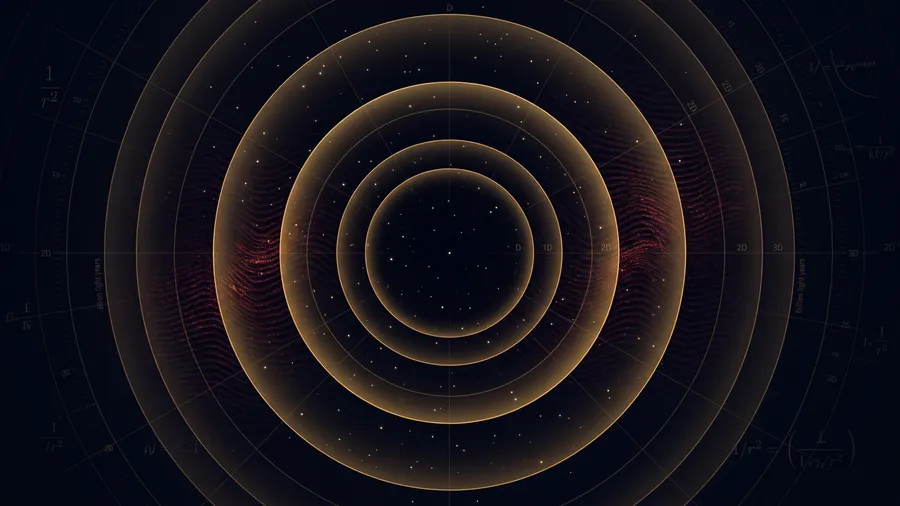
Step outside on a clear, moonless night far from city lights and look upward. You will see a vast canopy of pitch-black emptiness punctured by a few thousand glittering pinpricks of starlight.
To human intuition, darkness at night feels entirely natural—the Sun has set, so the sky goes dark. Yet, from the perspective of classical physics and astronomy, a dark night sky is a profound cosmological contradiction.
For centuries after the Copernican revolution, astronomers widely assumed that the universe was infinitely large, infinitely old, and uniformly populated with stars stretching forever in every direction. If those assumptions were true, every single line of sight leaving your eye—no matter which direction you looked—would inevitably intersect the surface of a star, just as every line of sight inside an endless, dense forest eventually hits a tree trunk.
Under those conditions, the entire night sky should blaze with the uniform, blinding brilliance of the Sun’s surface, turning Earth into an incinerated cinder.
This glaring discrepancy between theoretical expectation and everyday observation is known as Olbers’ Paradox, named after the German astronomer Heinrich Wilhelm Olbers who formalized the problem in 1823—and solving it forced humanity to discover that our universe had a beginning.
The Mathematics of an Infinite Stellar Forest
At first glance, one might assume that distant stars are simply too far away to brighten the night sky. After all, light dims rapidly with distance according to the inverse-square law: a star located ten times farther away appears one hundred times fainter.
However, as astronomers Thomas Digges, Johannes Kepler, and Edmond Halley realized long before Olbers, distance alone cannot save a static, infinite universe:
- Imagine dividing space around Earth into concentric spherical shells, like the layers of an onion.
- As you move outward to a shell twice as far away, the light from each individual star inside that shell drops to one-quarter of its brightness.
- At the exact same time, the surface area of that larger shell increases by four times—meaning it contains four times as many stars.
- When you multiply one-quarter brightness by four times as many stars, the two effects cancel each other out completely.
Every concentric shell of space contributes the exact same total amount of starlight to Earth’s sky. If you stack an infinite number of shells extending forever into space, the total brightness adds up to infinity—or, once nearer stars block out stars directly behind them, a solid wall of stellar fire covering the entire celestial sphere.
Why Interstellar Dust Cannot Hide the Light
In the 19th century, Olbers himself attempted to resolve the paradox without abandoning the idea of an eternal, infinite cosmos. He proposed that vast clouds of dark interstellar dust and gas drift between the stars, absorbing the light from distant galaxies before it ever reaches Earth.
While clever, this explanation fails under the First and Second Laws of Thermodynamics:
- If dark dust clouds continuously absorb blazing radiation from an infinite number of stars over infinite time, that energy cannot simply vanish.
- The dust grains steadily heat up until they reach thermal equilibrium with the surrounding starlight—at roughly 5,000 to 6,000 Kelvin.
- Once heated, the dust clouds themselves begin glowing just as brightly as the stars they were supposed to block.
In an eternal, static universe, dust acts merely as a temporary sponge; once saturated, the entire sky still erupts into blinding light.
A Poet’s Intuition and the Finite Age of the Cosmos
Surprisingly, one of the earliest correct insights into Olbers’ Paradox came not from a professional astronomer, but from the American writer Edgar Allan Poe. In his 1848 prose poem Eureka, Poe proposed a radical solution: the night sky is dark because the universe has not existed forever.
Because light travels at a finite speed—roughly 300,000 kilometers per second—looking out into deep space is equivalent to looking backward in time.
- The universe is approximately 13.8 billion years old, and the first stars ignited several hundred million years after the Big Bang.
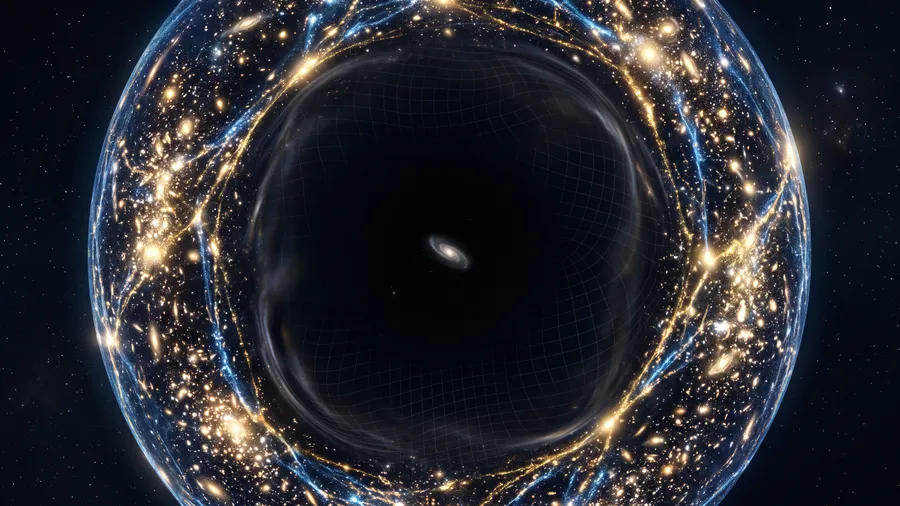
- Consequently, we can only see light from stars and galaxies situated within our observable cosmic horizon—the sphere from which light has had enough time to reach Earth since the birth of the cosmos.
- Beyond that horizon lie countless stars whose light is still en route, unable to reach us yet.
Because the observable universe contains a finite number of stars rather than an infinite wall, vast gaps of darkness remain between them.
Cosmic Expansion and the Stretching of Starlight
While the finite age of the universe explains why we do not see infinitely distant stars, modern relativistic cosmology adds a second, equally vital mechanism: the expansion of space.
In 1929, Edwin Hubble demonstrated that distant galaxies are receding from us as the fabric of spacetime itself expands. As photons emitted by ancient galaxies travel across billions of light-years toward Earth, the stretching of space physically elongates their wavelengths—a phenomenon called cosmological redshift:
- Energetic, short-wavelength visible and ultraviolet light emitted by young stars gets stretched into longer, lower-energy infrared radiation.
- Stretching a photon’s wavelength directly reduces its energy, draining light from the visible spectrum before it arrives at our eyes.
Together, the finite age of the universe and the cosmological redshift of expanding space strip the night sky of its theoretical blaze, leaving behind the serene darkness we see overhead.
The Sky Actually Is Glowing—Just Beyond Human Vision
In a remarkable twist of modern astrophysics, Olbers’ Paradox turns out to be partially true after all.
If human eyes were sensitive not to visible light, but to microwave radiation, stepping outside at midnight would reveal a sky glowing uniformly in every single direction with zero dark gaps anywhere.
That ubiquitous glow is the Cosmic Microwave Background (CMB)—the ancient thermal radiation left over from the scorching plasma of the early universe roughly 380,000 years after the Big Bang. Over 13.8 billion years of cosmic expansion, that blinding primordial fireball has been redshifted by a factor of roughly 1,100, cooling down to a faint microwave hum at just 2.725 degrees above absolute zero.
Every dark patch of night sky between the stars is, in truth, an unbroken wall of ancient light—stretched silently into invisibility by an expanding cosmos.