· astronomy · 6 min read
Magnetars: The Dead Stars With Magnetic Fields Strong Enough to Tear Atoms Apart
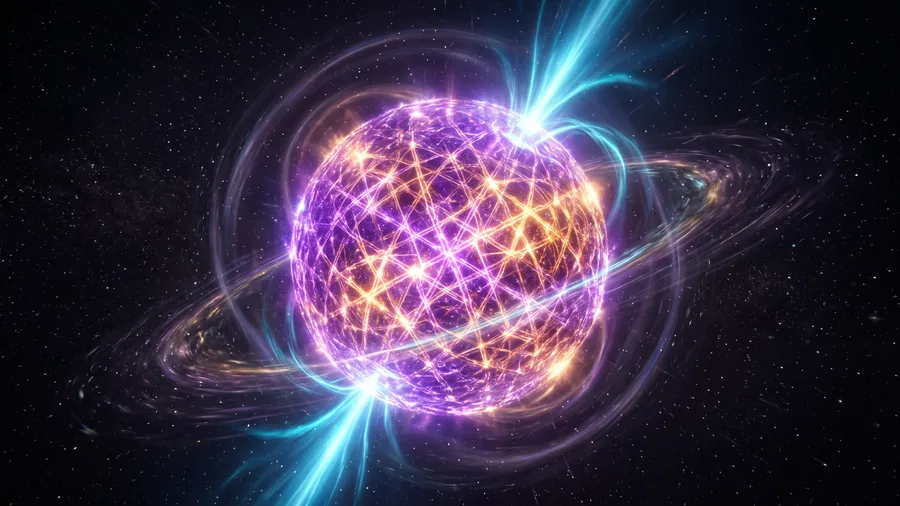
Packing the mass of the Sun into a city-sized sphere, magnetars generate the most powerful magnetic fields in the known universe—warping the quantum vacuum, stretching atoms into needles, and unleashing flares felt across galaxies.
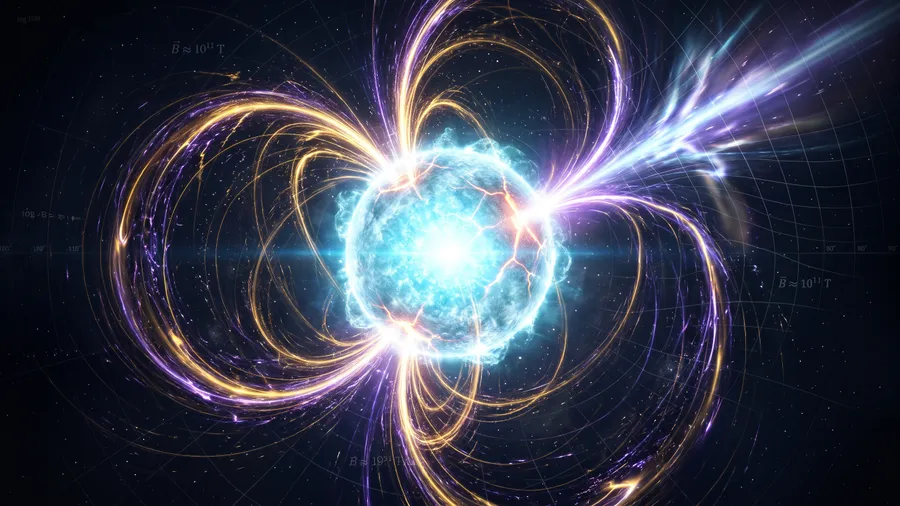
When a massive star exhausts its nuclear fuel and collapses in a supernova explosion, its core is crushed into one of the densest forms of matter in the cosmos: a neutron star. Packing up to twice the mass of our Sun into a sphere roughly 20 kilometers across—no wider than a modern city—a single sugar-cube-sized scoop of neutron star material weighs roughly one billion tons on Earth.
Yet, among the universe’s population of stellar corpses, a rare and volatile subclass takes physical extremes to an entirely different level.
Roughly one in ten young neutron stars is born as a magnetar—an ultra-magnetized stellar remnant possessing a magnetic field up to a thousand times stronger than an ordinary neutron star, and roughly a quadrillion (a thousand trillion) times stronger than Earth’s geomagnetic field.
In the immediate vicinity of a magnetar, magnetism ceases to be an invisible force that nudges compass needles. It becomes a dominant physical titan capable of distorting the shape of atoms, altering the behavior of empty space, and triggering starquakes bright enough to ionize Earth’s upper atmosphere from fifty thousand light-years away.
Forging a Cosmic Dynamo
On Earth, the strongest continuous magnetic fields ever engineered inside research laboratories reach roughly 45 Tesla—powerful enough to levitate a live frog through diamagnetism. A typical refrigerator magnet measures around 0.005 Tesla, and Earth’s planetary magnetic field hovers near 0.00005 Tesla.
A magnetar generates a surface magnetic field between 10 billion and 100 billion Tesla ($10^{10}$ to $10^{11}$ Tesla).
Astrophysicists believe these monstrous fields are forged during the first few seconds after a supernova collapse through a runaway convective dynamo mechanism:
- As the progenitor star’s core implodes, conservation of angular momentum spins the newborn neutron star up to frantic speeds—completing a full rotation every one to ten milliseconds.
- Simultaneously, scorching neutrino-driven heat causes the dense, electrically conducting neutron-rich fluid inside the star to boil and churn violently.
- If the star rotates faster than the speed of its internal convective currents, the churning plasma twists, stretches, and amplifies seed magnetic field lines exponentially—locking a colossal reservoir of magnetic energy into the star within seconds before it settles down.
Stretching Atoms Into Microscopic Needles
If a human being were somehow transported within 1,000 kilometers of a magnetar, the gravitational tidal forces would not be what killed them first—the magnetic field would shred their biochemistry instantly.
In ordinary matter, negatively charged electrons orbit positively charged atomic nuclei in roughly spherical clouds held together by the electrostatic Coulomb force.
However, once a magnetic field exceeds the quantum critical threshold of roughly 4.4 billion Tesla:
- Magnetic forces completely overwhelm the electrical attraction binding electrons to their nuclei.
- Spherical atoms are violently squeezed and elongated along the magnetic field lines into ultra-thin, needle-like cylinders roughly 200 times longer than they are wide.
- Because electron orbitals are flattened into one-dimensional needles, normal chemical bonding collapses entirely. Water molecules, proteins, and DNA strands simply dissolve into tangled metallic-like molecular chains.
At that distance, a magnetar does not merely pull iron from your bloodstream; it erases the atomic structure of your body.
Warping Empty Space: Vacuum Birefringence
Even more astonishing than its effect on solid matter is what a magnetar does to completely empty space.
In classical physics, a vacuum is an inert void through which light rays pass undisturbed, completely unaffected by magnetic fields. However, Quantum Electrodynamics (QED)—the quantum theory of light and matter formulated in the 1930s by Werner Heisenberg and Hans Euler—predicts that empty space is actually seething with “virtual” electron-positron pairs popping into and out of existence for fleeting fractions of a second.
Near a magnetar, the magnetic field is so intense that it aligns these transient virtual particles like microscopic compass needles, turning the quantum vacuum itself into a warped optical medium:
- Vacuum Birefringence: Just as a calcite crystal splits a beam of light into two separate rays traveling at different speeds, the magnetized vacuum around a magnetar forces light waves polarized parallel to the magnetic field to travel at a subtly different velocity than light waves polarized perpendicular to it.
- Photon Splitting: High-energy gamma-ray photons navigating a magnetar’s magnetosphere can interact directly with the magnetic field and spontaneously split into two lower-energy photons—a phenomenon impossible in weaker fields.
In 2016, astronomers observing the isolated neutron star RX J1856.5-3754 with the European Southern Observatory’s Very Large Telescope detected strong linear polarization in its visible light, providing the first observational confirmation of QED vacuum birefringence after eighty years of theoretical prediction.
Starquakes and the 2004 Galactic Blast
Because a magnetar’s colossal magnetic field is anchored deep inside its solid, crystalline iron-rich outer crust, the star exists in a state of perpetual mechanical tension.
As the magnetic field lines slowly untangle and drift through the dense interior, they exert unbearable strain on the rigid crust above—until the crust suddenly fractures and shifts by fractions of a millimeter in a cataclysmic starquake.
This abrupt snapping of magnetic field lines triggers a Giant Flare, blasting immense torrents of X-rays and gamma rays into space.
On December 27, 2004, telescopes around the world recorded the brightest extrasolar explosion ever witnessed in human history. The blast originated from SGR 1806-20, a magnetar located roughly 50,000 light-years away on the far side of the Milky Way galaxy:
- In just one-tenth of a second, the magnetar released more energy than our Sun emits over 150,000 years.
- Despite traveling across half the galaxy, the pulse of radiation was so intense that it temporarily blinded orbiting X-ray satellites and physically ionized Earth’s upper atmosphere—expanding the ionosphere downward and measurably disrupting low-frequency radio communications across the planet.
Had SGR 1806-20 been located within ten light-years of Earth, its giant flare would have stripped away our ozone layer and triggered a planetary mass extinction.
Solving the Mystery of Fast Radio Bursts
For over a decade, radio astronomers were baffled by Fast Radio Bursts (FRBs)—ultra-brief, millisecond flashes of radio waves arriving from distant galaxies billions of light-years away, each carrying as much energy in a thousandth of a second as the Sun radiates in days.
In April 2020, radio telescopes in North America detected an intense, millisecond radio burst originating inside our own Milky Way galaxy. Pinpointing the coordinates revealed the source: SGR 1935+2154, an active galactic magnetar undergoing an X-ray outburst.
That single detection bridged two cosmic mysteries, proving that magnetars serve as the powerhouse engines driving at least a major population of Fast Radio Bursts across the universe.
Fleeting Titans of the Cosmos
Unlike ordinary pulsars that spin and tick steadily for billions of years, magnetars burn through their vast magnetic reserves rapidly. The relentless internal heating and crust-shattering flares drain their magnetic fields within roughly 10,000 years—a mere blink of an eye in cosmic time.
Of the thousands of neutron stars cataloged in our galaxy, only about thirty active magnetars are known today. Yet within their brief, violent lifespans, these city-sized dynamos push matter, light, and the quantum vacuum to the absolute limits permitted by the laws of physics.