· astronomy · 6 min read
Quasi-Stars: The Colossal Primordial Behemoths Powered by Black Hole Hearts
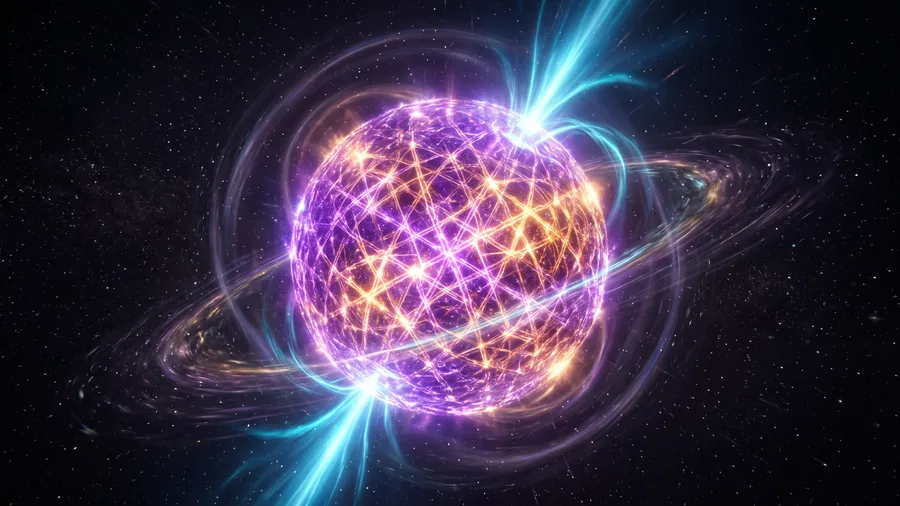
In the dawn of cosmic history, conditions permitted stars millions of times more massive than the Sun. Instead of nuclear fusion, these hypothetical titans were powered from the inside out by feeding black holes.
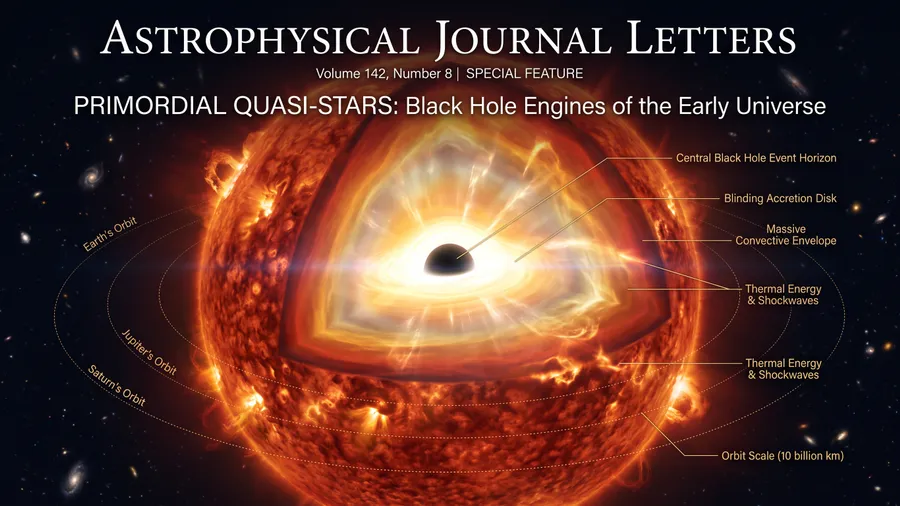
In the contemporary universe, stellar physics operates under strict, inviolable boundaries. When a massive star forms from a collapsing molecular cloud, its inner core heats up until nuclear fusion ignites, converting hydrogen into helium. The outward thermal radiation pressure generated by fusion balances the inward pull of gravity, keeping the star stable.
If a star grows too massive—exceeding roughly 100 to 150 times the mass of our Sun—its radiation pressure becomes violent. This threshold, known as the Eddington limit, blows away the outer layers of the star into interstellar space, effectively halting any further accumulation of matter.
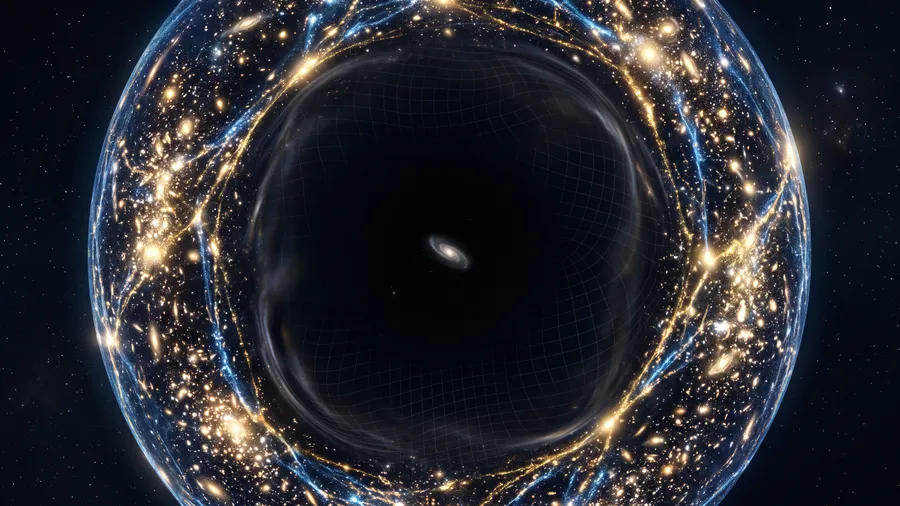
Yet, when modern observatories like the James Webb Space Telescope peer deep into the cosmic dawn, they encounter an astrophysical paradox that defies standard stellar growth: supermassive black holes containing billions of solar masses thriving merely 400 to 500 million years after the Big Bang.
Under standard accretion rates, growing a black hole from a typical stellar collapse to a billion solar masses should require over a billion years. There simply was not enough time in the newborn cosmos for them to grow so large so quickly.
Theoretical astrophysicists believe the answer lies in an exotic, long-extinct class of celestial object that roamed the early universe: the Quasi-Star, also known as a Black Hole Star.
The Birth of an Impossible Monster
To create a quasi-star, the universe required conditions that no longer exist today.
In our modern galaxy, interstellar gas is heavily enriched with “metals”—astronomers’ term for any chemical element heavier than hydrogen and helium, such as carbon, oxygen, and iron. These heavy elements act as efficient cooling agents, causing collapsing gas clouds to fragment into thousands of small pockets, birthing modest stars like our Sun.
In the first few hundred million years following the Big Bang, the cosmos was pristine:
- Interstellar gas consisted almost exclusively of pure hydrogen and helium.
- Without heavy elements, gas clouds could not easily radiate away their heat and fragment into small clumps.
- If a massive gas cloud was simultaneously illuminated by intense ultraviolet radiation from neighboring starbursts, the molecular hydrogen that would normally trigger fragmentation was destroyed.
As a result, a colossal primordial cloud containing tens of thousands or even millions of solar masses could undergo direct, monolithic gravitational collapse without shattering into individual stars.
The Inverted Engine: A Black Hole in the Core
As this titanic cloud collapsed inward, it initially formed an unimaginably bloated proto-star. But its core faced an immediate crisis: the sheer weight of the outer envelope was so overwhelming that conventional nuclear fusion could not generate sufficient outward pressure to halt gravitational collapse.
Within mere moments, the core collapsed past its event horizon, forming a newborn black hole of roughly twenty to one hundred solar masses right at the star’s center.
In any modern star, the birth of a central black hole triggers a violent supernova explosion that instantly shreds the surrounding stellar mantle, casting it out into deep space.
In a proto-quasi-star, however, the outer envelope was so extraordinarily massive and dense that the newborn explosion was completely smothered. The gravitational grip of the falling envelope swallowed the energy of the initial detonation, trapping the black hole inside.
Thus, an astonishing new celestial hybrid was born: a living star possessing a ravenous black hole as its nuclear heart.
Accretion Replaces Fusion
The physics of a quasi-star is entirely inverted compared to ordinary stars:
- Ordinary Stars: Gravity pulls inward, and thermonuclear fusion at the core pushes outward.
- Quasi-Stars: Gravity pulls inward, feeding gas directly into the central black hole. As matter swirls toward the event horizon, gravitational energy converts into intense, blinding accretion radiation.
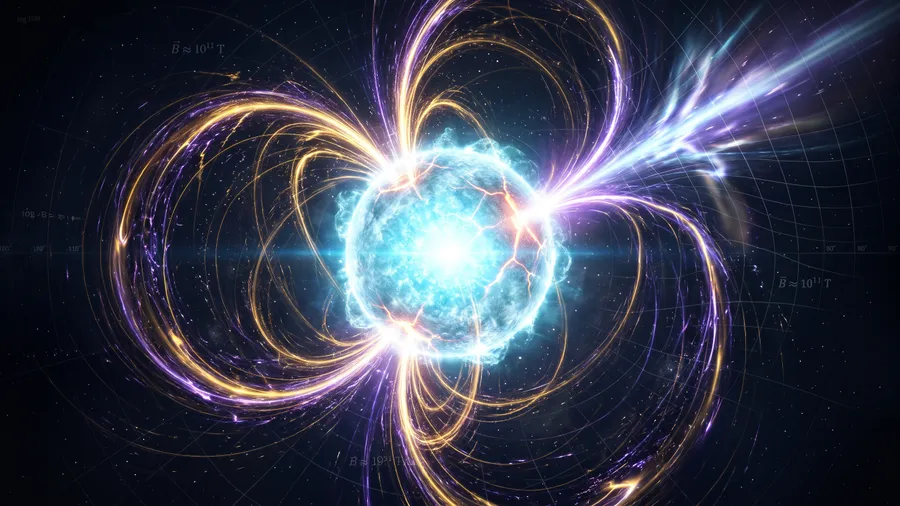
This inward infall creates a dense, churning accretion disk trapped deep inside the stellar mantle. The radiation produced by the central black hole is so immense that it acts as the new thermal furnace of the star, generating an outward radiation pressure that counterbalances the weight of the immense outer gas shell.
The black hole does not instantly swallow the star. Instead, the accretion radiation pushes back against the surrounding layers, establishing a delicate, self-regulating equilibrium.
If the black hole accretes too quickly, the radiation flares outward, expanding the envelope and starving the core of fresh fuel. If the accretion drops, the envelope contracts, dumping fresh gas into the central disk and reigniting the outward blast.
The object remains stable, shining brilliantly across cosmic voids—powered not by the fusion of atomic nuclei, but by pure gravity.
Dimensions of a Cosmic Giant
The physical scale of a mature quasi-star challenges human comprehension:
- Mass: Between 10,000 and 1,000,000 solar masses, dwarfing the most massive modern stars by thousands of times.
- Diameter: A quasi-star’s outer photosphere would span tens of billions of kilometers across. If placed at the center of our solar system, its surface would swallow Mercury, Venus, Earth, Mars, Jupiter, and Saturn, extending all the way out past the orbit of Neptune.
- Temperature and Color: Despite harboring an ultra-hot accretion disk at its center reaching millions of degrees, the outer envelope was so vast that the energy cooled as it radiated outward. Its surface temperature hovered around 4,000 Kelvin, causing this immense stellar giant to glow with an eerie, deep reddish-orange hue.
- Luminosity: A single quasi-star shone with the brilliance of an entire small galaxy, releasing more light than hundreds of millions of Suns combined.
The Dissolution and the Supermassive Seed
Despite their colossal scale, quasi-stars lived fleeting, violent lives. While stars like the Sun burn quietly for ten billion years, a quasi-star burned through its reservoir within roughly one to seven million years.
As the central black hole steadily gorged on the inner mantle, it grew rapidly from an initial seed of a few dozen solar masses into a leviathan of ten thousand to one hundred thousand solar masses.
Eventually, the balance tilted:
- The outer envelope gradually thinned due to fierce stellar winds and accretion consumption.
- The mass of the central black hole grew so large that its radiation pressure overwhelmed the remaining envelope’s gravitational cohesion.
- The bloated red atmosphere of the star was violently blown away into the intergalactic void, unveiling the dark beast within.
When the dust cleared, the quasi-star was gone. In its place remained an intermediate-mass black hole weighing hundreds of thousands of solar masses—an already massive, healthy seed ready to feast on primordial gas streams and merge with other seeds.
Solving the Cosmic Dawn Paradox
Quasi-stars provide the most elegant theoretical bridge to resolve the greatest puzzle uncovered by the James Webb Space Telescope.
They explain how the universe bypassed the tedious, multi-billion-year process of growing supermassive black holes from small stellar remnants. By wrapping primordial black holes in hyper-dense stellar cocoons, nature created an engine capable of super-Eddington accretion—growing black holes at rates orders of magnitude faster than conventional physics permits in the modern universe.
These short-lived stellar leviathans were the forgotten architects of the cosmic dawn. They burned brightly in the ancient dark, sacrificed their incandescent bodies, and left behind the dark hearts that now anchor the magnificent spiral and elliptical galaxies we observe today.