· earth-science · 7 min read
The Buried World: How Giant Anomalies in Earth's Mantle Could Be Remnants of an Alien Planet
Thousands of kilometers beneath Africa and the Pacific Ocean lie two colossal structures hundreds of times taller than Mount Everest. Known as LLSVPs, geophysicists now suspect these mysterious mantle blobs are the sunken corpses of the protoplanet Theia.
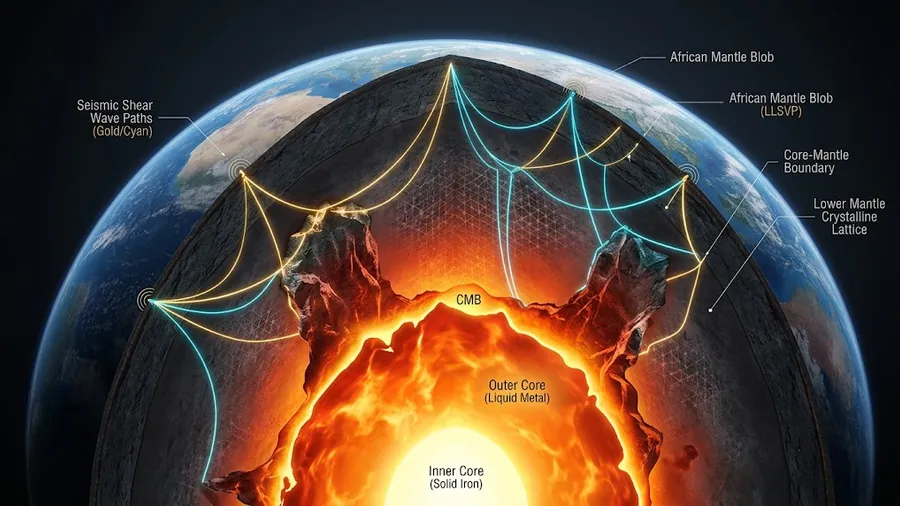
Human beings have mapped the topography of Mars, surveyed the craters of Mercury, and photographed the ice plains of Pluto. Yet, the region directly beneath our feet remains one of the most enigmatic frontiers in modern science. The deepest borehole ever drilled by human engineers—the Kola Superdeep Borehole in Russia—plunged just 12.2 kilometers into the continental crust, barely scratching 0.2 percent of the distance to the center of the Earth.
To see what lies deeper, geophysicists do not dig; they listen.
Whenever massive earthquakes rupture tectonic faults, they release powerful seismic waves that propagate straight through the interior of the globe. By recording how these waves bend, refract, and change velocity as they travel through different densities of rock, geophysicists can construct three-dimensional tomographic scans of the planet, much like a medical CT scan.
In the late 20th century, seismic tomography revealed an astonishing subterranean landscape. Resting directly on top of Earth’s molten iron outer core, roughly 2,900 kilometers down, sit two gargantuan, continent-sized structures.
Known scientifically as Large Low-Shear-Velocity Provinces (LLSVPs)—or colloquially as “the Blobs”—these subterranean anomalies are reshaping our understanding of planetary evolution. Emerging astrophysical and geodynamical evidence suggests that they are not native to Earth at all, but the preserved, buried remnants of an alien protoplanet that collided with us 4.5 billion years ago.
The Scale of the Titans
To appreciate the sheer scale of the LLSVPs, one must leave standard mountain geography behind:
- One blob sits deep beneath the African continent, spanning from the southern tip of the Atlantic Ocean to the Mediterranean.
- The other sits directly on the opposite side of the globe, anchored beneath the vast expanse of the central Pacific Ocean.
- Each structure stretches horizontally for thousands of kilometers and towers vertically between 500 and 1,000 kilometers into the lower mantle.
If either of these structures were brought to the surface of the Earth, it would dwarf Mount Everest by a factor of a hundred, breaching the stratosphere and penetrating straight into low Earth orbit.
Together, these two colossal provinces make up between 3 and 9 percent of Earth’s entire mantle volume, representing hundreds of times the mass of the Moon.
The Seismic Discovery: Why “Low Velocity”?
Seismic waves travel through the interior of the Earth in two primary forms: primary compressional waves (P-waves) and secondary transverse shear waves (S-waves).
The speed of an S-wave depends strictly on the physical properties of the rock it passes through—specifically its shear modulus (rigidity) and density. When seismic shear waves generated by deep subduction earthquakes strike the boundary of these two provinces, their velocities suddenly plummet by up to 3 to 5 percent.
For years, geophysicists debated the physical cause of this deceleration:
- The Thermal Model: Were the blobs simply immense plumes of superheated mantle rock? Hot rock is less rigid than cold rock, which naturally slows down shear waves.
- The Thermochemical Model: Were the blobs chemically distinct from the surrounding silicates? If the rock within the blobs contains a significantly higher concentration of heavy elements—specifically iron—its higher density would naturally cause seismic waves to drag and slow down.
High-resolution seismic imaging eventually settled the debate. The boundaries of the LLSVPs are razor-sharp rather than diffuse, and deep tidal resonance measurements confirmed that the blobs are roughly 2 to 3.5 percent denser than the surrounding ambient mantle.
They are not mere bubbles of warm rock; they are vast, ancient mountains of dense, chemically alien composition resting permanently at the core-mantle boundary.
The Ghost of Theia: A Primordial Collision
Where did millions of cubic kilometers of dense, iron-rich material originate?
Roughly 4.5 billion years ago, during the violent infancy of our solar system, the proto-Earth was struck by a Mars-sized planetary embryo known as Theia. According to the Giant Impact Hypothesis, the titanic grazing collision vaporized outer layers of both worlds and ejected an enormous ring of debris into orbit, which rapidly coalesced to form the Moon.
For decades, numerical simulations assumed that the energy of the impact was so catastrophic that Theia and early Earth completely melted into a homogeneous, thoroughly blended ocean of liquid magma.
However, in 2021 and 2023, high-precision computer simulations led by geophysicist Qian Yuan and astrophysicists at Caltech and the Chinese Academy of Sciences uncovered a dramatically different narrative:
- Theia’s mantle was naturally richer in iron and significantly denser than Earth’s primordial mantle.
- Because the impact was an oblique, low-velocity collision, the lower portions of Theia’s mantle did not fully vaporize into gas.
- Instead, massive solid or partially molten fragments of Theia—spanning thousands of kilometers across—plunged into the young Earth’s magma ocean.
- Because of their higher iron content, these immense slabs were too heavy to remain suspended. They sank through the liquid mantle like iron weights dropping through water, eventually settling along the stable floor of the core-mantle boundary.
Over 4.5 billion years of convection, the drifting fragments gathered into two antipodal thermochemical piles.
The LLSVPs are quite literally the buried corpse of Theia, entombed at the bottom of our world.
The Geochemical Fingerprint
This planetary burial hypothesis gained compelling support from isotopic geochemistry.
Geologists analyzing ocean island basalts—volcanic lavas erupted from deep-rooted mantle plumes in places like Hawaii, Iceland, and Samoa—discovered anomalous isotopic signatures:
- Most surface volcanic rocks show modern isotopic ratios of helium, strontium, and neodymium, reflecting rocks that have cycled through plate tectonic subduction over hundreds of millions of years.
- However, lavas originating from hotspots directly above the margins of the LLSVPs contain exceptionally high ratios of Helium-3 to Helium-4.
Helium-3 is a primordial isotope forged in the Big Bang and trapped inside planetary embryos during the formation of the solar system. Because it is light and volatile, it easily escapes into space during volcanic outgassing. The presence of primordial Helium-3 in modern Hawaiian lavas indicates that their magma source has remained undisturbed and unmixed for over four billion years.
The LLSVPs have served as a sealed, unmixed subterranean vault, protecting primordial planetary material from the churn of mantle convection since the dawn of the Earth.
Architects of the Surface World
Despite sitting nearly 3,000 kilometers beneath our feet, the LLSVPs actively shape the world we live in today.
The edges of these dense mantle provinces are known as Plume Generation Zones. As heat radiates upward from Earth’s 5,000-degree molten core, it is channeled along the sloping flanks of the LLSVPs, creating thermal chimneys that generate massive upwellings of superheated mantle rock.
These deep-seated plumes drive:
- Supervolcanoes and Large Igneous Provinces: Geological reconstructions show that virtually every major supervolcanic eruption over the past 300 million years—including the Siberian Traps that triggered the catastrophic End-Permian extinction—occurred directly above the margins of the African or Pacific blobs.
- The Breakup of Supercontinents: When supercontinents like Pangea drift over the margins of the LLSVPs, the focused thermal plumes weaken the continental crust from below, rifting landmasses apart into new oceans.
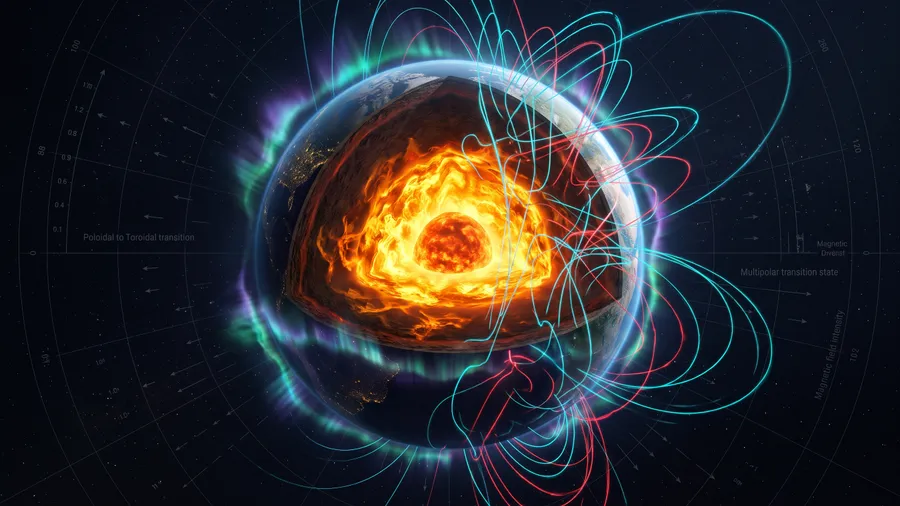
- The Asymmetry of the Geomagnetic Field: By imposing an uneven thermal blanket over the core-mantle boundary, the blobs influence the convective flow of liquid iron in Earth’s outer core, subtly modulating the strength and reversal cycles of our planetary magnetic shield.
Walking on Two Worlds
For generations, science fiction writers dreamed of finding remnants of alien worlds drifting through deep space.
Geophysics has revealed that we do not need to look to distant stars to find the ruins of another planet. We walk on them every single day.
Earth is not a simple, single planetary body. It is a cosmic hybrid—a chimeric world carrying the frozen heart of an ancient planetary neighbor deep within its bones, forever steering the earthquakes, volcanoes, and continents that shape our living crust.