· quantum-physics · 4 min read
Bell's Theorem: How a Simple Inequality Proved the Universe Is Not Locally Real
Albert Einstein derided quantum entanglement as 'spooky action at a distance,' convinced that particles carried hidden instructions. In 1964, John Stewart Bell devised a mathematical test that shattered classical realism forever.
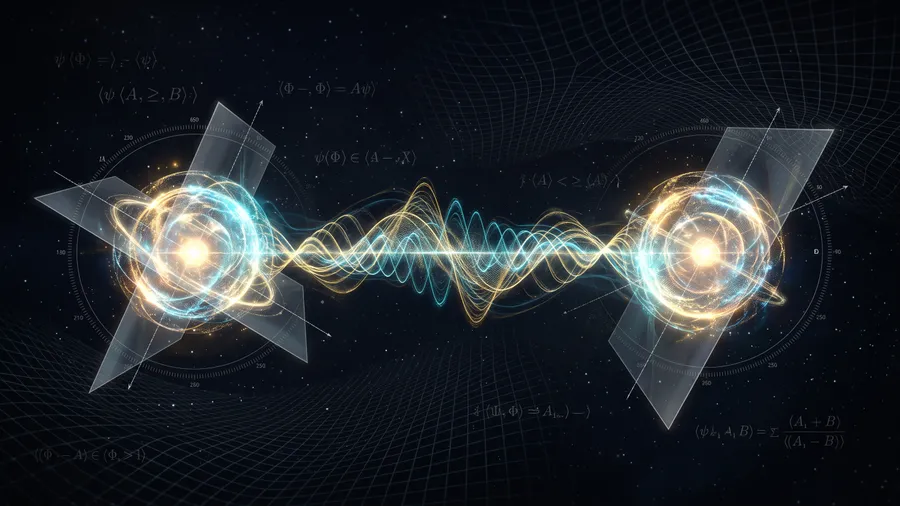
In 1935, Albert Einstein, Boris Podolsky, and Nathan Rosen published a famous paper designed to expose what they believed was a fatal flaw in quantum mechanics.
According to the standard Copenhagen interpretation championed by Niels Bohr, subatomic particles do not possess definite physical properties—such as position, momentum, or spin—until an observer measures them. Prior to measurement, a particle exists in a blurry superposition of all possible states simultaneously.
Einstein found this deeply unsettling. When two particles interact and become quantum entangled, quantum theory predicts that measuring one particle instantaneously determines the state of its partner, even if the two particles are separated by light-years of empty space.
Einstein famously mocked this idea as “spooky action at a distance.” He insisted that quantum mechanics must be incomplete—that entangled particles must carry secret, pre-programmed internal instructions dictating how they will behave when measured, much like a pair of DNA twins separated at birth.
For nearly thirty years, the debate between Einstein and Bohr remained trapped in philosophy. Neither side could propose an experiment capable of distinguishing between Einstein’s hidden instructions and Bohr’s quantum indeterminacy—until a quiet Irish physicist working on particle accelerators at CERN changed physics forever.
The Two Pillars of Classical Common Sense
To appreciate what John Stewart Bell accomplished, one must examine the two intuitive assumptions that Einstein believed governed the physical universe, collectively known as Local Realism:
- Realism: Physical objects possess definite, pre-existing properties regardless of whether anyone observes them. An unmeasured electron has a specific spin orientation just as surely as the Moon exists in the sky even when nobody is looking at it.
- Locality: Physical influences cannot travel faster than the speed of light. An action performed in a laboratory on Earth cannot instantaneously alter the physical state of a particle orbiting a distant star.
In Einstein’s view, quantum entanglement had a completely ordinary explanation. Imagine taking a pair of gloves, placing the left glove in one box and the right glove in another, and shipping one box to Tokyo and the other to New York. The moment the box in New York is opened and reveals a right-handed glove, you instantaneously know the box in Tokyo holds the left-handed glove. No faster-than-light signal traveled between the cities; the handedness was fixed from the moment the boxes were packed.
Bell’s 1964 Breakthrough
In 1964, while on sabbatical from CERN, physicist John Stewart Bell asked a deceptively simple question: if entangled particles really do carry secret “hidden variables” like gloves in boxes, is there any measurable difference between Einstein’s hidden-variable world and Bohr’s quantum world?
Bell proved mathematically that the answer is yes.
If you only measure entangled particles along the exact same axis (say, vertical vs. horizontal), hidden-variable theories and quantum mechanics yield identical predictions. However, Bell realized that if you tilt the detectors at specific intermediate angles—such as 22.5 degrees and 45 degrees—the two theories diverge sharply:
- The Classical Ceiling (Bell’s Inequality): Bell proved that in any universe governed by local realism—regardless of how clever or complex the hidden variables might be—the statistical correlation between measurements at tilted angles cannot exceed a strict mathematical ceiling.
- The Quantum Violation: Standard quantum mechanics predicts correlations at those exact angles that smash straight through Bell’s mathematical ceiling, producing significantly stronger agreement between distant particles than any hidden instructions could ever coordinate.
For the first time in history, metaphysics had been converted into a decisive laboratory experiment.
Closing the Loopholes Across Space and Time
Because Bell’s test required manipulating individual entangled photons with extreme precision, experimental physicists spent decades refining the setup to eliminate every conceivable “loophole” that might allow nature to fake the results:
- 1972 (John Clauser): Using calcium atoms emitting pairs of entangled photons at UC Berkeley, Clauser conducted the first experimental Bell test. The results decisively violated Bell’s inequality, confirming quantum predictions over local realism.
- 1982 (Alain Aspect): Critics noted that if the measurement detectors were fixed in place before the photons left their source, the particles could