· quantum-physics · 6 min read
Time Crystals: How Matter Breaks the Fundamental Symmetry of Time
In 2012, Nobel laureate Frank Wilczek asked an audacious question: if ordinary crystals repeat periodically across space, could a state of matter repeat periodically across time? The creation of time crystals proved him right—without violating the laws of thermodynamics.
Look at a diamond, a grain of common table salt, or an intricate snowflake under a microscope. Each of these objects is an ordinary spatial crystal.
In the gas or liquid state, atoms float randomly in a uniform soup. The laws of physics governing those atoms are identical everywhere: if you shift the entire system by two millimeters to the left, the physical laws do not change. This property is known as continuous spatial translation symmetry.
When water freezes into ice or carbon crystallizes into diamond, something fundamental happens: the atoms spontaneously lock into rigid, repeating geometric lattices.
By freezing into a specific grid, the crystal breaks the smooth, continuous symmetry of space. You can no longer shift the system by an arbitrary fraction of a millimeter and see the exact same arrangement; you must shift it by the precise spacing of the atomic grid. Physicists call this spontaneous symmetry breaking—the foundational mechanism behind magnets, superconductors, and the Higgs mechanism.
In 2012, Nobel laureate Frank Wilczek posed a provocative question: if the laws of physics treat space and time on an intertwined footing, could the exact same phenomenon happen along the axis of time?
Could a physical system spontaneously break time translation symmetry—oscillating forever in a periodic loop through time without absorbing or expending any energy?
The Apparent Violation: The Perpetual Motion Trap
When Wilczek first published his theoretical proposal, the physics community responded with skepticism. To many, a system that moves perpetually in time without an external energy source sounded dangerously close to a forbidden perpetual motion machine.
The Second Law of Thermodynamics dictates that any isolated system left to itself must inevitably settle into thermal equilibrium—a state of maximum entropy where all macroscopic movement ceases.
If an object rests in its absolute ground state (its lowest possible energy configuration):
- It has no excess energy to give up to the outside world.
- If it were to continuously oscillate or tick like an eternal clock, how could it sustain motion without radiating energy?
In 2015, theoretical physicists Haruki Watanabe and Masaki Oshikawa proved a rigorous “no-go theorem”: in thermal equilibrium and in true ground states, time crystals are mathematically impossible.
Wilczek’s original formulation in static equilibrium seemed dead. But the defeat opened a far more interesting doorway: non-equilibrium quantum systems.
Moving Beyond Equilibrium: The Floquet Time Crystal
While systems in thermal equilibrium cannot break time translation symmetry, our universe contains physical realms that never reach equilibrium.
In 2016, theoretical teams led by Norman Yao at UC Berkeley and Vedika Khemani at Princeton realized that time crystals could exist if they were continuously “driven” by a periodic external pulse—a framework known as a Floquet system.
Imagine a child on a playground swing. If you push the swing once every two seconds, the swing moves at the exact same rhythm: once every two seconds. The response of the swing matches the period of the driving force.
A Floquet time crystal, however, behaves in a fundamentally unnatural way:
- You illuminate an array of quantum particles with a laser pulse that flips their spins at a regular period, say every unit of time ($T$).
- Under ordinary physics, the particles should absorb the laser’s energy, heat up rapidly, and settle into thermal chaos.
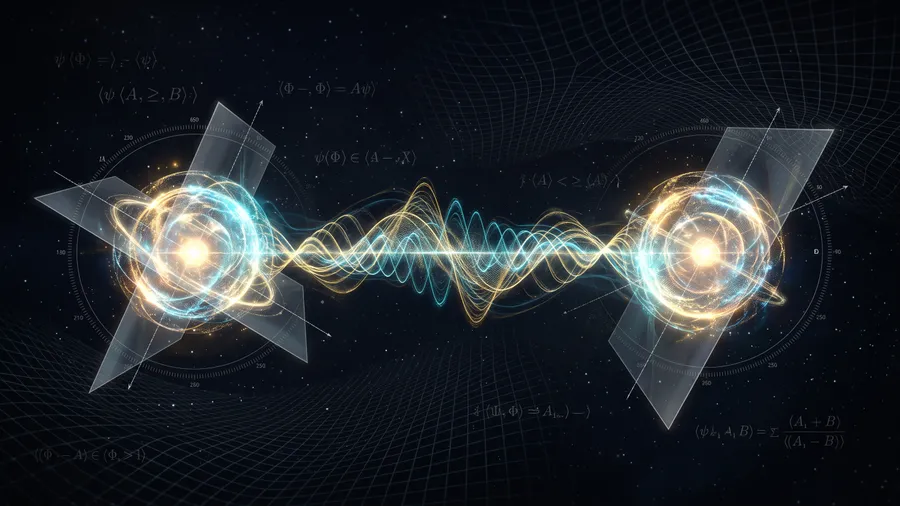
- Instead, due to a phenomenon called Many-Body Localization, the quantum particles become so intensely entangled and disordered that they are unable to absorb heat from the drive.
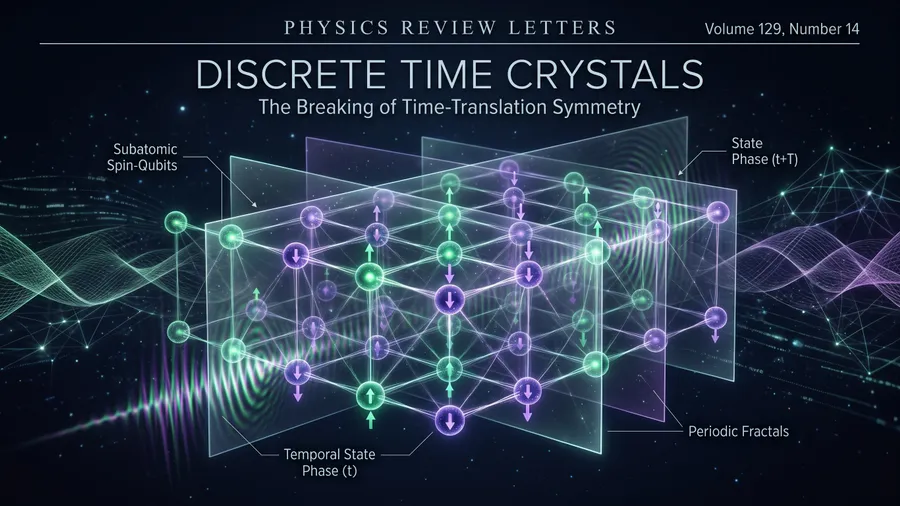
- When you measure the particles, they do not respond with the period of the pulse ($T$). They respond at twice the period ($2T$), or integer multiples of it.
The system literally ignores the rhythmic timing of the external driver and sets its own internal temporal tempo. It breaks the discrete time translation symmetry of the driving laser.
The Signature of a True Time Crystal
What separates a genuine time crystal from an ordinary electronic frequency divider or a mechanical pendulum?
Three absolute criteria define a true discrete time crystal:
- Symmetry Breaking: The system oscillates at a subharmonic frequency distinct from the driving force, ticking to its own beat.
- Many-Body Quantum Rigidity: The oscillation is not a fragile property of a single particle. It is a collective, protected quantum state shared across dozens or hundreds of entangled particles. If you alter the pulse slightly—pushing with 95 percent power instead of 100 percent—the time crystal stubbornly maintains its precise period without drifting.
- Absence of Thermal Dissipation: Despite being bombarded with periodic external energy, the system does not heat up into entropy. It remains permanently trapped in an out-of-equilibrium quantum loop.
Bringing Time Crystals into Reality
Between 2017 and 2021, theoretical predictions crossed over into physical laboratory reality:
- In 2017, experimentalists at the University of Maryland created a discrete time crystal using a string of ten ytterbium ions held in place by electromagnetic fields and nudged with laser pulses. Simultaneously, a team at Harvard University synthesized a time crystal inside a solid diamond containing one million nitrogen-vacancy defects.
- In 2021, researchers using Google’s Sycamore superconducting quantum processor demonstrated a time crystal comprising 20 quantum bits (qubits). The qubits exhibited stable, non-thermal oscillations across thousands of cycles, validating that the phase of matter is stable against quantum decoherence.
- In 2022, physicists at the University of Hamburg achieved a continuous time crystal inside an ultra-cold Bose-Einstein condensate trapped within an optical cavity, showing that the phenomenon extends across multiple quantum architectures.
Why They Do Not Break the Laws of Physics
A common misunderstanding is that time crystals can be used as a perpetual engine to generate infinite clean electricity.
This is physically impossible.
A time crystal cannot perform work on its environment. The moment you attempt to extract mechanical or electrical work from the oscillating cycle, you disrupt the delicate many-body localization that prevents the crystal from heating up. The quantum coherence breaks, the symmetry collapses, and the crystal dissolves into ordinary thermal dissipation.
A time crystal does not provide free energy; it represents an entirely new phase of matter that lives permanently outside thermal equilibrium.
The Quantum Frontier
Why are physicists and computer scientists so fascinated by time crystals?
First, they expand the map of fundamental physics. Historically, almost every phase of matter—solids, liquids, gases, plasmas, and superfluids—was classified under the rules of equilibrium thermodynamics. Time crystals mark the very first stable, macroscopic phase of matter defined entirely outside of equilibrium.
Second, their extreme resistance to perturbation makes them prime candidates for the future of quantum computing.
One of the greatest engineering bottlenecks in quantum processors is environmental noise, which rapidly scrambles delicate qubits. Because the periodic oscillations of a time crystal are protected by topological and quantum rigidity, researchers are exploring whether time-crystalline substrates can be used to construct robust, error-resistant quantum memories.
A New Axis of Reality
For centuries, physics treated time as a passive coordinate: an unyielding river along which matter changes its form. Space could be frozen, shaped, structured, and crystallized, but time was merely the background counter of events.
Time crystals dismantle this historic divide. They show that matter can structure time just as easily as it structures space—turning the flow of duration into a self-perpetuating, repeating geometric architecture that ticks eternally within the quantum realm.