· physics · 3 min read
The Force of Nothingness: How Empty Space Physically Crushes Metal
In classical physics, a complete vacuum contains absolute zero energy. In 1948, Hendrik Casimir proved that pure nothingness exerts a measurable physical force capable of pushing matter.
The Illusion of the Void
Pump every molecule of gas out of a sealed chamber. Shield it from cosmic rays, block all thermal radiation, and drop the temperature to absolute zero (−273.15°C).
Under classical Newtonian physics, what remains inside is absolute, motionless nothingness.
Under quantum field theory, that “nothingness” is a violent, boiling cauldron of activity.
According to Heisenberg’s Uncertainty Principle, energy and time share a fundamental quantum trade-off: energy can fluctuate wildly as long as it does so over vanishingly brief timescales. In every cubic millimeter of empty space, pairs of virtual particles and antiparticles spontaneously flash into existence, interact, and annihilate each other trillions of times per second.
You cannot bottle this quantum vacuum, nor can you turn it off. It is the irreducible ground state of reality: Zero-Point Energy.
Hendrik Casimir’s Boundary Experiment
In 1948, Dutch physicist Hendrik Casimir proposed an audacious thought experiment: What happens if you place two uncharged, perfectly conducting metal plates parallel to each other inside a total vacuum, separated by mere nanometers?
In ordinary mechanics, nothing should happen. The plates carry no electrical charge, have negligible gravitational attraction toward each other, and sit in empty space with zero air pressure.
Yet Casimir calculated that the plates would experience an attractive force—pulled together by a mysterious invisible vise.
The mechanical reason lies in wave mechanics:
- Virtual photons can materialize at any wavelength across infinite frequencies.
- In the vast space outside the plates, virtual waves of all possible wavelengths can exist freely.
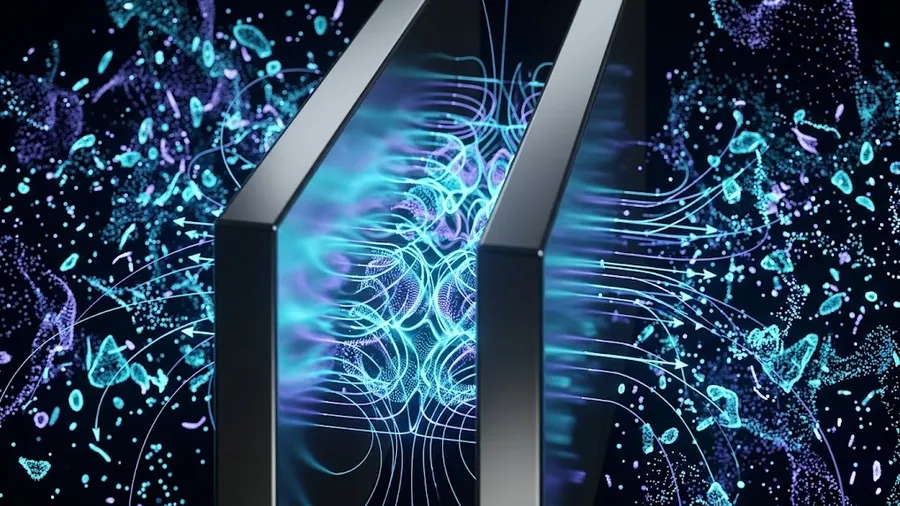
- Between the two plates, however, only virtual electromagnetic waves whose wavelengths fit precisely into the gap (d) can exist, resembling the standing harmonics of a plucked guitar string. All other wavelengths are physically excluded.
Because there are more virtual particle modes pushing from the outside than from within the narrow boundary, the external vacuum pressure overpowers the internal vacuum pressure. The plates are slammed together by the sheer statistical weight of the surrounding emptiness.
The Inverse Fourth Power Law
Casimir derived the exact attractive pressure generated between the two mirrors:
F / A = −(π² · ħ · c) / (240 · d⁴)
Where:
- F / A is the Casimir force per unit area (hydrodynamic-like quantum pressure).
- π (pi) represents circular phase geometry.
- ħ (h-bar) is the reduced Planck constant (quantum action).
- c is the cosmic speed of light (relativistic coupling).
- d is the nanometer separation distance between the plates.
Notice the denominator: the force scales inversely with the fourth power of the distance (d⁴).
If you cut the separation between the plates in half, the crushing force does not double—it increases sixteen-fold. At separations under 10 nanometers, this quantum vacuum force exerts a pressure exceeding 1 atmosphere (100 kilopascals), strong enough to weld microscopic engineered components together permanently.
From Chalkboard Heresy to Nanotech Reality
For nearly fifty years, mainstream physics treated Casimir’s equation as a mathematical curiosity that was virtually impossible to measure due to electrostatic noise and microscopic surface roughness.
That changed in 1997, when Steve Lamoreaux at the University of Washington used an ultra-sensitive torsion pendulum to measure the force down to within 5% of Casimir’s exact prediction. Subsequent tests using atomic force microscopy confirmed the formula down to a 1% margin of error.
Today, the Casimir Effect is not just abstract theory—it is an engineering bottleneck in modern nanotechnology. Designers of Micro-Electro-Mechanical Systems (MEMS), such as the microscopic silicon gyroscopes inside modern smartphones and vehicle airbag sensors, must actively engineer around “stiction”—the catastrophic sticking together of tiny silicon levers pulled into fatal contact by the pressure of empty space.
The vacuum is not a dead, empty stage where physical drama plays out. Space itself is a dynamic, physical participant in the universe, exerting tangible force upon everything that dares to occupy it.